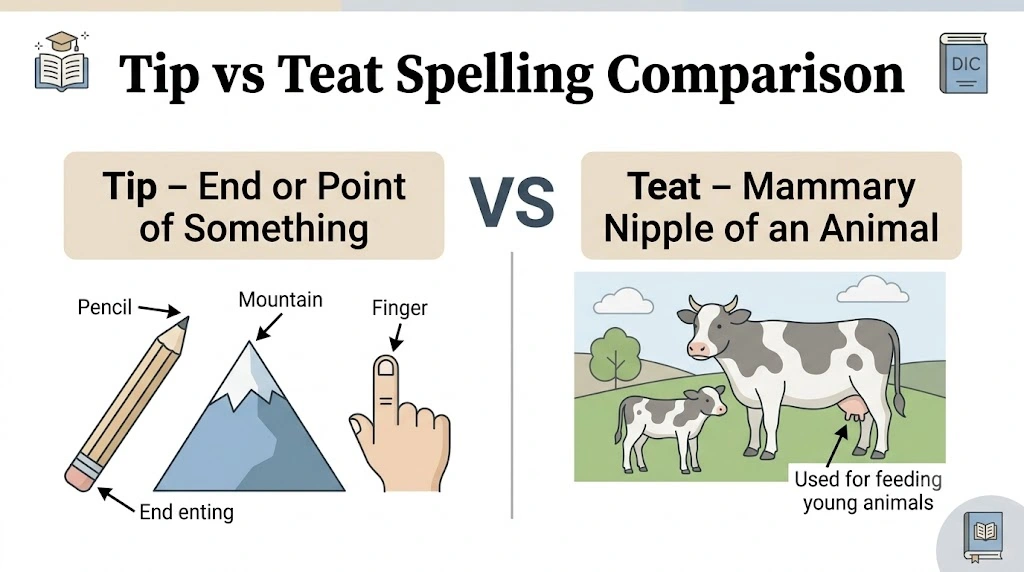
Have you ever wondered whether you should write a tip or teat? Many English learners and writers search for this pair because the words look similar and can appear in discussions about animals, feeding equipment, and everyday objects. However, tip and teat are not spelling variations of the same word. They are two completely different words with different meanings.
Understanding the difference helps you avoid mistakes in writing, school assignments, business communication, and online content. While tip usually refers to the end of something, advice, or an extra payment, teat refers to the nipple of a mammal or the feeding nipple on a baby bottle.
This guide explains the meanings, origins, usage differences, examples, common mistakes, and popularity of both words. By the end, you will know exactly when to use tip and when to use teat, helping you write with confidence and accuracy.
Tip or Teat – Quick Answer
Tip and teat are different words with different meanings.
| Word | Meaning | Example |
| Tip | End or pointed part of something; advice; extra payment | The tip of the pencil broke. |
| Teat | Nipple of a mammal or feeding bottle | The calf drank milk from the cow’s teat. |
Examples
- The bird landed on the tip of the branch.
- She gave me a useful tip for the interview.
- The baby sucked on the bottle teat.
- The lamb found its mother’s teat quickly.
Read more: Preterite or Imperfect: Understanding the Difference
Quick Rule: Use tip for advice, endings, or payments. Use teat for feeding anatomy or bottle nipples.
The Origin of Tip or Teat
Origin of Tip
The word tip comes from Middle English and has been used for centuries to describe the end or point of an object. Over time, it gained additional meanings, including advice and gratuity.
Examples:
- Tip of a knife
- Helpful tip
- Restaurant tip
Origin of Teat
The word teat comes from Old English and Germanic roots related to nursing and feeding. It has always referred to the nipple of an animal or a feeding device.
Examples:
- Cow’s teat
- Goat’s teat
- Baby bottle teat
Read more: Girth or Length: What’s the Difference?
Why the Difference Exists
The two words developed from completely different origins. Their similar appearance is accidental. They are not British and American spelling variants.
British English vs American English Spelling
Unlike words such as colour/color or realise/realize, tip and teat are not regional spellings.
Both British English and American English use the same words for the same meanings.
Comparison Table
| Meaning | British English | American English |
| End of an object | Tip | Tip |
| Helpful advice | Tip | Tip |
| Extra payment | Tip | Tip |
| Animal nipple | Teat | Teat |
| Bottle nipple | Teat | Teat |
Examples
British English
- The pen tip is damaged.
- The calf found the teat.
American English
- The pencil tip is sharp.
- The bottle teat needs cleaning.
There is no spelling difference between the two regions.
Which Spelling Should You Use?
Your choice depends entirely on the meaning.
Use Tip When:
- Referring to advice
- Talking about the end of an object
- Mentioning a gratuity or payment
Examples:
- Here is a useful study tip.
- The tip of the iceberg was visible.
- We left a tip for the waiter.
Use Teat When:
- Discussing animals and nursing
- Referring to feeding equipment
- Talking about baby bottles
Examples:
- The calf suckled from the teat.
- Replace the bottle teat regularly.
Global Writing Advice
No matter where your audience is located, use:
- Tip for advice, endings, and gratuities
- Teat for feeding-related meanings
Common Mistakes with Tip or Teat
Many writers confuse these words because they sound somewhat similar.
Incorrect vs Correct
| Incorrect | Correct |
| Thanks for the useful teat. | Thanks for the useful tip. |
| The pencil teat broke. | The pencil tip broke. |
| The baby drank from the bottle tip. | The baby drank from the bottle teat. |
| The cow’s tip was injured. | The cow’s teat was injured. |
Common Error #1
❌ She gave me a great teat.
✅ She gave me a great tip.
Common Error #2
❌ The calf drank from the cow’s tip.
✅ The calf drank from the cow’s teat.
Tip or Teat in Everyday Examples
In Emails
- Thank you for the helpful tip.
- Your travel tips were very useful.
In News Articles
- Experts shared safety tips for drivers.
- Farmers checked the health of each cow’s teats.
On Social Media
- Quick fitness tip for beginners.
- Veterinarians explain proper teat care for dairy animals.
In Formal Writing
- The report provides practical business tips.
- Researchers examined teat health in dairy cattle.
Tip or Teat – Google Trends & Usage Data
Search data shows that tip is far more common than teat.
Why Tip Is More Popular
People frequently search for:
- Money-saving tips
- Travel tips
- SEO tips
- Writing tips
- Health tips
Because of these everyday uses, the word appears across many industries.
Why Teat Is Less Common
The word teat is mainly used in:
- Farming
- Veterinary medicine
- Animal care
- Parenting products
Popularity by Context
| Word | Common Contexts |
| Tip | Advice, payments, object endings |
| Teat | Animals, feeding equipment, agriculture |
Popularity by Country
| Country | More Common Word |
| United States | Tip |
| United Kingdom | Tip |
| Canada | Tip |
| Australia | Tip |
| New Zealand | Tip |
The word teat appears mainly in specialized topics rather than everyday searches.
Tip vs Teat Comparison Table
| Feature | Tip | Teat |
| Part of Speech | Noun | Noun |
| Meaning | Advice, point, gratuity | Nipple or feeding nipple |
| Common Usage | Very common | Specialized |
| Used in Business Writing | Yes | Rarely |
| Used in Agriculture | Sometimes | Frequently |
| Used Worldwide | Yes | Yes |
| British/American Difference | None | None |
Frequently Asked Questions (FAQs)
1. Is teat another spelling of tip?
No. They are different words with different meanings.
2. Which word means advice?
Tip means advice.
3. Which word refers to a bottle nipple?
Teat refers to a bottle nipple or animal nipple.
4. Do British and American English spell them differently?
No. Both countries use tip and teat in the same way.
5. Can tip and teat be used interchangeably?
No. Using one instead of the other changes the meaning completely.
6. Which word is more common?
Tip is much more common in everyday English.
7. Is teat used only for animals?
Mostly yes, but it can also refer to the nipple on a baby feeding bottle.
Conclusion
Understanding the difference between tip and teat is simple once you know their meanings. Although the words look somewhat similar, they are not spelling variations and cannot replace each other. Tip refers to advice, a pointed end, or an extra payment, making it one of the most commonly used words in everyday English. Teat, on the other hand, relates specifically to feeding anatomy in animals or the nipple of a baby bottle.
Writers, students, farmers, parents, and professionals should choose the word based on context rather than spelling preference. There is no British-versus-American spelling difference, and both forms are accepted worldwide with their specific meanings. When discussing advice, object endings, or gratuities, use tip. When discussing nursing animals or feeding equipment, use teat.
Keeping this distinction in mind will improve your writing, prevent misunderstandings, and ensure your message remains clear and professional in every situation.

Hi, I’m Henry James, the author behind GrammarTribe.com. I’m passionate about the English language and specialize in grammar, helping readers understand complex rules in a simple, clear way. Over the years, I’ve dedicated myself to creating content that makes learning grammar practical, fun, and accessible for everyone. If you’re a student, professional, or language enthusiast.
Through GrammarTribe.com, I share tips, guides, and examples to help people write confidently and correctly. My goal is to make grammar less intimidating and more useful in everyday writing, emails, social media, and professional communication. Writing and teaching grammar isn’t just my profession — it’s my passion.
When I’m not writing, I enjoy reading, exploring language trends, and discovering new ways to make English learning engaging and easy. My mission is to empower readers to communicate clearly and confidently, one grammar tip at a time.