Have you ever stopped while writing and wondered, should I use “which” or “what”? Many English learners, students, writers, and even native speakers face this question. These two words seem similar because both are used to ask questions and gather information. However, they are not always interchangeable.
The confusion usually happens when choosing between a limited set of options and asking for general information. Using the wrong word can make your sentence sound unnatural or unclear. That is why many people search for “which or what” to understand the difference.
The good news is that the distinction is simple once you know the basic rule. In this guide, you will learn the meaning of each word, their origins, common mistakes, real-life examples, and when to use one instead of the other. By the end, you will feel confident using which and what correctly in both casual and formal writing.
Which or What – Quick Answer
The simple rule is:
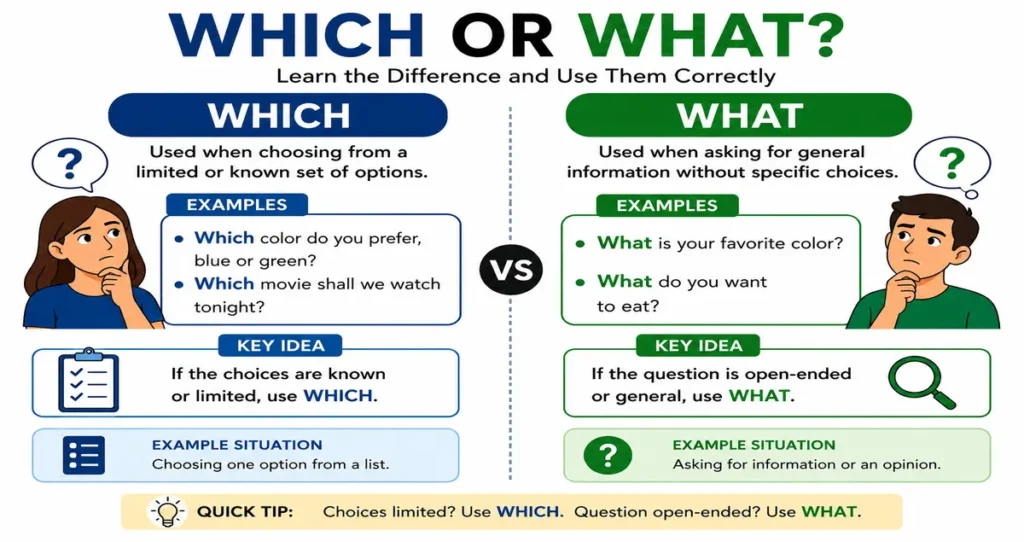
- Which = used when choosing from a limited or known set of options.
- What = used when asking for general information without specific choices.
Examples
Which
- Which color do you prefer, blue or green?
- Which book should I read first?
What
- What is your favorite color?
- What do you want to eat?
Quick Tip
If the choices are known or limited, use which.
If the possibilities are open-ended, use what.
Read more: Inclosed or Enclosed: Which Spelling Is Correct
The Origin of Which or What
Both words come from Old English and belong to a group called interrogative pronouns.
Origin of “Which”
The word which comes from the Old English word hwilc, meaning “what sort of” or “which one.” It was traditionally used when selecting from identifiable options.
Origin of “What”
The word what comes from the Old English word hwæt, meaning “what” or “something.” It has been used for centuries to request information without restricting possible answers.
Why the Difference Exists
English developed separate words because speakers needed a way to distinguish between:
- Asking about a specific choice (which)
- Asking for general information (what)
This distinction remains important in modern English.
Read more:
Posted inGrammar Knowledge
Outting or Outing: Which Spelling Is Correct?
British English vs American English Spelling
Unlike many English words, which and what have the same spelling in both British and American English.
The difference is not spelling but usage.
| Feature | Which | What |
| British English | Which | What |
| American English | Which | What |
| Spelling Difference | None | None |
| Meaning | Choice from known options | General information |
| Common Use | Selection questions | Open-ended questions |
Examples
British English
- Which train goes to London?
- What time does the meeting start?
American English
- Which route is faster?
- What movie are you watching?
The spelling remains identical across English-speaking countries.
Which Spelling Should You Use?
Since there is no spelling difference, the real question is which word should you use?
Use “Which” When:
- Choices are limited.
- Options are known.
- The answer comes from a specific list.
Examples:
- Which shirt do you want?
- Which candidate won?
Use “What” When:
- Asking broad questions.
- Seeking general information.
- No options are given.
Examples:
- What happened yesterday?
- What is your job?
Audience-Based Advice
| Audience | Recommended Usage |
| United States | Follow standard distinction |
| United Kingdom | Follow standard distinction |
| Australia | Follow standard distinction |
| Canada | Follow standard distinction |
| Global Audience | Use which for choices, what for general information |
Common Mistakes with Which or What
Many learners make these errors.
Mistake 1
❌ What color do you prefer, red or blue?
✅ Which color do you prefer, red or blue?
Reason: The options are limited.
Mistake 2
❌ Which is your favorite hobby?
✅ What is your favorite hobby?
Reason: No list of hobbies is provided.
Mistake 3
❌ What of these phones is best?
✅ Which of these phones is best?
Reason: The phones are specific choices.
Mistake 4
❌ Which happened after the meeting?
✅ What happened after the meeting?
Reason: Asking for general information.
Which or What in Everyday Examples
In Emails
- Which date works best for you?
- What information do you need?
In News Writing
- Which team won the championship?
- What caused the accident?
On Social Media
- Which outfit looks better?
- What are your plans this weekend?
In Formal Writing
- Which method provides the highest accuracy?
- What factors influence customer satisfaction?
In Daily Conversation
- Which restaurant should we choose?
- What do you want for dinner?
Which or What – Google Trends & Usage Data
Search behavior shows that many people look for which or what because they are unsure about the difference.
General Usage Trends
- What is one of the most frequently used words in English?
- Which is slightly less common because it applies to specific selection situations.
- English learners often search for grammar explanations comparing the two words.
Popular Countries Searching This Topic
- United States
- United Kingdom
- Canada
- Australia
- India
- Pakistan
Contexts Where People Search
- English grammar lessons
- Academic writing
- Business communication
- ESL learning
- Exam preparation
Comparison Table: Which vs What
| Feature | Which | What |
| Purpose | Select from options | Ask for information |
| Number of Choices | Limited | Unlimited |
| Type of Question | Specific | General |
| Example | Which car is yours? | What car do you drive? |
| Formal Writing | Very common | Very common |
| Everyday Speech | Common | Extremely common |
FAQs About Which or What
1. What is the main difference between which and what?
Which is used for specific choices, while what is used for general information.
2. Can which and what be used interchangeably?
Sometimes, but not always. The context determines the correct choice.
3. Which is more common in English?
What is generally more common because people often ask broad questions.
4. Is there a spelling difference between British and American English?
No. Both words are spelled the same everywhere.
5. Should I use which when options are listed?
Yes. Use which whenever the choices are known or limited.
6. Can what be used with unlimited possibilities?
Yes. That is its primary purpose.
7. Is using the wrong word a serious grammar mistake?
Usually not, but it can make your sentence sound less natural or precise.
Conclusion
Understanding the difference between which and what is easier than many people think. The key idea is that which is used when selecting from known or limited options, while what is used when asking for general information without restrictions. This simple rule helps make your writing and speaking clearer.
Although both words are common in everyday English, choosing the correct one improves communication and prevents misunderstandings. Whether you are writing emails, social media posts, academic papers, or professional documents, knowing when to use which and what can make your sentences sound more natural and accurate.
Remember this easy guideline: if there is a list of choices, use which. If there are no specific choices, use what. With a little practice, the distinction becomes automatic. Mastering this small grammar point can greatly improve your confidence in English and help you communicate more effectively in any situation.

Hi, I’m Henry William, the author of GrammarTribe.com. I’m passionate about the English language and have dedicated my career to helping people master grammar, spelling, and effective writing. Over the years, I’ve guided learners, writers, and professionals in understanding common mistakes, tricky rules, and nuances of English grammar in a simple and easy-to-follow way.
Through GrammarTribe.com, I aim to make grammar approachable and enjoyable for everyone. My work focuses on providing clear explanations, practical tips, and examples that readers can apply in everyday writing, whether it’s emails, essays, social media, or professional documents. I believe that strong grammar skills empower people to communicate confidently and professionally.
When I’m not writing or researching grammar, I enjoy reading, exploring language trends, and creating educational content that simplifies complex concepts. I’m committed to helping my audience write better, understand English deeply, and avoid common pitfalls, all while making learning grammar a fun and rewarding journey.