If you are learning Spanish, one of the most confusing grammar topics is preterite or imperfect. Many learners struggle to know which past tense to use because both refer to events that happened in the past. However, they serve different purposes and can completely change the meaning of a sentence.
People often search for preterite or imperfect because they want a quick answer that helps them avoid mistakes in conversations, writing, exams, and language-learning apps. Understanding the difference is important because native speakers use these tenses every day.
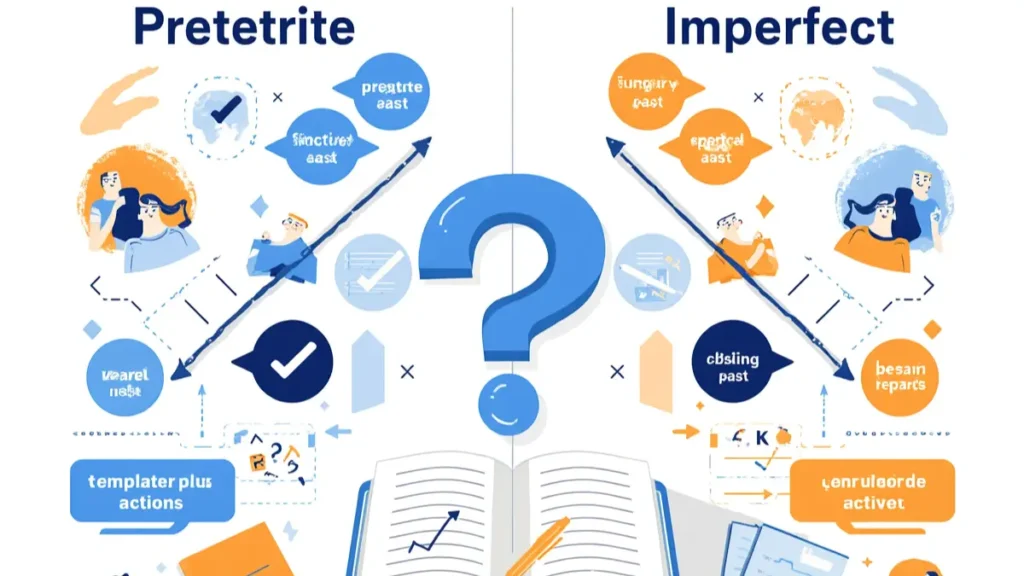
The good news is that the distinction is easier than it seems. The preterite tense describes completed actions, while the imperfect tense describes ongoing actions, habits, or background information in the past.
In this guide, you’ll learn the difference between preterite and imperfect, their origins, common mistakes, real-world examples, usage trends, and practical advice for choosing the correct tense every time.
Preterite or Imperfect – Quick Answer
The preterite is used for actions that were completed in the past.
The imperfect is used for actions that were ongoing, repeated, or descriptive in the past.
Examples
| Preterite | Imperfect |
| I ate dinner. | I was eating dinner. |
| She arrived at 8 PM. | She used to arrive early. |
| We visited Spain last year. | We visited Spain every summer. |
Simple Rule
- Preterite = completed action
- Imperfect = ongoing action, habit, or description
Read more: Stayed or Staid: What’s the Difference and When to Use Each
The Origin of Preterite or Imperfect
The terms preterite and imperfect come from Latin grammar.
Preterite
The word preterite comes from the Latin word praeteritum, meaning “gone by” or “past.”
It developed into a grammatical term used to describe actions that are finished and complete.
Imperfect
The word imperfect comes from the Latin imperfectus, meaning “unfinished.”
It describes actions that were ongoing, repeated, or incomplete in the past.
Why the Difference Exists
Languages often need a way to distinguish:
- What happened
- What was happening
- What used to happen
The preterite and imperfect tenses help speakers express these differences clearly.
British English vs American English Spelling
Unlike words such as “colour” and “color,” preterite and imperfect do not have major British and American spelling differences.
Both varieties of English use the same spellings.
Read more: Dice or Die: What’s the Correct Word?
Comparison Table
| Term | British English | American English |
| Preterite | Preterite | Preterite |
| Imperfect | Imperfect | Imperfect |
| Past Tense | Past Tense | Past Tense |
| Grammar Usage | Same | Same |
Key Point
Whether you are in the United Kingdom, the United States, Canada, Australia, or New Zealand, the spelling remains unchanged.
Which Spelling Should You Use?
Since there are no major spelling differences, use:
- Preterite for completed past actions.
- Imperfect for ongoing or habitual past actions.
For US Audiences
Use the standard grammar terms:
- Preterite
- Imperfect
For UK Audiences
Use the same standard grammar terms:
- Preterite
- Imperfect
For Global Audiences
These terms are internationally recognized in language learning, education, and grammar resources.
Common Mistakes with Preterite or Imperfect
Many learners understand the rule but still make mistakes.
Mistake 1: Using Preterite for Habits
❌ When I was young, I played outside every day. (in Spanish, often imperfect)
✅ When I was young, I used to play outside every day.
Mistake 2: Using Imperfect for Completed Actions
❌ Yesterday I was arriving at school at 8.
✅ Yesterday I arrived at school at 8.
Mistake 3: Ignoring Context
❌ She was reading a book and finished it.
This mixes ongoing and completed actions incorrectly.
✅ She was reading a book when she finished it.
Mistake 4: Confusing Description with Action
❌ The weather was becoming cold yesterday at 7 PM.
✅ The weather was cold yesterday.
Descriptions often require the imperfect.
Mistake 5: Translating Directly from English
English often uses one simple past tense where Spanish requires a choice between preterite and imperfect.
Preterite or Imperfect in Everyday Examples
In Emails
Preterite
I completed the report yesterday.
Imperfect
I was working on the report when your message arrived.
In News Writing
Preterite
The company announced a new product.
Imperfect
The company was experiencing rapid growth.
On Social Media
Preterite
I visited Paris last weekend!
Imperfect
I used to visit this café every day.
In Formal Writing
Preterite
The study concluded in 2024.
Imperfect
Researchers were examining several factors.
In Daily Conversation
Preterite
I bought a new phone yesterday.
Imperfect
I was looking for a new phone for months.
Preterite or Imperfect – Google Trends & Usage Data
Search interest for preterite or imperfect remains strong because it is one of the most challenging Spanish grammar topics.
Countries with High Interest
- United States
- Mexico
- Spain
- Colombia
- Argentina
- Canada
Why People Search for It
Users commonly want to:
- Pass Spanish exams
- Improve speaking skills
- Understand native speakers
- Complete language-learning courses
- Avoid grammar mistakes
Common Search Queries
- Preterite or imperfect quiz
- Preterite vs imperfect examples
- When to use preterite
- When to use imperfect
- Spanish past tense guide
Preterite vs Imperfect Comparison Table
| Feature | Preterite | Imperfect |
| Action Type | Completed | Ongoing |
| Focus | Event | Process |
| Duration | Specific | Unspecified |
| Habits | Rarely | Commonly |
| Descriptions | Usually No | Usually Yes |
| Interruptions | Main Event | Background Event |
| Example | She arrived. | She was arriving. |
| Example | I finished. | I was finishing. |
FAQs
What is the difference between preterite and imperfect?
The preterite describes completed actions, while the imperfect describes ongoing, repeated, or descriptive past actions.
Is preterite the same as the simple past?
Not exactly. The preterite often corresponds to the English simple past but has more specific grammatical functions.
When should I use the imperfect?
Use the imperfect for habits, descriptions, ongoing actions, and background information.
Why is preterite difficult for learners?
Many languages do not separate completed and ongoing past actions as clearly as Spanish does.
Can both tenses appear in one sentence?
Yes.
Example:
I was studying when the phone rang.
The ongoing action uses the imperfect, and the interruption uses the preterite.
Which tense is used for age and weather?
The imperfect is generally used.
Examples:
- I was ten years old.
- The weather was sunny.
How can I remember the difference?
Think:
- Preterite = finished
- Imperfect = ongoing or habitual
Conclusion
Understanding preterite or imperfect is essential for speaking and writing Spanish accurately. Although both tenses describe the past, they serve different purposes. The preterite focuses on actions that began and ended at a specific point in time, while the imperfect focuses on actions that were ongoing, repeated, or descriptive.
A useful strategy is to ask yourself whether the action was completed or whether it was still in progress. If the action is clearly finished, choose the preterite. If it describes a habit, background detail, emotion, age, weather condition, or ongoing event, choose the imperfect.
Fortunately, there are no major spelling differences between British English and American English for these terms. The challenge is not spelling but understanding how each tense functions in context.
With regular practice, reading examples, and paying attention to real conversations, choosing between preterite and imperfect becomes much easier. Mastering this distinction will improve your Spanish fluency, confidence, and overall communication skills.

I am James Wilson, an author at GrammarTribe.com, specializing in English grammar and clear communication.
I create expert, reliable content to help learners write with confidence and accuracy.