
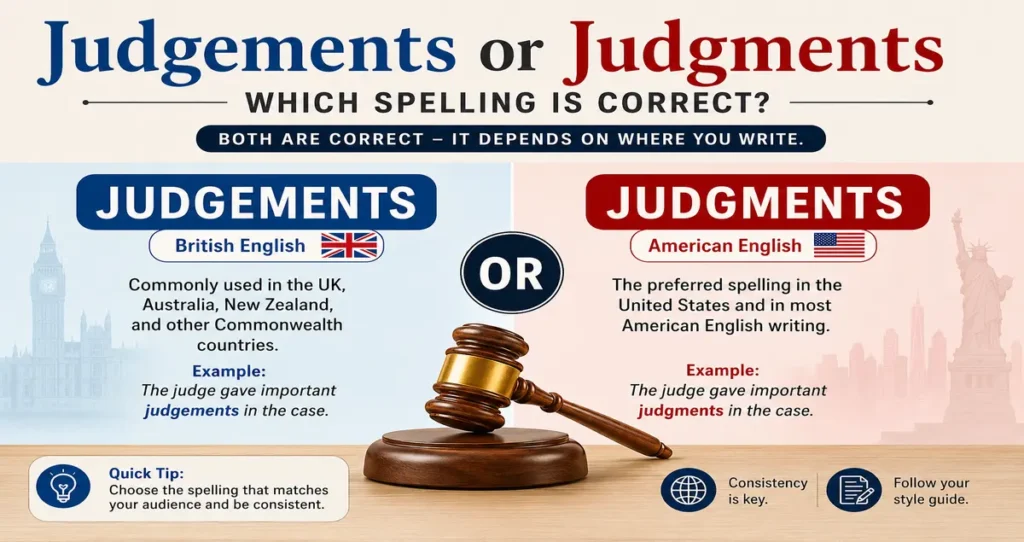
Have you ever written the word judgment and then stopped to wonder if it should actually be spelled judgement? You are not alone. Many writers, students, professionals, and English learners search for judgements or judgments because both spellings appear in books, websites, legal documents, and news articles.
The confusion comes from the differences between British English and American English. In some countries, one spelling is preferred, while in others, both forms may be accepted. This can make it difficult to know which version to use in essays, business writing, emails, or formal documents.
Understanding the difference is important because correct spelling helps your writing look professional and clear. In this guide, you will learn the meaning of both spellings, where they come from, how they differ across English-speaking countries, and which one is best for your audience. By the end, you will know exactly when to use judgements and when to use judgments.
Judgements or Judgments – Quick Answer
Both judgements and judgments are correct spellings of the same word.
- Judgments is the preferred spelling in American English.
- Judgements is more common in British English, although judgments is also accepted in many British contexts.
Examples
✅ American English:
- The court issued several judgments today.
- Good judgments help leaders make better decisions.
✅ British English:
- The judge delivered two important judgements.
- Personal judgements can sometimes be unfair.
The meaning remains the same regardless of spelling.
Read more:
Posted inGrammar Knowledge
Theirselves or Themselves: Which Word Is Correct?
The Origin of Judgements or Judgments
The word comes from the Old French word jugement, which itself developed from the Latin word judicare, meaning “to judge.”
For centuries, English writers used different spellings of many words. Before dictionaries standardized English, writers often spelled words according to personal preference.
The spelling judgement became common in Britain because it reflects the root word judge. Many people felt the extra “e” made the spelling look more logical.
However, American English gradually simplified many spellings. As a result, judgment became the standard form in the United States.
Today, both spellings have historical roots, but their usage depends largely on regional writing conventions.
British English vs American English Spelling
The biggest difference between judgements and judgments is regional preference.
| English Version | Preferred Spelling | Example |
| American English | Judgments | The court issued several judgments. |
| British English | Judgements | The court issued several judgements. |
| Canadian English | Often Judgments | The legal judgments were reviewed. |
| Australian English | Usually Judgements | The judge delivered important judgements. |
| International English | Either | Choose one style and stay consistent. |
Key Rule
- Writing for a US audience → Use judgments.
- Writing for a UK audience → Use judgements.
- Writing for an international audience → Either can work, but consistency matters.
Read more:
Posted inGrammar Knowledge
Practise or Practice: Which Is Correct and When You Use It?
Which Spelling Should You Use?
Choosing the right spelling depends on your audience.
Use “Judgments” If:
- You write for American readers.
- You are preparing academic papers in US institutions.
- You work with US businesses.
- You follow AP Style or most American style guides.
Use “Judgements” If:
- You write for British readers.
- You work in the UK, Australia, or New Zealand.
- Your organization follows British English conventions.
For Global Audiences
Pick one spelling and use it consistently throughout the document. Switching between the two may look unprofessional.
Common Mistakes with Judgements or Judgments
Many writers make errors when using these spellings.
Mistake 1: Mixing Both Spellings
❌ The court made several judgments, and the judge’s judgements were final.
✅ The court made several judgments, and the judge’s judgments were final.
Mistake 2: Thinking One Is Wrong
❌ Judgement is incorrect.
✅ Judgement is accepted in British English.
Mistake 3: Changing Spellings Mid-Document
❌ Use judgments in one paragraph and judgements in another.
✅ Choose one style and remain consistent.
Mistake 4: Confusing Meaning
Some people think the spellings have different meanings.
✅ They mean exactly the same thing.
Judgements or Judgments in Everyday Examples
In Emails
American English:
We appreciate your judgments regarding the project proposal.
British English:
We appreciate your judgements regarding the project proposal.
In News Articles
American:
The Supreme Court released several judgments.
British:
The High Court delivered important judgements.
On Social Media
- Your judgments shape your future.
- Don’t let quick judgements control your decisions.
In Formal Writing
- Professional judgments require experience.
- Ethical judgements are important in leadership roles.
Judgements or Judgments – Google Trends & Usage Data
Search behavior shows that both spellings are popular, but their usage varies by region.
Countries Where “Judgments” Is More Common
- United States
- Canada
- International legal publications
Countries Where “Judgements” Is More Common
- United Kingdom
- Australia
- New Zealand
- Ireland
Common Contexts
People search these spellings when discussing:
- Legal decisions
- Court rulings
- Personal opinions
- Academic writing
- Business communication
- Grammar and spelling questions
The internet contains both versions, which is why many writers become confused.
Comparison Table: Judgements vs Judgments
| Feature | Judgements | Judgments |
| Meaning | Decisions or opinions | Decisions or opinions |
| Correct Spelling | Yes | Yes |
| British English | Preferred | Accepted |
| American English | Less common | Preferred |
| Legal Writing (US) | Rare | Standard |
| Legal Writing (UK) | Common | Also used |
| Academic Writing | Depends on style guide | Depends on style guide |
| Pronunciation | Same | Same |
FAQs
1. Is it judgments or judgements?
Both are correct. Judgments is preferred in American English, while judgements is more common in British English.
2. Which spelling is used in the United States?
American English almost always uses judgments.
3. Which spelling is used in the United Kingdom?
British English commonly uses judgements, though judgments may also appear, especially in legal contexts.
4. Do judgments and judgements have different meanings?
No. Both words mean decisions, opinions, or conclusions.
5. Which spelling should I use in academic writing?
Follow the style guide required by your school, university, or publisher.
6. Is judgement considered incorrect?
No. It is a valid British English spelling.
7. Why do legal documents often use judgment?
Many legal systems, including courts in the US and some UK legal publications, traditionally prefer judgment.
Conclusion
The debate between judgements or judgments is not about right versus wrong. Both spellings are correct and have been used for centuries. The real difference lies in regional preference. American English strongly favors judgments, while British English often uses judgements, although judgment also appears in some legal settings.
When choosing between the two, think about your audience first. If your readers are in the United States, use judgments. If your readers are in the United Kingdom or other Commonwealth countries, judgements may feel more natural. For international writing, either version can work as long as you remain consistent.
Remember that the meaning never changes. Whether you write judgements or judgments, the word refers to decisions, opinions, or conclusions. By understanding the spelling difference and applying the correct regional style, you can make your writing clearer, more professional, and better suited to your audience.

I am James Wilson, an author at GrammarTribe.com, specializing in English grammar and clear communication.
I create expert, reliable content to help learners write with confidence and accuracy.