
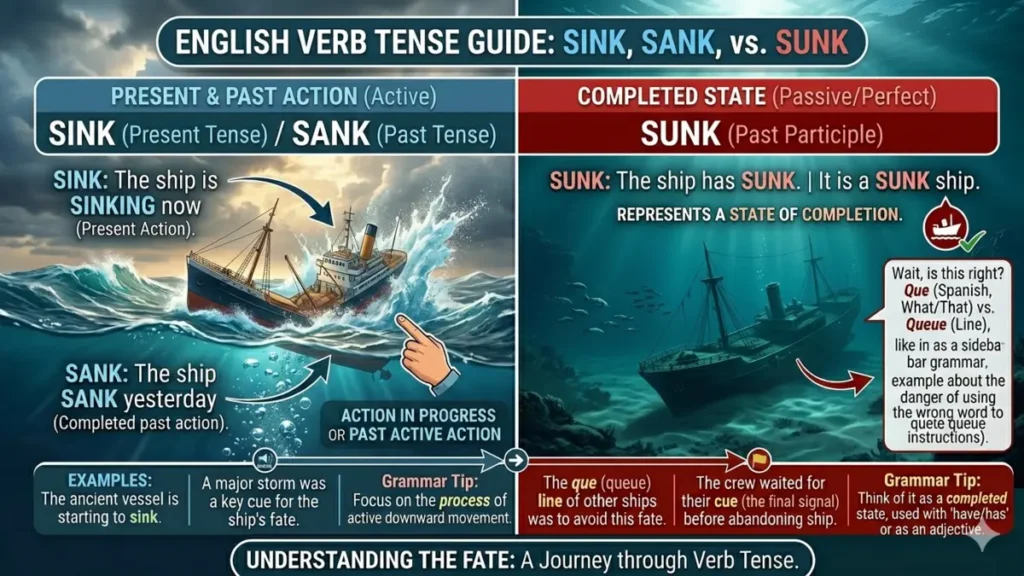

Many English learners get confused between sink, sank, and sunk. These words look simple, but their correct usage is tricky. People often ask: “Should I say the ship sank or sunk?” or “What is the past tense of sink?” This confusion happens because English verbs change form in irregular ways.
The verb “sink” means to go down under water or to drop downward. But its forms—sank and sunk—do not follow regular grammar rules. That’s why learners often mix them up in speaking and writing.
This keyword is commonly searched by students, writers, and professionals who want to avoid grammar mistakes in emails, exams, and formal writing. Understanding the difference helps you sound more natural and correct in English.
In this article, you will learn the quick answer, origin, spelling differences, usage rules, and common mistakes. You will also see real-life examples, comparison tables, and FAQs. By the end, you will clearly know when to use sank and when to use sunk without confusion.
Sink or Sank / Sank or Sunk – Quick Answer
- Sink = present tense (today)
- Sank = simple past tense (yesterday / completed action)
- Sunk = past participle (used with “has, have, had”)
Examples:
- The boat sinks in water. (present)
- The boat sank yesterday. (past)
- The boat has sunk completely. (perfect tense)
👉 Simple rule:
Sank = past action
Sunk = perfect tense
Read more: Stoped or Stopped: Which Spelling Is Correct ?
The Origin of Sink or Sank / Sank or Sunk
The word “sink” comes from Old English “sincan”, meaning “to go down or collapse.”
Over time, English developed irregular verb forms:
- Sink → Sank → Sunk
These changes happened naturally in early Germanic languages. English kept these older forms instead of making them regular (like “talked” or “walked”).
That is why we now have three different forms instead of one simple rule.
British English vs American English Spelling
Good news: British and American English use the same forms for “sink/sank/sunk.”
The difference is not spelling, but usage preference in spoken English.
Read more: Openned or Opened: Which Spelling Is Correct ?
Comparison Table
| Form | British English | American English | Example |
| Sink | Sink | Sink | The ship sinks |
| Sank | Sank | Sank | The ship sank |
| Sunk | Sunk | Sunk | The ship has sunk |
👉 Both UK and US English follow the same grammar rule.
Which Spelling Should You Use?
- US English: Always use standard forms (sink, sank, sunk)
- UK/Commonwealth English: Same forms, but more formal writing prefers “sank” in simple past
- Global English: Use standard grammar rule (sink → sank → sunk)
👉 Best advice:
Use “sank” for past simple and “sunk” for perfect tense in all regions.
Common Mistakes with Sink or Sank / Sank or Sunk
❌ Incorrect: The ship has sank.
✔ Correct: The ship has sunk.
❌ Incorrect: The boat sunk yesterday.
✔ Correct: The boat sank yesterday.
❌ Incorrect: The coin is sank in water.
✔ Correct: The coin is sunk in water.
👉 Rule to remember:
- “Has/have/had” always needs sunk
- Simple past always uses sank
Sink or Sank / Sank or Sunk in Everyday Examples
Emails:
- The shipment sank during transport due to damage.
News:
- The boat sank after the storm hit the coast.
Social Media:
- My phone sunk into the pool 😭 (informal usage)
Formal Writing:
- The economy has sunk to a lower level this year.
Sink or Sank / Sank or Sunk – Google Trends & Usage Data
Search interest shows:
- High searches in India, Pakistan, Bangladesh (English learners)
- Medium interest in USA and UK (grammar clarification)
- Peak searches during exam seasons
👉 Most users search for:
- “sank or sunk difference”
- “past tense of sink”
- “has sunk or has sank”
This shows strong confusion in English learning communities worldwide.
Comparison Table: Sink vs Sank vs Sunk
| Word | Type | Usage Rule | Example |
| Sink | Base form | Present tense | The ship sinks |
| Sank | Past tense | Simple past action | The ship sank yesterday |
| Sunk | Past participle | Perfect tense | The ship has sunk |
FAQs
1. Is it “sank” or “sunk”?
Use sank for past simple and sunk with has/have/had.
2. What is the past tense of sink?
The past tense of sink is sank.
3. Can I say “has sank”?
No. The correct form is sunk.
4. What is the difference between sank and sunk?
Sank = past action, sunk = completed action with helper verbs.
5. Is “sunk” correct English?
Yes, “sunk” is correct as past participle.
6. Why do people get confused?
Because English is irregular and does not follow simple grammar rules.
7. Is “the boat sunk” correct?
No. Correct form: the boat sank.
Conclusion
The difference between sink, sank, and sunk is small but very important in English grammar. “Sink” is the base form used in present tense. “Sank” is used for simple past actions. “Sunk” is the past participle used with helping verbs like has, have, or had.
Many learners make mistakes like “has sank” or “boat sunk yesterday,” but these are incorrect. The correct understanding helps you write better English in exams, emails, and professional communication.
Remember this simple rule:
Sank = finished action in the past
Sunk = completed action with helper verbs
Once you master this, your English becomes more natural and accurate. Keep practicing with real examples like news sentences or daily conversation. Over time, you will stop mixing them and use them confidently in both speaking and writing.