Many English learners get confused between “preformed” or “performed.” These two words look similar, but they are not the same. One small letter changes the whole meaning. This is why people often search for this keyword.
In writing, exams, emails, and online content, using the wrong word can completely change your sentence. For example, “performed” is very common when talking about actions, shows, or tasks. On the other hand, “preformed” is less common and usually used in science, manufacturing, or shaped materials.
This confusion solves a big problem: writers want to know which spelling is correct in their context. Many users also worry about British and American English differences. However, this case is not about spelling variation—it is about meaning difference.
In this article, you will learn the clear difference between preformed and performed, their origins, correct usage, common mistakes, and real-life examples. By the end, you will never mix them again. The explanation is simple, clear, and perfect for students, professionals, and content writers.
Preformed or Performed – Quick Answer
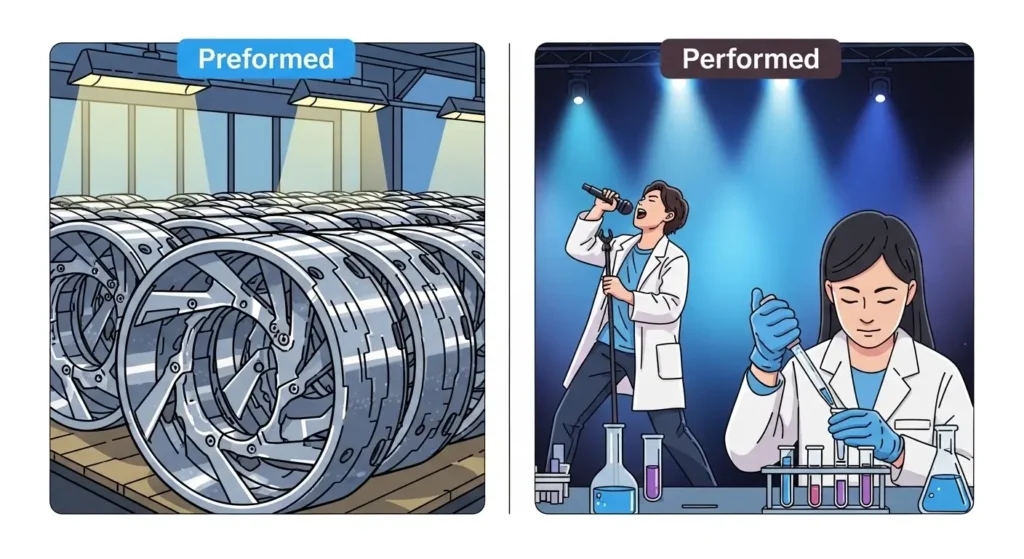
- Performed → Means to do, carry out, or act.
- Example: She performed in the school play.
- Preformed → Means already shaped or made before use.
- Example: The pipe is preformed for easy installation.
👉 Key difference:
Performed = action done
Preformed = already formed before
Recognise or Recognize: What Is the Correct Spelling ?
The Origin of Preformed and Performed
- Performed
- Comes from Latin “performare”
- Means “to carry out completely”
- Used in art, work, duties, and tasks
- Preformed
- Comes from prefix “pre-” meaning “before”
- “formed” meaning shaped or made
- Used in manufacturing and science
- Comes from prefix “pre-” meaning “before”
👉 Simple idea:
- Performed = doing something
- Preformed = already made before use
British English vs American English Spelling
Good news: this is NOT a UK vs US spelling issue.
Both British and American English use:
- Performed ✔
- Preformed ✔
The difference is meaning, not region.
Cosy or Cozy: What’s the Correct Spelling and When to Use Each?
Comparison Table
| Word | Meaning | Usage Area | Example |
| Performed | To carry out an action | General English | He performed well in exams |
| Preformed | Already shaped/made | Technical/Science | Preformed plastic parts |
Which Spelling Should You Use?
- Use “performed” if you talk about actions, work, music, sports, or tasks.
- Use “preformed” if you talk about materials, engineering, or manufacturing.
- Global English users should follow meaning, not region rules.
👉 Tip: If you are unsure, ask:
- Is it an action? → performed
- Is it already shaped? → preformed
👉 Most mistakes happen because learners think both words are the same.
Preformed or Performed in Everyday Examples
- Email:
“The task was performed successfully by the team.” - News:
“The singer performed live in London.” - Social Media:
“She performed amazingly at the event!” - Technical Writing:
“Preformed steel parts were used in construction.”
Preformed or Performed – Google Trends & Usage Data
- Performed is extremely common worldwide.
- Used heavily in:
- USA
- UK
- India
- Pakistan
- Global business writing
- Preformed is rare and mostly used in:
- Engineering
- Manufacturing
- Scientific documents
👉 Insight:
“Performed” dominates general language, while “preformed” stays technical.
Comparison Table (Quick View)
| Feature | Performed | Preformed |
| Type | Action word | Condition word |
| Usage | Daily English | Technical English |
| Meaning | To do something | Already formed |
| Example | She performed well | Preformed mold used |
| Frequency | Very common | Rare |
FAQs
1. Is it preformed or performed correct?
Both are correct, but they have different meanings.
2. What does performed mean?
It means to carry out an action or task.
3. What does preformed mean?
It means already shaped or made before use.
4. Is preformed a real English word?
Yes, but it is mainly used in technical fields.
5. Can I use preformed in daily English?
Rarely. Use it only when talking about materials or manufacturing.
6. Why do people confuse these words?
Because they look similar but have different meanings.
7. Is this a British or American English issue?
No, both forms are used globally with the same meaning rules.
Conclusion
Understanding the difference between preformed and performed is very important for clear English writing. Many learners confuse these two words because they look similar, but their meanings are completely different. This small spelling change can change your entire sentence’s meaning.
“Performed” is widely used in everyday English. It describes actions like work, music, sports, or tasks. On the other hand, “preformed” is a technical word used in science, engineering, and manufacturing to describe something already shaped or prepared before use.
There is no British or American spelling difference here. Both regions use these words in the same way. The real difference is meaning and context. If you remember this simple rule—action vs already made—you will never get confused again.
For students, writers, and professionals, using the correct word improves clarity and avoids mistakes in exams, emails, and content writing. Keep practicing with real examples, and soon the difference will feel natural. English becomes easy when you understand meaning, not just spelling.

Hi, I’m Henry James, the author behind GrammarTribe.com. I’m passionate about the English language and specialize in grammar, helping readers understand complex rules in a simple, clear way. Over the years, I’ve dedicated myself to creating content that makes learning grammar practical, fun, and accessible for everyone. If you’re a student, professional, or language enthusiast.
Through GrammarTribe.com, I share tips, guides, and examples to help people write confidently and correctly. My goal is to make grammar less intimidating and more useful in everyday writing, emails, social media, and professional communication. Writing and teaching grammar isn’t just my profession — it’s my passion.
When I’m not writing, I enjoy reading, exploring language trends, and discovering new ways to make English learning engaging and easy. My mission is to empower readers to communicate clearly and confidently, one grammar tip at a time.