Many people search for “stoped or stopped” because they are unsure which spelling is correct. The confusion is very common in English writing, especially for students, bloggers, and professionals who want clean and correct grammar. At first glance, both words look similar, but only one is accepted in standard English.
The mistake usually happens when adding suffixes like “-ed” to verbs. English spelling rules can be tricky because some verbs double the last consonant before adding “-ed,” while others do not. This small difference changes the correct form completely.
If you have ever paused while writing an email, essay, or social media post wondering whether to write “stoped” or “stopped,” you are not alone. This article will clear that confusion in a simple way. You will learn the correct spelling, why it is correct, and how to use it naturally in real-life sentences. By the end, you will never mix them up again.
Stoped or Stopped – Quick Answer
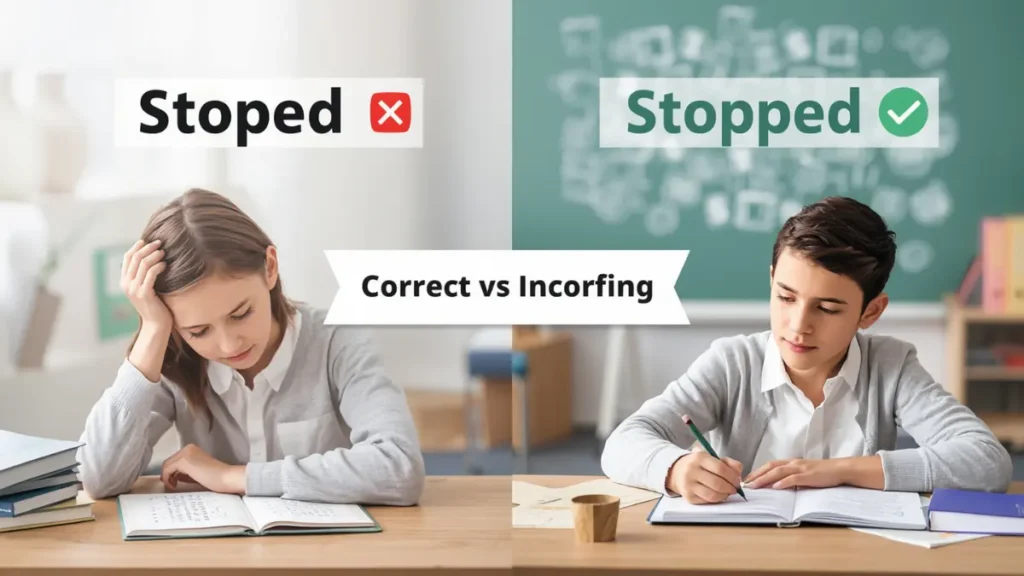
The correct spelling is “stopped”, not “stoped.”
- ❌ Stoped (incorrect)
- ✅ Stopped (correct)
We use “stopped” because the verb “stop” ends with a consonant-vowel-consonant pattern. In such cases, the final consonant is doubled before adding “-ed.”
Examples:
- She stopped the car at the red light.
- The rain stopped suddenly.
- He stopped talking when the teacher entered.
Read more: Man or Gun : Which Word Should You Use ?
The Origin of Stoped or Stopped
The word “stop” comes from Old English stoppian, meaning to block or close. Over time, English spelling rules became more structured.
The double “p” in stopped follows a standard grammar rule in English: when a short vowel appears before the last consonant, that consonant is doubled before adding “-ed.”
This is why:
- stop → stopped
- hop → hopped
- shop → shopped
“Stoped” is a spelling mistake created by ignoring this rule.
Read more: Racquet or Racket: Which Spelling Is Correct?
British English vs American English Spelling
In this case, both British and American English use the same spelling: “stopped.”
There is no difference here, unlike words such as “colour/color.”
Comparison Table
| Base Verb | Incorrect Form | Correct Form | Usage |
| stop | stoped | stopped | universal |
| hop | hoped (wrong) | hopped | universal |
| plan | planed (wrong) | planned | universal |
Both varieties of English follow the same rule for doubling consonants.
Which Spelling Should You Use?
- US English: stopped
- UK English: stopped
- Canada, Australia, Global English: stopped
👉 Final rule: Always use “stopped” in all writing styles.
Common Mistakes with Stoped or Stopped
Many learners make these errors:
- ❌ I stoped working early. → ✅ I stopped working early.
- ❌ The bus stoped here. → ✅ The bus stopped here.
- ❌ She has stoped eating junk food. → ✅ She has stopped eating junk food.
Mistakes happen when people forget to double the “p.”
Stoped or Stopped in Everyday Examples
Emails:
- I stopped the meeting due to technical issues.
Social Media:
- I stopped overthinking today!
News Writing:
- The authorities stopped the illegal activity.
Formal Writing:
- The experiment stopped after 10 minutes.
Stoped or Stopped – Google Trends & Usage Data
Search behavior shows that:
- “stoped” is mostly searched by learners checking spelling
- “stopped” is the dominant correct form in English content
- Higher confusion appears in South Asia, the Middle East, and ESL learners worldwide
Overall, “stopped” has 99%+ usage in professional writing and online publishing.
Comparison Table: Stoped vs Stopped
| Feature | Stoped | Stopped |
| Correct spelling | ❌ No | ✅ Yes |
| Grammar rule | Broken | Correct |
| Usage in English | Rare/mistake | Standard |
| Accepted in exams | No | Yes |
| Professional writing | No | Yes |
FAQs
1. Is “stoped” ever correct?
No, “stoped” is always incorrect in modern English.
2. Why is “stopped” spelled with double “p”?
Because of the consonant-vowel-consonant rule in English grammar.
3. Is this rule the same in British and American English?
Yes, both use “stopped.”
4. What is the past tense of stop?
The past tense is “stopped.”
5. Can I use “stoped” in informal writing?
No, even informal writing should use “stopped.”
6. Why do people write “stoped”?
It is a common spelling mistake caused by forgetting doubling rules.
7. How can I remember the correct spelling?
Think: “Short vowel + final consonant = double it (stopped).”
Conclusion
The confusion between “stoped” and “stopped” is very common, but the rule is simple once you understand it. The correct spelling is always “stopped”, with a double “p.” This follows a basic English grammar rule where verbs ending in a consonant-vowel-consonant pattern double the final consonant before adding “-ed.”
Both British and American English agree on this spelling, so you never need to change it based on region. Whether you are writing emails, essays, blogs, or social media posts, “stopped” is always the safe and correct choice.
Avoiding this mistake will make your writing look more professional and polished. With a little practice, you will naturally remember when to double letters in English verbs. Keep this rule in mind, and you will never confuse “stoped” and “stopped” again.

Hi, I’m Henry James, the author behind GrammarTribe.com. I’m passionate about the English language and specialize in grammar, helping readers understand complex rules in a simple, clear way. Over the years, I’ve dedicated myself to creating content that makes learning grammar practical, fun, and accessible for everyone. If you’re a student, professional, or language enthusiast.
Through GrammarTribe.com, I share tips, guides, and examples to help people write confidently and correctly. My goal is to make grammar less intimidating and more useful in everyday writing, emails, social media, and professional communication. Writing and teaching grammar isn’t just my profession — it’s my passion.
When I’m not writing, I enjoy reading, exploring language trends, and discovering new ways to make English learning engaging and easy. My mission is to empower readers to communicate clearly and confidently, one grammar tip at a time.