
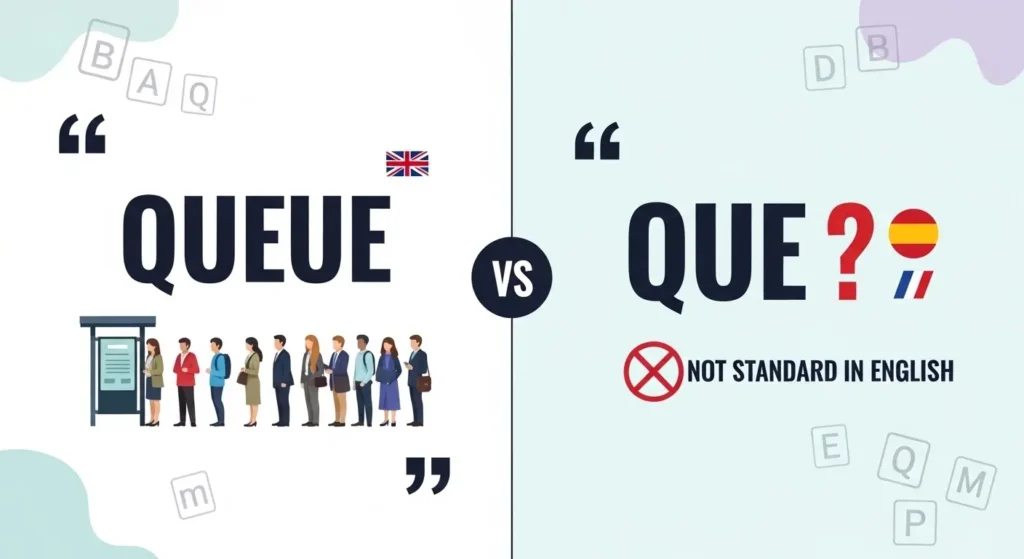
People often get confused between “queue” and “que” when writing or searching online. Both words look similar, but only one is correct in standard English. This confusion is very common in typing, gaming chats, social media, and even in formal writing. Many users search this keyword because they are unsure about spelling, meaning, or whether both words are valid. Some think “que” is a short form of “queue,” while others believe it is a different word in British or American English.
This article clears all confusion in a simple way. You will learn the correct spelling, origin, usage, and differences between “queue” and “que.” You will also see real examples, common mistakes, and when to use each form. By the end, you will clearly understand which spelling is correct in English and how to use it confidently in writing, exams, emails, and online communication.
Queue or Que – Quick Answer
The correct English word is “queue.”
“Que” is not a standard English spelling of this word.
Meaning of “queue”
A queue means a line of people, vehicles, or data waiting for something.
Examples:
- People are waiting in a queue at the bank.
- The printer has a long queue of documents.
- Students stood in a queue for tickets.
👉 “Que” is sometimes seen as:
- A typo
- A short form in gaming chats
- A word in other languages (like Spanish “qué” meaning “what”)
The Origin of Queue or Que
The word “queue” comes from Old French.
- Old French: cue or queue = tail
- Latin root: cauda = tail
The idea is simple: people standing in a line look like a “tail” of people.
Over time, English adopted the French spelling queue, keeping the silent “ueue” ending.
“Que” developed later as:
- A shortened informal typing form
- A mistake due to pronunciation
- Confusion with Spanish or other languages
British English vs American English Spelling
Unlike many words, queue is spelled the same in both British and American English.
But usage frequency and style differ slightly.
| Feature | British English | American English |
| Spelling | queue | queue |
| Meaning | line/waiting line | line/waiting line |
| Usage frequency | Very common | Common |
| Short form | Rare | Rare |
| Informal use | “Q” sometimes in notes | “line” used more often |
👉 Important:
There is no official “que” spelling in English in either region.
Which Spelling Should You Use?
Use “queue” if you are:
- Writing exams
- Writing formal emails
- Writing articles or blogs
- Using professional English
Regional advice:
- UK, India, Pakistan, Commonwealth countries: Use “queue”
- USA: Prefer “line,” but “queue” is still correct in tech or computing
- Global English: Always use “queue”
👉 Avoid “que” completely in formal writing.
Common Mistakes with Queue or Que
1. Writing “que” instead of “queue”
❌ I am standing in a que
✔ I am standing in a queue
2. Thinking both are correct
❌ que = short form of queue
✔ Only “queue” is correct English
3. Mixing languages
❌ What is the que?
✔ What is the queue?
4. Using “que” in exams
❌ This can cause marks loss
✔ Always use “queue”
Queue in Everyday Examples
1. Emails
- Please wait in the support queue for assistance.
2. News writing
- Long queues formed outside polling stations.
3. Social media
- “The update is stuck in the queue 😅”
4. Gaming
- “You are in a matchmaking queue.”
5. Technology
- “Your download is in the queue.”
Queue – Google Trends & Usage Data
Search behavior shows:
- Highest searches: India, Pakistan, UK
- Medium searches: USA, Canada
- Low confusion: native English speakers
- High confusion: ESL learners
Why people search this:
- Spelling confusion (“que vs queue”)
- Typing mistakes
- Gaming terminology
- Academic writing doubts
👉 “queue” dominates global search results, while “que” is mostly seen as a mistake or unrelated word in other languages.
Comparison Table: Queue vs Que
| Feature | Queue | Que |
| Correct English word | Yes | No |
| Meaning | Line of waiting | No meaning in English |
| Usage | Formal + informal | Typo or other languages |
| Accepted in exams | Yes | No |
| Dictionary entry | Yes | No |
FAQs About Queue or Que
1. Is “que” correct in English?
No, “que” is not correct English spelling for queue.
2. What is the correct spelling of queue?
The correct spelling is queue.
3. Why is the queue spelled with so many letters?
It comes from French, where silent letters are common.
4. Can I use “que” in texting?
Only informally or as a typo, but it is not recommended.
5. Is queue British or American English?
It is used in both, but spelled the same way.
6. What does queue mean in computers?
It means a list of tasks waiting to be processed.
7. Is “queue” plural?
No, but you can say “queues” for multiple lines.
Conclusion
The confusion between queue and que is very common, especially for learners of English. However, the answer is simple: only “queue” is correct in standard English. It is used in both British and American English with the same spelling and meaning. The word comes from French and refers to a line of people or things waiting their turn.
On the other hand, “que” is not a valid English spelling. It is usually a typing error or a word from other languages like Spanish. Using it in formal writing, exams, or professional communication can lead to mistakes.
To write correctly, always remember: queue = waiting line, correct spelling, universal usage. Whether you are writing emails, academic content, or social media posts, “queue” is the only safe and correct choice. Understanding this difference helps improve your English accuracy and avoids common spelling errors in daily communication.

Hi, I’m Henry William, the author of GrammarTribe.com. I’m passionate about the English language and have dedicated my career to helping people master grammar, spelling, and effective writing. Over the years, I’ve guided learners, writers, and professionals in understanding common mistakes, tricky rules, and nuances of English grammar in a simple and easy-to-follow way.
Through GrammarTribe.com, I aim to make grammar approachable and enjoyable for everyone. My work focuses on providing clear explanations, practical tips, and examples that readers can apply in everyday writing, whether it’s emails, essays, social media, or professional documents. I believe that strong grammar skills empower people to communicate confidently and professionally.
When I’m not writing or researching grammar, I enjoy reading, exploring language trends, and creating educational content that simplifies complex concepts. I’m committed to helping my audience write better, understand English deeply, and avoid common pitfalls, all while making learning grammar a fun and rewarding journey.