
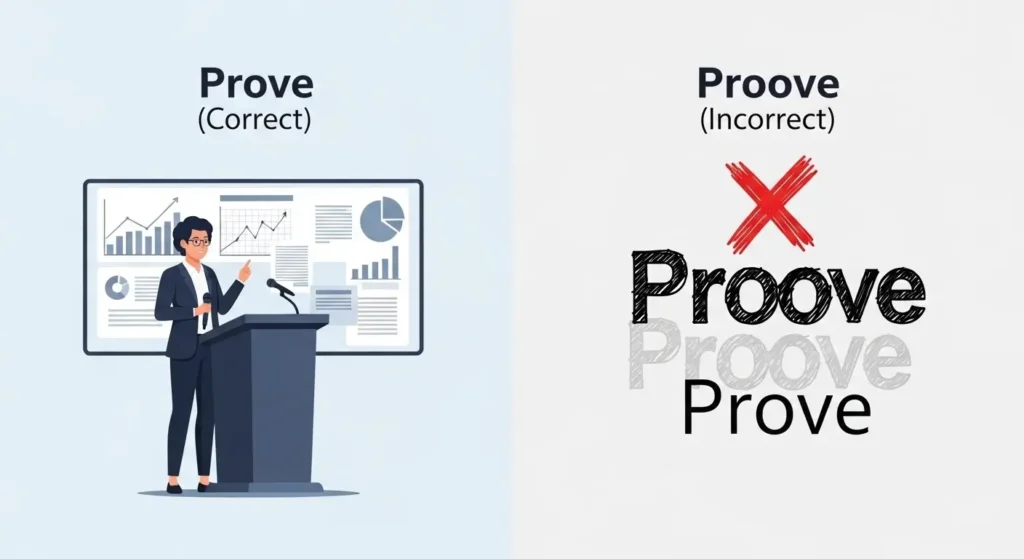
Many people search online for “proove or prove” because they are unsure about the correct spelling of this common English word. At first glance, both versions look similar, but only one is correct in modern English.
The confusion usually happens when learners double the letter “o” by mistake, thinking it follows the pattern of words like “choose” or “loose.” However, English spelling does not always follow simple rules, and this is one of those tricky cases.
The word “prove” is widely used in everyday communication, from school writing to professional emails and legal documents. Because it is so common, even small spelling errors can look unprofessional. Many users also get confused due to typing habits or auto-correct suggestions.
Understanding the correct spelling is important for clear communication, good writing scores, and professional credibility. In this article, we will clearly explain the correct form, its origin, usage rules, and common mistakes so you never get confused again.
Proove or Prove – Quick Answer
The correct spelling is “prove”.
❌ Proove = Incorrect spelling
✔️ Prove = Correct spelling
Examples:
- ✔️ I can prove my answer is right.
- ❌ I can proove my answer is right.
The word “prove” means to show something is true or to provide evidence.
Lilies or Lillies: Which Is the Correct Spelling?
The Origin of Prove
The word “prove” comes from an Old French prover, which itself comes from Latin probare, meaning “to test” or “to approve.”
Over time, English adopted the word in a simplified form. The double “o” spelling (“proove”) does not exist in standard English history. It likely appears due to typing mistakes or confusion with similar-sounding words.
English spelling evolved from many languages, which is why some words feel inconsistent. However, “prove” has remained stable for centuries in both spoken and written English.
British English vs American English Spelling
Unlike many English words that differ between UK and US spelling, “prove” is spelled the same in both varieties.
There is no difference between British and American English for this word.
Acknowledgement or Acknowledgment: Correct Spelling?
Comparison Table
| Meaning | British English | American English | Correct? |
| To show truth | prove | prove | ✔️ Yes |
| Incorrect form | proove | proove | ❌ No |
👉 Important: “proove” is not accepted in any standard English form.
Which Spelling Should You Use?
You should always use “prove” in all situations:
- US English: prove
- UK English: prove
- Canada, Australia, India, Pakistan: prove
- Formal writing (global): prove
No matter your audience, “prove” is the only correct spelling.
Common Mistakes with Prove
Here are the most frequent errors people make:
1. Doubling the vowel
- ❌ proove
- ✔️ prove
2. Confusing with “approve”
- ❌ I will proove it
- ✔️ I will prove it
3. Auto-correct mistakes
Sometimes typing quickly leads to incorrect “proove,” which must be corrected manually.
4. Mishearing pronunciation
Since “prove” sounds like it could have a longer vowel, people mistakenly add an extra “o.”
Prove in Everyday Examples
The word “prove” is used in many real-life situations:
Emails:
- Please prove your identity before access is granted.
Education:
- She can prove the theorem in mathematics class.
Social Media:
- I will prove everyone wrong with my results!
News Reports:
- Scientists aim to prove the theory through experiments.
Legal Writing:
- The evidence will prove the defendant’s innocence.
Prove – Google Trends & Usage Data
Search behavior shows that:
- The term “proove or prove” is often searched due to confusion
- “prove” is overwhelmingly dominant in all English-speaking countries
- “proove” appears mostly in spelling mistake queries
- Highest confusion regions: India, Pakistan, and ESL learners globally
👉 Insight: The search volume for “proove” is mainly correction-based, not usage-based.
Comparison Table: Prove vs Proove
| Feature | Prove (Correct) | Proove (Incorrect) |
| Spelling | Standard | Wrong |
| Usage | Formal & Informal | Not accepted |
| Dictionary | Included | Not listed |
| Grammar Score | Correct | Error |
| Professional Use | Yes | No |
FAQs About Proove or Prove
1. Is “proove” a real word?
No, “proove” is not a correct English word.
2. What is the correct spelling of prove?
The correct spelling is prove.
3. Why do people write proove?
It is usually a typing mistake or confusion with similar words.
4. Is “prove” British or American English?
It is used in both British and American English.
5. Can “proove” ever be correct?
No, it is always incorrect in modern English.
6. What does “prove” mean?
It means to show something is true using evidence or facts.
7. How do I remember the correct spelling?
Just remember: one “o” is enough to prove it!
Conclusion
The confusion between “proove or prove” is common, especially among English learners. However, the answer is simple and clear: the correct spelling is always “prove.” The word has a long history from Latin and Old French, but it has never included a double “o” in standard English.
Both British and American English use the same spelling, so there is no regional difference to worry about. Most mistakes come from typing errors or mishearing the word, but once you learn the rule, it becomes easy to remember.
Using the correct spelling is important for professional writing, exams, emails, and digital communication. Small spelling mistakes can affect credibility, so always double-check this word when writing. With this guide, you can now confidently use “prove” correctly in any context and avoid one of the most common English spelling errors.

Hi, I’m Henry James, the author behind GrammarTribe.com. I’m passionate about the English language and specialize in grammar, helping readers understand complex rules in a simple, clear way. Over the years, I’ve dedicated myself to creating content that makes learning grammar practical, fun, and accessible for everyone. If you’re a student, professional, or language enthusiast.
Through GrammarTribe.com, I share tips, guides, and examples to help people write confidently and correctly. My goal is to make grammar less intimidating and more useful in everyday writing, emails, social media, and professional communication. Writing and teaching grammar isn’t just my profession — it’s my passion.
When I’m not writing, I enjoy reading, exploring language trends, and discovering new ways to make English learning engaging and easy. My mission is to empower readers to communicate clearly and confidently, one grammar tip at a time.