
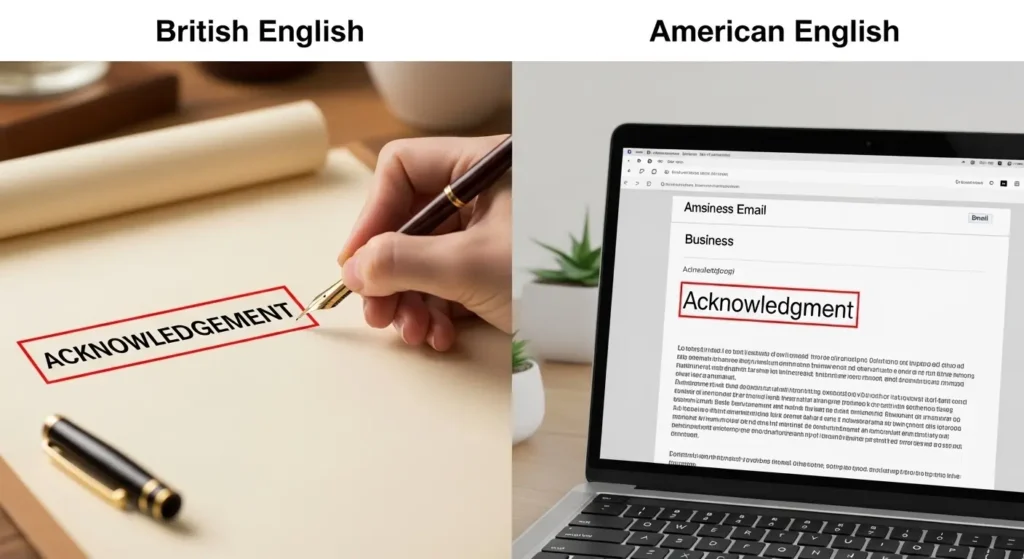
Many writers, students, and professionals often get confused between “acknowledgement” and “acknowledgment.” Both look correct, yet only one may be preferred depending on where you are writing. This small spelling difference can create doubt in emails, academic assignments, legal documents, and formal communication. People usually search for this keyword when they are unsure whether they are making a spelling mistake or following the wrong English standard.
The confusion mainly comes from British English and American English differences. One version includes an extra “e,” while the other drops it. Although the meaning stays the same, using the correct form is important for clarity, professionalism, and regional correctness. This article will clearly explain the difference, origin, usage rules, and real-life examples so you never make this mistake again. By the end, you will know exactly which spelling to use and when.
Acknowledgement or Acknowledgment – Quick Answer
Both “acknowledgement” and “acknowledgment” are correct spellings.
- Acknowledgement → British English (UK, India, Australia, Pakistan, etc.)
- Acknowledgment → American English (USA, Canada)
Trunk or Treats: Meaning and Origin?
Meaning:
It refers to recognizing or confirming something.
Examples:
- She sent an acknowledgement email after receiving the document. (UK)
- The company issued an acknowledgment of the complaint. (US)
Both mean the same thing; only spelling differs.
The Origin of Acknowledgement / Acknowledgment
The word comes from Middle English, formed from:
- “acknow” (to recognize)
- “-ledgement / -ledgment” (state or action suffix)
Over time, English spelling evolved differently in regions.
- British English preserved older spellings like “acknowledgement”
- American English simplified many words, dropping silent letters like “e”
This simplification trend was influenced by Noah Webster in the 18th–19th century, who aimed to make English spelling more logical and shorter in the United States.
Olive or Twist – How to Use It?
British English vs American English Spelling
The main difference lies in spelling standardization.
| Feature | British English | American English |
| Spelling | acknowledgement | acknowledgment |
| Usage Region | UK, Commonwealth countries | USA, Canada |
| Style Preference | Traditional | Simplified |
| Common in | Academic UK writing | Business & legal US writing |
Examples:
- UK: Please send your acknowledgement letter.
- US: Please send your acknowledgment letter.
Which Spelling Should You Use?
Your choice depends on your audience:
- UK / Commonwealth countries (India, Pakistan, Australia): Use acknowledgement
- USA / Canada: Use acknowledgment
- Global audience: Choose one style and stay consistent
👉 Tip: If you’re writing for the internet or international readers, “acknowledgment” (American spelling) is often more widely accepted.
Common Mistakes with Acknowledgement / Acknowledgment
1. Mixing both spellings in one document
❌ Wrong: acknowledgement in one sentence and acknowledgment in another
✔ Correct: Use one version consistently
2. Using the wrong regional form
❌ Wrong: Using “acknowledgment” in UK academic writing
✔ Correct: Use “acknowledgement” for UK standards
3. Confusing meaning with spelling
Both words mean the same thing, so don’t treat them as different meanings.
Acknowledgement / Acknowledgment in Everyday Examples
Emails:
- “This is to confirm receipt and acknowledgement of your email.” (UK)
Business:
- “We sent an acknowledgment of your order.” (US)
Academic Writing:
- “The thesis includes an acknowledgement section for contributors.”
Social Media:
- “Thanks for the shoutout and acknowledgment!”
Legal Documents:
- “The party signed an acknowledgment of agreement.”
Acknowledgement vs Acknowledgment – Google Trends & Usage Data
- Acknowledgment (US spelling) dominates global web content, especially in:
- Legal documents
- Corporate communication
- Tech writing
- Acknowledgement (UK spelling) is more common in:
- Academic writing in Commonwealth countries
- Government documents in UK and India
Trend Insight:
- American spelling has higher online search volume globally
- British spelling remains strong in formal education systems outside the US
Comparison Table: Acknowledgement Variations
| Word Type | British English | American English |
| Noun | acknowledgement | acknowledgment |
| Verb form | acknowledge | acknowledge |
| Usage tone | Formal, traditional | Simple, modern |
| Writing style | Academic UK | Business US |
FAQs about Acknowledgement / Acknowledgment
1. What is the correct spelling: acknowledgement or acknowledgment?
Both are correct. British English uses “acknowledgement,” while American English uses “acknowledgment.”
2. Is acknowledgment wrong in UK English?
No, but it is less preferred. UK writing generally uses “acknowledgement.”
3. Why are there two spellings?
Because British and American English developed different spelling standards over time.
4. Which spelling is used in IELTS or academic exams?
IELTS and UK-based exams prefer “acknowledgement.”
5. Can I mix both spellings in one document?
No, always use one consistent spelling style.
6. Is acknowledgment more common online?
Yes, American spelling is more common in global digital content.
7. Do both words have the same meaning?
Yes, they both mean recognizing or confirming receipt or truth.
Conclusion
The confusion between acknowledgement and acknowledgment is common but easy to solve once you understand regional spelling rules. Both words are correct, but the difference lies in British and American English usage. British English prefers the extra “e” in *acknowledgement,” while American English simplifies it to acknowledgment. The meaning remains the same in both forms.
When writing, the most important rule is consistency. Choose one spelling style based on your audience and stick with it throughout your document. For academic and formal writing in the UK and Commonwealth countries, use “acknowledgement.” For US-based writing or global business content, “acknowledgment” is widely accepted.
By mastering this small difference, you improve your writing accuracy, professionalism, and credibility. Whether you are writing emails, essays, or business documents, correct spelling always leaves a strong impression.

Hi, I’m Henry James, the author behind GrammarTribe.com. I’m passionate about the English language and specialize in grammar, helping readers understand complex rules in a simple, clear way. Over the years, I’ve dedicated myself to creating content that makes learning grammar practical, fun, and accessible for everyone. If you’re a student, professional, or language enthusiast.
Through GrammarTribe.com, I share tips, guides, and examples to help people write confidently and correctly. My goal is to make grammar less intimidating and more useful in everyday writing, emails, social media, and professional communication. Writing and teaching grammar isn’t just my profession — it’s my passion.
When I’m not writing, I enjoy reading, exploring language trends, and discovering new ways to make English learning engaging and easy. My mission is to empower readers to communicate clearly and confidently, one grammar tip at a time.