Have you ever written an email or formal letter and paused to wonder whether to use inclosed or enclosed? This question is more common than you might think. Many people encounter both words in business correspondence, legal documents, and older texts, leading to confusion about which spelling is correct today.
The confusion exists because inclosed was once a standard English spelling, while enclosed has become the modern and preferred form. As language evolved, usage patterns changed, and one version gradually became dominant. Today, most style guides, dictionaries, and professional writers recommend enclosed.
Understanding the difference between inclosed or enclosed is important for anyone who writes emails, letters, reports, or formal documents. Using the right term makes your communication look professional and clear.
In this guide, you’ll learn the meaning of each word, their history, regional usage, common mistakes, practical examples, and which spelling you should use in modern English.
If you’re looking for a quick answer, enclosed is usually the correct choice for contemporary writing.
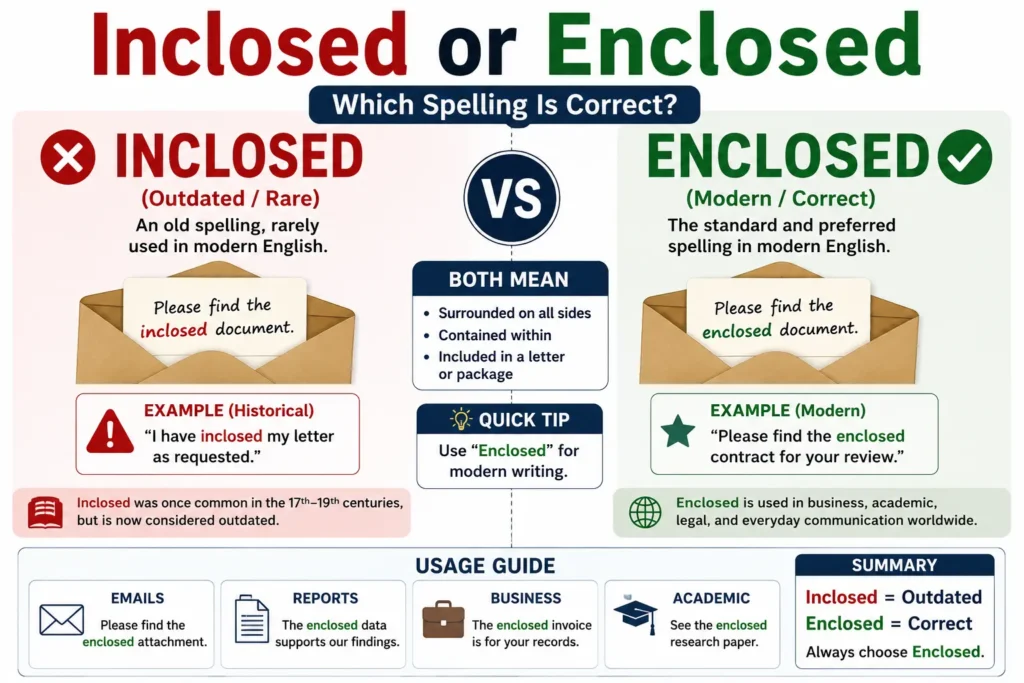
Inclosed or Enclosed – Quick Answer
✅ Enclosed is the modern and preferred spelling.
⚠️ Inclosed is an older spelling that is now rarely used.
Meaning
Both words mean:
- Surrounded on all sides
- Contained within something
- Included inside a letter, package, or document
Examples
✅ Please find the enclosed document.
✅ The garden was enclosed by a fence.
⚠️ Please find the inclosed document. (Old-fashioned)
Read more: Spilled or Spilt: Which Spelling Is Correct?
Quick Comparison
| Word | Status | Modern Usage |
| Enclosed | Correct | Yes |
| Inclosed | Archaic | Rare |
The Origin of Inclosed or Enclosed
Both words come from the verb enclose, which traces its roots to Middle English and Old French influences.
Historically, English writers used both inclose and enclose. During the 17th, 18th, and early 19th centuries, inclosed appeared frequently in official documents, books, and correspondence.
Over time, however, enclosed became the dominant form.
Read more:
Posted inGrammar Knowledge
Tip or Teat: Which Word Should You Use?
Why the Difference Exists
The prefixes:
- En-
- In-
often had similar meanings in older English.
As English became more standardized, dictionaries and style guides favored enclose and enclosed, leading to the gradual decline of inclosed.
Historical Comparison
| Word | Historical Use | Current Status |
| Enclosed | Common | Standard |
| Inclosed | Common in older texts | Rare |
British English vs American English Spelling
Unlike many English spelling differences, both British and American English now prefer enclosed.
Examples
| British English | American English |
| Please see the enclosed file. | Please see the enclosed file. |
| The property was enclosed by walls. | The property was enclosed by walls. |
Comparison Table
| Feature | British English | American English |
| Preferred Form | Enclosed | Enclosed |
| Inclosed Accepted? | Rarely | Rarely |
| Professional Use | Enclosed | Enclosed |
| Everyday Writing | Enclosed | Enclosed |
Which Spelling Should You Use?
The answer depends mainly on your audience and purpose.
Use Enclosed
Use enclosed for:
- Emails
- Business letters
- Academic writing
- Reports
- Legal documents
- Professional communication
Use Inclosed
You may encounter inclosed in:
- Historical documents
- Old books
- Archived correspondence
- Classical literature
Audience-Based Advice
| Audience | Recommended Spelling |
| US Readers | Enclosed |
| UK Readers | Enclosed |
| Canada | Enclosed |
| Australia | Enclosed |
| Global Audience | Enclosed |
For modern communication, always choose enclosed.
Common Mistakes with Inclosed or Enclosed
Mistake 1
❌ Please find the inclosed report.
✅ Please find the enclosed report.
Mistake 2
❌ The inclosed area is private property.
✅ The enclosed area is private property.
Mistake 3
❌ I have inclosed my résumé.
✅ I have enclosed my résumé.
Mistake 4
❌ See the inclosed attachment.
✅ See the enclosed attachment.
Easy Rule
If you’re writing modern English, use enclosed.
Inclosed or Enclosed in Everyday Examples
Emails
✅ Please find the enclosed invoice.
News Writing
✅ The enclosed compound was secured by authorities.
Social Media
✅ Check the enclosed image for details.
Formal Writing
✅ The enclosed materials support the findings of the report.
Business Communication
✅ The enclosed contract requires your signature.
Inclosed or Enclosed – Google Trends & Usage Data
Searches for inclosed or enclosed continue because many people encounter older documents and wonder which spelling is correct.
Common Search Queries
- Inclosed or enclosed
- Is inclosed a word?
- Enclosed meaning
- Inclosed meaning
- Enclosed vs inclosed
Popular Regions
| Country | Search Interest |
| United States | High |
| United Kingdom | High |
| Canada | Moderate |
| Australia | Moderate |
| India | High |
Most searches come from students, business professionals, researchers, and writers.
Usage Trend
Modern publications overwhelmingly favor enclosed, while inclosed appears mainly in historical texts.
Inclosed vs Enclosed Comparison Table
| Feature | Inclosed | Enclosed |
| Correct Modern Spelling | No | Yes |
| Historical Usage | Yes | Yes |
| Modern Professional Writing | No | Yes |
| Business Emails | No | Yes |
| Academic Writing | No | Yes |
| Dictionary Recognition | Limited | Standard |
| Common Today | Rare | Very Common |
FAQs
Is inclosed a real word?
Yes. It is an older English spelling, but it is rarely used today.
Which is correct: inclosed or enclosed?
For modern English, enclosed is correct and preferred.
Is inclosed wrong?
Not historically, but it is considered outdated in contemporary writing.
Do British people use inclosed?
Modern British English generally uses enclosed.
Do Americans use inclosed?
Modern American English also prefers enclosed.
Can I use inclosed in a business email?
No. Use enclosed to maintain a professional tone.
Why do old documents use inclosed?
Because it was once an accepted alternative spelling before English spelling became standardized.
Conclusion
When comparing inclosed or enclosed, the modern answer is clear. Enclosed is the preferred spelling in contemporary English and is accepted in business, academic, legal, and everyday writing. While inclosed is not technically wrong from a historical perspective, it is now considered outdated and appears mainly in older books, archives, and historical documents.
The confusion exists because both forms were once used interchangeably. However, language evolves, and standard usage eventually becomes enclosed. Today, professional writers, editors, teachers, and dictionaries overwhelmingly recommend using enclosed.
To avoid confusion and ensure clear communication, remember this simple rule: if you are writing for a modern audience, choose enclosed. Reserve inclosed only for discussing historical texts or quoting original documents. Following this advice will make your writing clearer, more professional, and easier for readers to understand.

Hi, I’m Henry James, the author behind GrammarTribe.com. I’m passionate about the English language and specialize in grammar, helping readers understand complex rules in a simple, clear way. Over the years, I’ve dedicated myself to creating content that makes learning grammar practical, fun, and accessible for everyone. If you’re a student, professional, or language enthusiast.
Through GrammarTribe.com, I share tips, guides, and examples to help people write confidently and correctly. My goal is to make grammar less intimidating and more useful in everyday writing, emails, social media, and professional communication. Writing and teaching grammar isn’t just my profession — it’s my passion.
When I’m not writing, I enjoy reading, exploring language trends, and discovering new ways to make English learning engaging and easy. My mission is to empower readers to communicate clearly and confidently, one grammar tip at a time.