Have you ever typed “puting” and wondered if it was correct? You’re not alone. Many English learners, students, and even native speakers search for puting or putting because the spelling can seem confusing. Since the verb put is short, people often assume that adding -ing creates puting. However, English spelling rules work differently in this case.
The correct spelling is putting, with a double t. The form puting is considered a spelling mistake in standard English. This confusion happens because English verbs follow different patterns when forming present participles. Some verbs double the final consonant before adding -ing, while others do not.
Understanding the correct spelling is important for writing emails, school assignments, social media posts, and professional documents. In this guide, you’ll learn the difference between puting and putting, their origins, spelling rules, common mistakes, real-world examples, and usage trends. By the end, you’ll know exactly which spelling to use and why.
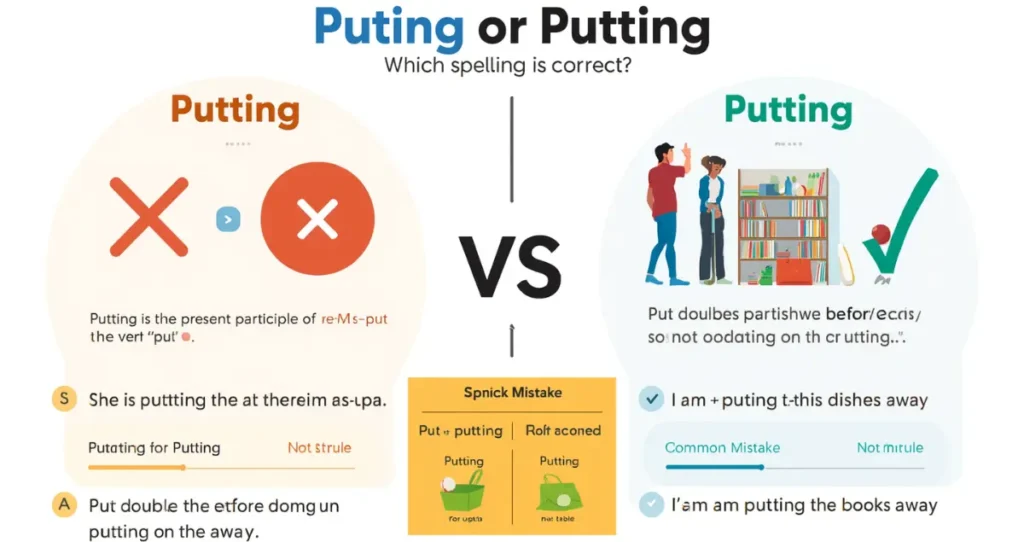
Puting or Putting – Quick Answer
Putting is the correct spelling.
❌ Puting
✅ Putting
The word putting is the present participle and gerund form of the verb put.
Examples
✅ I am putting the books on the shelf.
✅ She is putting together a new project.
✅ They are putting money into savings.
❌ I am puting the books on the shelf.
Read more: Ones or One’s: Meaning and Difference?
The Origin of Puting or Putting
The word put has been part of the English language since Middle English. It means to place, move, or position something somewhere.
Why Does “Putting” Have Two Ts?
English spelling rules often require doubling the final consonant when:
- The verb has one syllable.
- It ends in a consonant.
- A vowel comes before the final consonant.
Since put follows this pattern, the correct form becomes:
- Put + ing = Putting
The spelling ignores this rule and is considered incorrect.
Read more: Edgewater or Deserters: Meaning and Differences?
Historical Development
| Word Form | Status |
| Put | Base verb |
| Putting | Correct modern form |
| Puting | Misspelling |
The double t has been the accepted spelling for centuries.
British English vs American English Spelling
Unlike many spelling debates, putting is spelled the same in both British and American English.
There is no regional difference.
Comparison Table
| Word | British English | American English |
| Put | Put | Put |
| Putting | Putting | Putting |
| Puting | Incorrect | Incorrect |
Examples
| Correct Usage | Example |
| British English | She is putting the files away. |
| American English | He is putting gas in the car. |
| Global English | We are putting the plan into action. |
Which Spelling Should You Use?
You should always use putting.
For US Audiences
✅ Putting
For UK Audiences
✅ Putting
For Australia, Canada, and New Zealand
✅ Putting
For Global Audiences
✅ Putting
The spelling should be avoided because it is not accepted in standard English.
Audience-Based Advice Table
| Audience | Recommended Spelling |
| United States | Putting |
| United Kingdom | Putting |
| Canada | Putting |
| Australia | Putting |
| International Audience | Putting |
Common Mistakes with Puting or Putting
Many writers make simple spelling errors when using the word.
Mistake #1: Dropping a T
❌ I am puting the dishes away.
✅ I am putting the dishes away.
Mistake #2: Using Puting in Formal Writing
❌ The company is puting new policies in place.
✅ The company is putting new policies in place.
Mistake #3: Assuming Short Words Never Double Letters
❌ Put + ing = Puting
✅ Put + ing = Putting
Mistake #4: Typing Too Quickly
❌ We are puting together a report.
✅ We are putting together a report.
Puting or Putting in Everyday Examples
In Emails
“Thank you for putting this information together.”
In News Articles
“The government is putting new measures into effect.”
On Social Media
“I’m putting all my energy into this project!”
In Formal Writing
“The organization is putting resources toward research.”
In Everyday Conversation
“I’m putting my keys on the table.”
Puting or Putting – Google Trends & Usage Data
Searches for puting or putting are common because people want to confirm the correct spelling.
Usage Popularity
| Variation | Popularity |
| Putting | Extremely High |
| Puting | Very Low |
Countries with Frequent Searches
- United States
- United Kingdom
- Canada
- Australia
- India
Common Search Intent
People usually search for:
- Correct spelling
- Grammar help
- School assignments
- Professional writing
- English learning
Usage Context
| Word | Common Context |
| Putting | Daily writing, business, education |
| Puting | Spelling error searches |
Comparison Table: Puting vs Putting
| Feature | Puting | Putting |
| Correct Spelling | No | Yes |
| Dictionary Accepted | No | Yes |
| Used in Professional Writing | No | Yes |
| Used in Academic Writing | No | Yes |
| Standard English | No | Yes |
| Search Frequency | Low | Very High |
Frequently Asked Questions (FAQs)
1. Is puting a real word?
No. Puting is generally considered a misspelling of putting.
2. Which is correct: puting or putting?
Putting is the correct spelling.
3. Why does putting have two Ts?
English spelling rules require doubling the final consonant before adding -ing to put.
4. Is putting correct in British English?
Yes. Putting is the standard spelling in British English.
5. Is putting correct in American English?
Yes. American English also uses putting.
6. Can I use puting in informal writing?
No. It is still considered incorrect.
7. What does putting mean?
Putting means placing, positioning, arranging, or moving something somewhere.
Conclusion
The answer to puting or putting is simple: putting is always the correct spelling. The form puting is a common mistake that happens when writers forget the English rule of doubling the final consonant before adding -ing. Because the base verb put ends with a consonant and contains a short vowel sound, the correct form becomes putting.
The good news is that there is no British versus American spelling difference. English speakers around the world use putting in exactly the same way. Whether you are writing an email, school paper, business report, news article, or social media post, putting is the spelling you should choose.
If you remember one rule from this guide, let it be this: put + ing = putting. Using the correct spelling improves clarity, professionalism, and credibility in your writing. Whenever you are unsure, double-check your work and choose putting, the accepted form in standard English.

Hi, I’m Henry William, the author of GrammarTribe.com. I’m passionate about the English language and have dedicated my career to helping people master grammar, spelling, and effective writing. Over the years, I’ve guided learners, writers, and professionals in understanding common mistakes, tricky rules, and nuances of English grammar in a simple and easy-to-follow way.
Through GrammarTribe.com, I aim to make grammar approachable and enjoyable for everyone. My work focuses on providing clear explanations, practical tips, and examples that readers can apply in everyday writing, whether it’s emails, essays, social media, or professional documents. I believe that strong grammar skills empower people to communicate confidently and professionally.
When I’m not writing or researching grammar, I enjoy reading, exploring language trends, and creating educational content that simplifies complex concepts. I’m committed to helping my audience write better, understand English deeply, and avoid common pitfalls, all while making learning grammar a fun and rewarding journey.