
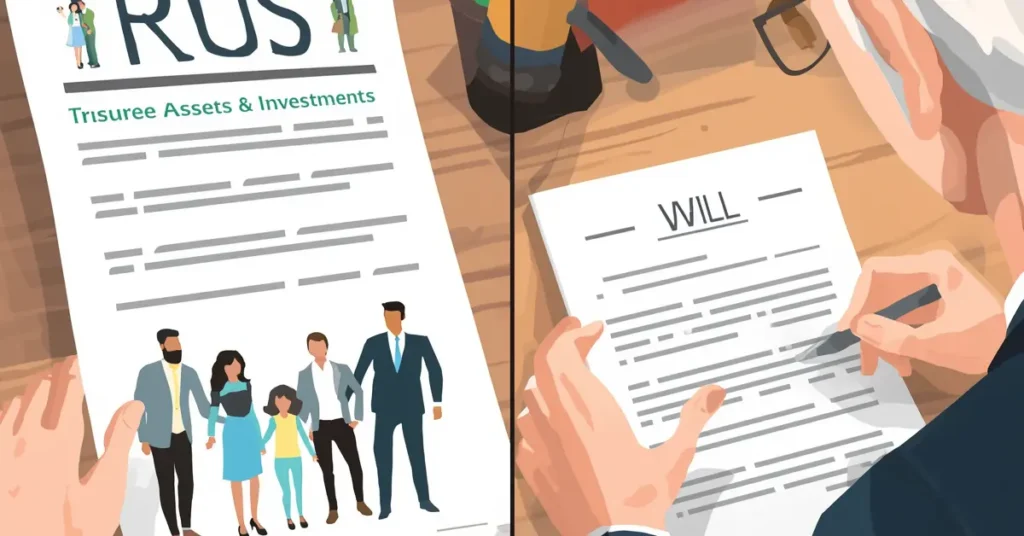
Imagine you want to protect your family after you are gone. You start searching online and see two common terms: trust or will. Many people feel confused about trust or will because both deal with passing assets, but they work in very different ways. Some think they are the same, while others are unsure which one is better. This confusion is why people search for trust or will to make the right legal and financial choice.
Understanding trust or will can help you avoid legal problems, save time, and protect your loved ones. A will is simple and common, but a trust can offer more control and privacy. Choosing between trust or will depends on your needs, assets, and goals. This guide will clearly explain everything so you can decide with confidence.
Trust or Will – Quick Answer
A will is a legal document that explains how your assets are distributed after death.
A trust is a legal arrangement where a trustee manages assets for beneficiaries, often during and after your lifetime.
Example:
- Will: “I leave my house to my son.”
- Trust: “My trustee manages my house for my son until he turns 25.”
The Origin of Trust or Will
- Will comes from Old English “willan”, meaning desire or wish. It reflects your final wishes after death.
- Trust comes from Old Norse “traust”, meaning confidence or protection. It shows a relationship where one person manages assets for another.
There are no spelling differences here, but the meanings evolved from different legal traditions.
British English vs American English Spelling
Good news: “trust” and “will” have the same spelling in both British and American English.
| Term | British English | American English | Difference |
| Trust | Trust | Trust | None |
| Will | Will | Will | None |
The difference is not in spelling, but in legal use and structure.
Which Spelling Should You Use?
Since there is no spelling variation, your focus should be on usage:
- USA audience → Use legal terms like “living trust” and “last will and testament”
- UK/Commonwealth → Same terms apply, but legal processes may differ
- Global audience → Use simple terms and explain both clearly
Common Mistakes with Trust or Will
1. Thinking they are the same
❌ Wrong: A trust and will do the same thing
✅ Correct: They serve different purposes
2. Believing a will avoids court
❌ Wrong: A will skips legal process
✅ Correct: A will goes through probate
3. Assuming trusts are only for rich people
❌ Wrong: Only wealthy people need trusts
✅ Correct: Trusts can help many families
4. Not updating documents
❌ Wrong: One-time setup is enough
✅ Correct: Update after life changes
Trust or Will in Everyday Examples
“I’m planning my estate and deciding between a trust or will.”
News
“Experts advise choosing between a trust or will based on asset size.”
Social Media
“Not sure about trust or will? A trust gives more control!”
Formal Writing
“A trust or will is essential for proper estate planning.”
Trust or Will – Google Trends & Usage Data
- United States: “trust vs will” is highly searched due to estate planning awareness
- United Kingdom: “will” is more common than “trust”
- Canada & Australia: Both terms are popular in legal searches
Trend Insight:
- “Will” is more searched by beginners
- “Trust” is searched by users with more assets
Comparison Table: Trust vs Will
| Feature | Trust | Will |
| Takes effect | During life or after death | After death only |
| Probate | Avoids probate | Goes through probate |
| Privacy | Private | Public record |
| Cost | Higher setup cost | Lower cost |
| Control | More control over assets | Basic instructions |
FAQs
1. What is better: trust or will?
It depends. A trust offers more control, while a will is simpler and cheaper.
2. Do I need both trust and will?
Yes, many people use both for full protection.
3. Does a trust replace a will?
Not completely. A will is still needed for some assets.
4. Is a trust expensive?
It costs more upfront but may save money later.
5. Can I make a will without a lawyer?
Yes, but legal advice is recommended.
6. Who manages a trust?
A trustee manages the assets.
7. Does a will cover all assets?
Not always, especially jointly owned or trust assets.
Conclusion
Choosing between a trust or will is an important step in planning your future. A will is simple, affordable, and suitable for most people with basic needs. A trust, on the other hand, offers greater control, privacy, and flexibility, especially for larger or complex estates. The right choice depends on your financial situation, family needs, and long-term goals.
Understanding trust or will helps you avoid confusion and make smart decisions. Many experts suggest using both together for complete coverage. Take time to review your assets and consult a professional if needed. With the right plan, you can protect your loved ones and ensure your wishes are followed.

I am James Wilson, an author at GrammarTribe.com, specializing in English grammar and clear communication.
I create expert, reliable content to help learners write with confidence and accuracy.