
Many English learners get confused when writing sentences like “He’s into the pool.” Should it be dove or dived? This small grammar doubt creates big confusion, especially in exams, writing, and professional communication.
The keyword dove or dived is often searched because both forms appear in books, movies, and even online articles, but they are not always used the same way. People want to know which one is correct, whether both are acceptable, and if usage depends on British or American English.
The confusion around dove or dived usually comes from regional differences and irregular verb patterns in English. Some learners are told “dove is wrong,” while others see it used in modern American writing. Understanding dove or dived helps improve grammar accuracy, writing confidence, and speaking fluency. In this article, we will clearly explain the difference, origin, correct usage, and real-world examples so you never feel unsure again.
Dove or Dived – Quick Answer
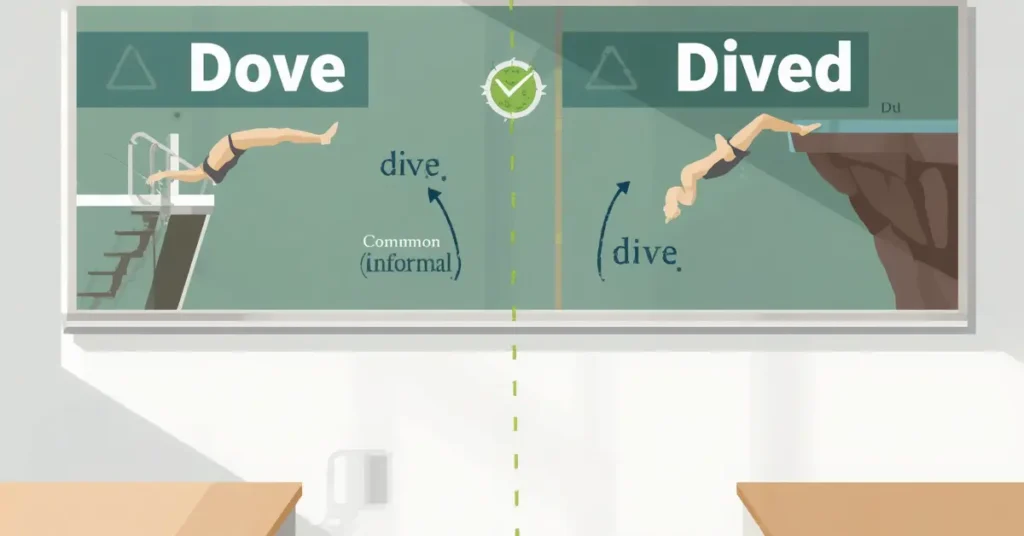
Both “dove” and “dived” are past tense forms of the verb “dive.”
- Dived = Standard and widely accepted (especially British English)
- Dove = Common in American English (informal or spoken usage)
Examples:
- She dived into the water. (UK / formal)
- She dove into the water. (US / casual)
Posted inGrammar Knowledge
Wierd or Weird: Which Spelling Is Correct?
The Origin of Dove or Dived
The verb “dive” comes from Old English dyfan, meaning “to plunge into water.”
Originally, the correct past tense was “dived.” Over time, American English speakers began using “dove” by analogy with irregular verbs like drive → drove. This made “dove” popular in the United States, while British English kept the traditional “dived.”
This historical split is why both forms exist today.
British English vs American English Spelling
| Feature | British English | American English |
| Past tense | Dived | Dove (also dived accepted) |
| Usage style | Formal | Casual / spoken |
| Example | He dived into the pool | He dove into the pool |
| Preference | Standard grammar | Common speech |
Which Spelling Should You Use?
- US audience: “dove” is more natural in everyday writing
- UK/Commonwealth: “dived” is preferred in formal writing
- Global/academic writing: “dived” is safest choice
If you are unsure, always use “dived” because it is universally accepted in formal English.
Autism or ADHD: Key Differences, Signs
Common Mistakes with Dove or Dived
- ❌ Using “dove” in British academic writing
✔ He dived into the research topic. - ❌ Thinking “dove” is incorrect everywhere
✔ It is correct in American English. - ❌ Mixing forms in one text
✔ Choose one style and stay consistent. - ❌ Using “dove” as present tense
✔ Present tense is “dive.”
Dove or Dived in Everyday Examples
- Emails:
“The swimmer dived into training early this morning.” - News:
“The pilot dove/dived to avoid the obstacle.” - Social Media:
“He dove into the comments section instantly.” - Formal writing:
“The researcher dived into the dataset for analysis.”
Dove or Dived – Google Trends & Usage Data
- “Dove” is more searched in the United States
- “Dived” dominates in the UK, India, Pakistan, and Commonwealth countries
- Overall, “dived” is more common in formal writing globally
- “Dove” appears more in spoken English, movies, and social media
Comparison Table: Dove vs Dived
| Aspect | Dove | Dived |
| Grammar status | Informal (US) | Standard (UK + global) |
| Formal writing | Less preferred | Preferred |
| Origin | Modern American usage | Original English form |
| Acceptability | Regional | Universal |
| Example | He dove into the lake | He dived into the lake |
FAQs
1. Is “dove” grammatically correct?
Yes, in American English it is accepted as a past tense of “dive.”
2. Is “dived” correct in the US?
Yes, but it sounds more formal.
3. Which is better for exams?
“Dived” is safer and widely accepted.
4. Why do two forms exist?
Because of differences between British and American English evolution.
5. Is “dove” informal?
Yes, mostly used in casual American speech.
6. Can I use both in writing?
No, stay consistent with one style.
7. What is the present tense?
The present tense is “dive.”
Conclusion
The confusion between dove or dived comes from regional differences in English usage. While both are correct, their acceptability depends on context. “Dived” is the original and universally accepted form, especially in British and formal English. “Dove” is a common American alternative used in everyday speech.
Understanding this difference helps you write more confidently and avoid grammar mistakes in exams, emails, and professional writing.
If you are writing for a global or academic audience, “dived” is the safest choice. However, if you are reading or speaking American English content, you will often see “dove.” Knowing both forms allows you to understand English better and use it naturally in different situations.

Hi, I’m Henry William, the author of GrammarTribe.com. I’m passionate about the English language and have dedicated my career to helping people master grammar, spelling, and effective writing. Over the years, I’ve guided learners, writers, and professionals in understanding common mistakes, tricky rules, and nuances of English grammar in a simple and easy-to-follow way.
Through GrammarTribe.com, I aim to make grammar approachable and enjoyable for everyone. My work focuses on providing clear explanations, practical tips, and examples that readers can apply in everyday writing, whether it’s emails, essays, social media, or professional documents. I believe that strong grammar skills empower people to communicate confidently and professionally.
When I’m not writing or researching grammar, I enjoy reading, exploring language trends, and creating educational content that simplifies complex concepts. I’m committed to helping my audience write better, understand English deeply, and avoid common pitfalls, all while making learning grammar a fun and rewarding journey.