
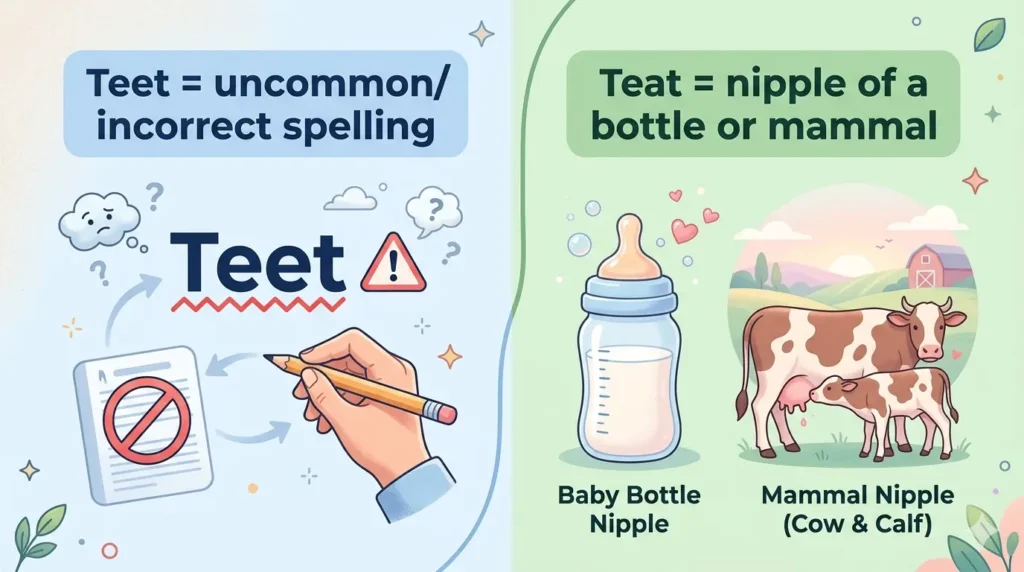
Many people get confused when they see the words “teet” or “teat” and wonder which one is correct. At first glance, they look similar, but they have very different meanings. This confusion often happens in searches, especially when people are reading farming content, biology texts, or informal writing online.
Some users think both words are spelling variations of the same term, while others are unsure if one is even correct English.In reality, only one of these words is widely accepted in standard English, while the other is commonly used as a mistaken form or in very specific contexts.
This confusion leads people to search online for clarification, correct usage, and examples. Understanding the difference is important for students, writers, farmers, and anyone dealing with animals or anatomy-related topics.
In this article, we will clearly explain “teet or teat”, their meanings, origins, correct usage, and real-world examples so you never mix them up again.
Teet or Teat – Quick Answer
The correct standard English word is “teat”.
- Teat → The nipple-like part of a mammary gland in animals (cow, goat, sheep, etc.).
- Example: The calf drinks milk from the cow’s teat.
- Teet → This is not a standard English word. It is often a spelling mistake or confusion with the plural of “tooth” (teeth).
- Correct form: teeth, not teet
So, in most cases, “teat” is correct, and “teet” is incorrect.
Wierd or Weird: Which Spelling Is Correct,Guide with Examples
The Origin of Teat or Teet
The word “teat” comes from Old French “tete”, meaning nipple or breast. It entered Middle English around the 14th century and was used mainly in animal anatomy.
Over time, the spelling became standardized as “teat” in modern English.
On the other hand, “teet” likely appears due to:
- Mishearing the word “teeth”
- Typing errors
- Lack of awareness of the correct spelling
There is no historical root for “teeth” as a valid anatomical term.
British English vs American English Spelling
In this case, there is no British vs American spelling difference for “teat.” Both use the same spelling.
However, confusion arises because of similar-looking words:
Accidently Or Accidentally: Spelling, Usage, and new Tips
| Meaning | British English | American English |
| Animal nipple | teat | teat |
| Plural of tooth | teeth | teeth |
| Incorrect form | teet (wrong) | teet (wrong) |
So unlike many English words, “teat” stays the same in both regions.
Which Spelling Should You Use?
- US English: Use teat
- UK English: Use teat
- Global English: Always use teat
Avoid using “teet” in any formal or academic writing. It is considered incorrect in all standard English systems.
Common Mistakes with Teat or Teet
- ❌ Writing “teet” instead of “teeth”
✔ Correct: The child lost his teeth. - ❌ Using “teet” for animal anatomy
✔ Correct: The calf feeds from the cow’s teat. - ❌ Thinking both are interchangeable
✔ Correct: Only “teat” is valid for animals - ❌ Spelling errors in farming documents
✔ Always double-check spelling as “teat”
Teat in Everyday Examples
- Email (Veterinary):
“The infection was found near the cow’s teat area.” - News Article:
“Farmers are monitoring teat health to improve milk production.” - Social Media Post:
“Healthy cows mean clean teats and better milk yield.” - Academic Writing:
“The calf attaches to the teat to receive nutrition.” - Farmer Conversation:
“Check the teat for any swelling or injury.”
Teat – Google Trends & Usage Data
Search behavior shows:
- Higher searches in India, Pakistan, and agricultural countries
- Common use in veterinary and farming contexts
- “Teet” appears mostly as a misspelling search query
- “Teat” dominates in medical and biology content
This shows that users are mainly looking for correct spelling and animal-related meaning, not a new word.
Comparison Table: Teat vs Teet
| Feature | Teat | Teet |
| Correctness | Correct | Incorrect |
| Meaning | Animal nipple | No valid meaning |
| Usage | Veterinary, biology | Misspelling |
| Dictionary status | Accepted | Not accepted |
| Example | Cow’s teat | Wrong spelling of “teeth” |
FAQs About Teet or Teat
1. Is “teet” a real English word?
No, “teet” is not a recognized English word.
2. What does “teat” mean?
It refers to the nipple-like part of animals like cows and goats.
3. Is “teet” ever correct?
No, it is always incorrect in standard English.
4. Why do people write “teet”?
Because of spelling mistakes or confusion with “teeth.”
5. Can “teat” be used for humans?
It is very rare and usually considered informal or outdated.
6. Is “teat” used in medical English?
Yes, mainly in veterinary science and animal biology.
7. What is the plural of teat?
The plural is teats.
Conclusion
The confusion between “teet or teat” is common, but the correct answer is simple. “Teat” is the only correct and accepted English word, used in veterinary science and animal anatomy. It refers to the milk-producing part of animals like cows and goats. On the other hand, “teet” is not a valid word and usually appears due to spelling errors or confusion with “teeth.”
Understanding this difference is important for students, farmers, writers, and researchers who work with animal-related topics. Using the correct spelling improves clarity and professionalism in writing. Since English has many similar-looking words, small mistakes like this can change meaning completely.
By remembering that teat = animal anatomy and teet = incorrect, you can avoid confusion in future writing. Always double-check spelling in formal work, especially in scientific or agricultural content where accuracy matters most.

Hi, I’m Henry William, the author of GrammarTribe.com. I’m passionate about the English language and have dedicated my career to helping people master grammar, spelling, and effective writing. Over the years, I’ve guided learners, writers, and professionals in understanding common mistakes, tricky rules, and nuances of English grammar in a simple and easy-to-follow way.
Through GrammarTribe.com, I aim to make grammar approachable and enjoyable for everyone. My work focuses on providing clear explanations, practical tips, and examples that readers can apply in everyday writing, whether it’s emails, essays, social media, or professional documents. I believe that strong grammar skills empower people to communicate confidently and professionally.
When I’m not writing or researching grammar, I enjoy reading, exploring language trends, and creating educational content that simplifies complex concepts. I’m committed to helping my audience write better, understand English deeply, and avoid common pitfalls, all while making learning grammar a fun and rewarding journey.