vThe terms “payor” or “payer” often confuse people in business, insurance, and legal writing. Both words refer to a person or organization that makes a payment, but the spelling difference creates uncertainty.
Many users search this keyword because they see both versions in contracts, medical billing, banking documents, and international reports. This leads to questions like: Which spelling is correct? Are they interchangeable? Does one look more professional than the other?
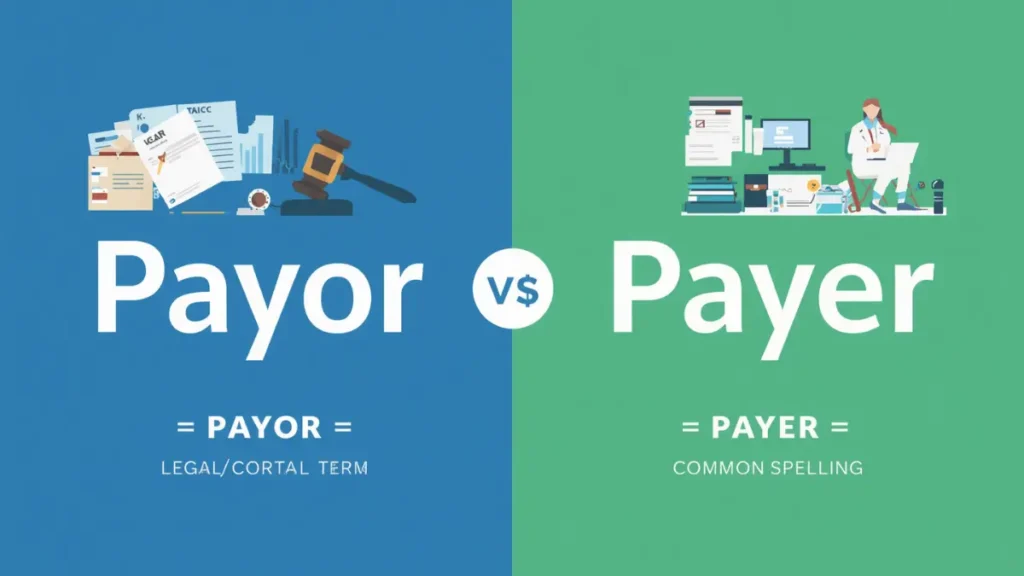
In most cases, both “payor” and “payer” mean the same thing, but usage depends on region, industry, and style guides. “Payer” is the modern and more common spelling in general English, while “payor” is still widely used in legal, insurance, and financial documents, especially in the United States.
This article clears up the confusion by explaining meanings, origins, spelling differences, usage rules, common mistakes, and real-world examples. By the end, you will know exactly which form to use in professional writing, academic work, and everyday communication without hesitation.
Payor or Payer – Quick Answer
Payer and payor both mean a person or organization that pays money to another party.
- Payer (most common): Used in general English
Example: The payer must submit the invoice on time. - Payor (formal/legal): Used in legal, insurance, and financial documents
Example: The payor is responsible for all premium payments.
👉 In short: “payer” is standard English, “payor” is formal/legal variation.
Supercede or Supersede – Which Spelling Is Correct?
The Origin of Payor or Payer
The word comes from the verb “pay”, which traces back to the Latin word pacare, meaning “to pacify or settle a debt.”
- “Payer” developed as a natural English formation: pay + er
- “Payor” emerged in legal writing to avoid confusion in complex contracts, where “payer” could visually mix with similar words or formatting
Over time, both forms stayed in use, but “payer” became dominant in everyday English.
British English vs American English Spelling
Unlike many spelling differences, payor vs payer is not strictly British vs American. Instead, it is style-based.
- British English: prefers payer
- American English: uses payer, but payor appears in legal/insurance contexts
Lieing or Lying? Which One Is Correct (And Why It Matters)
Comparison Table
| Term | Usage Area | Formality | Example |
| Payer | General English | Standard | The payer must sign the form |
| Payor | Legal/Insurance | Formal | The payor agrees to the contract |
| Pay-er | Not used | Incorrect | ✖ Avoid |
Which Spelling Should You Use?
Your choice depends on your audience:
- US general writing: Use payer
- Legal/insurance documents: payor is acceptable
- UK/Commonwealth writing: Use payer
- Academic or SEO content: Prefer payer (more common globally)
👉 Rule of thumb:
If you are unsure, always choose “payer.”
Common Mistakes with Payor or Payer
- ❌ Mixing both forms in one document
✔ Use only one style consistently - ❌ Using “payor” in casual writing
✔ Prefer “payer” in blogs and emails - ❌ Thinking they have different meanings
✔ They mean the same thing - ❌ Assuming British vs American rule applies strictly
✔ It is mostly industry-based, not regional
Payor or Payer in Everyday Examples
- Email:
“Dear Sir, the payer has completed the transaction.” - Banking:
“The payer must verify identity before transfer.” - Insurance:
“The payor is responsible for monthly premiums.” - News report:
“The government is the main payer in public healthcare systems.” - Social media/business post:
“Late payer fees will now be applied automatically.”
Payor or Payer – Google Trends & Usage Data
Search behavior shows:
- “Payer” is more popular globally due to everyday usage
- “Payor” appears more in:
- Legal documents
- Insurance claims
- Healthcare billing systems
Countries like the US, UK, Canada, and Australia mostly use “payer” in general writing, while “payor” is concentrated in professional and institutional systems.
👉 Trend insight:
People search “payor or payer” mainly when reading contracts or medical billing terms.
Comparison Table: Payor vs Payer Variations
| Variation | Status | Usage Context | Recommendation |
| Payer | Standard | Everyday English | Highly recommended |
| Payor | Formal | Legal/Insurance | Use when required |
| Pay-er | Incorrect | None | Avoid completely |
FAQs About Payor or Payer
1. Is payor or payer correct?
Both are correct, but “payer” is more common.
2. Is payor outdated?
No, it is still used in legal and insurance documents.
3. Which is better for SEO writing?
“Payer” is better due to higher search volume.
4. Do payor and payer mean different things?
No, they have the same meaning.
5. Why do legal documents use payor?
For formality and clarity in contracts.
6. Can I use payer in contracts?
Yes, unless the template specifies “payor.”
7. Which spelling should I teach students?
Teach “payer” as the standard form.
Conclusion
The confusion between payor or payer is common, but the difference is simple once you understand usage context. Both words refer to the same meaning: the person or organization that makes a payment. However, “payer” is the modern, widely accepted spelling used in everyday English, business communication, and academic writing. On the other hand, “payor” is mainly reserved for legal, insurance, and financial documents where traditional terminology is preferred.
If you are writing for a general audience, blogging, or SEO content, “payer” is the safest and most effective choice. It is clearer, more widely recognized, and better aligned with modern English usage. Only use “payor” when working with official documents that specifically require it.
Understanding this small difference helps improve your professional writing, avoids confusion in contracts, and ensures consistency across communication. Whether you are a student, writer, or business professional, choosing the right form will make your content more accurate and credible in any context.

Hi, I’m Henry William, the author of GrammarTribe.com. I’m passionate about the English language and have dedicated my career to helping people master grammar, spelling, and effective writing. Over the years, I’ve guided learners, writers, and professionals in understanding common mistakes, tricky rules, and nuances of English grammar in a simple and easy-to-follow way.
Through GrammarTribe.com, I aim to make grammar approachable and enjoyable for everyone. My work focuses on providing clear explanations, practical tips, and examples that readers can apply in everyday writing, whether it’s emails, essays, social media, or professional documents. I believe that strong grammar skills empower people to communicate confidently and professionally.
When I’m not writing or researching grammar, I enjoy reading, exploring language trends, and creating educational content that simplifies complex concepts. I’m committed to helping my audience write better, understand English deeply, and avoid common pitfalls, all while making learning grammar a fun and rewarding journey.