Have you ever paused mid-sentence and wondered, “Is it shrank or shrunk?” You’re not alone. Many English learners and even native speakers get confused when using past tense forms of irregular verbs. The verb shrink is one of those tricky words that doesn’t follow simple rules, which is why people often search for the correct usage.
The confusion usually comes from mixing up past tense and past participle forms. You might hear someone say, “My shirt shrank in the wash,” while another says, “My shirt has shrunk.” Both sound right—but why? This article clears up that confusion in a simple and practical way. By the end, you’ll know exactly when to use shrank and when to use shrunk, along with examples, common mistakes, and usage tips for different audiences.
Shrank or Shrunk – Quick Answer
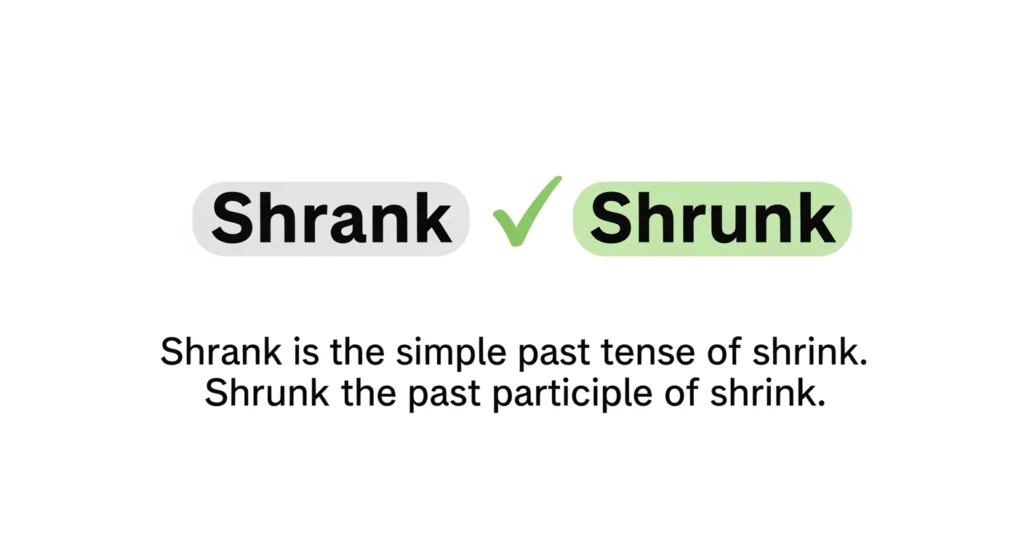
- Shrank = simple past tense
- Shrunk = past participle (used with has, have, had)
Examples:
- Correct: My sweater shrank after washing.
- Correct: My sweater has shrunk a lot.
👉 Quick tip:
If you see has/have/had, use shrunk.
Barbeque or Barbecue: Which Spelling Is Correct ?
The Origin of Shrank or Shrunk
The verb shrink comes from Old English “scrincan,” meaning “to contract or become smaller.” Like many old verbs, it is irregular, which means it doesn’t follow the standard -ed pattern.
Over time, English developed different forms:
- Present: shrink
- Past: shrank
- Past participle: shrunk
The difference exists because English kept older grammar patterns instead of simplifying them. That’s why we have both shrank and shrunk today.
Lovable or Loveable: Which Spelling Is Correct?
British English vs American English Spelling
Good news: there is no spelling difference between British and American English for this word. The difference is only in grammar, not spelling.
Comparison Table
| Form | British English | American English | Usage Type |
| Shrink | Same | Same | Present |
| Shrank | Same | Same | Past tense |
| Shrunk | Same | Same | Past participle |
👉 Both regions follow the same rule:
- He shrank (past)
- He has shrunk (perfect tense)
Which Spelling Should You Use?
- United States: Follow standard grammar rules → shrank (past), shrunk (with has/have/had)
- UK & Commonwealth: Same usage as the US
- Global audience: Stick to correct grammar to avoid confusion
👉 Simple rule for everyone:
- No helper verb → shrank
- With helper verb → shrunk
Common Mistakes with Shrank or Shrunk
❌ Wrong: My shirt has shrank.
✔ Correct: My shirt has shrunk.
❌ Wrong: It shrunk yesterday.
✔ Correct: It shrank yesterday.
❌ Wrong: The company has shrink.
✔ Correct: The company has shrunk.
👉 Most mistakes happen when people mix past tense with past participle.
Shrank or Shrunk in Everyday Examples
Emails:
- The file size shrank after compression.
- The file has shrunk significantly.
News:
- The economy shrank last quarter.
- The market has shrunk due to inflation.
Social Media:
- Oops! My jeans shrank in the wash 😅
- My savings have shrunk this month!
Formal Writing:
- The sample size shrank during the study.
- The dataset has shrunk over time.
Shrank or Shrunk – Google Trends & Usage Data
- “Shrunk” is searched more often because people use it in present perfect sentences (has shrunk).
- “Shrank” is still common in storytelling and past descriptions.
- In countries like the US, UK, Canada, and Australia, both forms are widely used—but correctly based on grammar.
👉 Context matters more than region.
Comparison Table (Side by Side)
| Keyword Form | Grammar Role | Example Sentence |
| Shrink | Present tense | Clothes shrink in hot water. |
| Shrank | Past tense | The shirt shrank yesterday. |
| Shrunk | Past participle | The shirt has shrunk a lot. |
FAQs
1. Is “shrunk” incorrect?
No. Shrunk is correct when used with has, have, or had.
2. Can I say “it shrunk yesterday”?
No. Use shrank for simple past: It shrank yesterday.
3. Why do people confuse shrank and shrunk?
Because both are past forms of shrink, but used in different grammar structures.
4. Is “has shrank” ever correct?
No. Always say has shrunk.
5. Which is more common: shrank or shrunk?
Shrunk is more common in modern usage due to frequent use with helper verbs.
6. Is this difference important in exams?
Yes. Grammar accuracy matters in writing tests and professional communication.
7. Do native speakers make this mistake?
Yes, especially in casual speech.
Conclusion
The difference between shrank and shrunk is simple once you understand the rule. Shrank is used for past tense, while shrunk is used with helper verbs like has, have, and had. This small distinction can make a big difference in how clear and professional your writing sounds.
There is no spelling difference between British and American English, which makes things easier. The real challenge is knowing when to use each form. By remembering the basic rule—no helper verb means shrank, and helper verb means shrunk—you can avoid common mistakes.
Whether you are writing emails, essays, or social media posts, using the correct form shows strong language skills. Keep practicing with real examples, and soon it will feel natural. Mastering small grammar details like this helps you communicate more clearly and confidently in English.

I am James Wilson, an author at GrammarTribe.com, specializing in English grammar and clear communication.
I create expert, reliable content to help learners write with confidence and accuracy.