
Many people get confused when writing the word “tardies” or “tardys,” especially students, teachers, and English learners. You might see both forms online and wonder which one is correct. This confusion often happens because English spelling can be tricky, and some words change form when they become plural. People also search this keyword when writing school reports, attendance records, or emails about late arrivals.
The main issue is simple: one spelling is correct, and the other is a common mistake. But knowing the difference is important if you want to write clearly and professionally. In schools and workplaces, using the wrong spelling can look like an error in English grammar. This article will help you understand the correct form, why the confusion happens, and how to use the word properly in real-life situations. You will also see examples, history, and usage tips to avoid mistakes forever.
Tardies or Tardys – Quick Answer
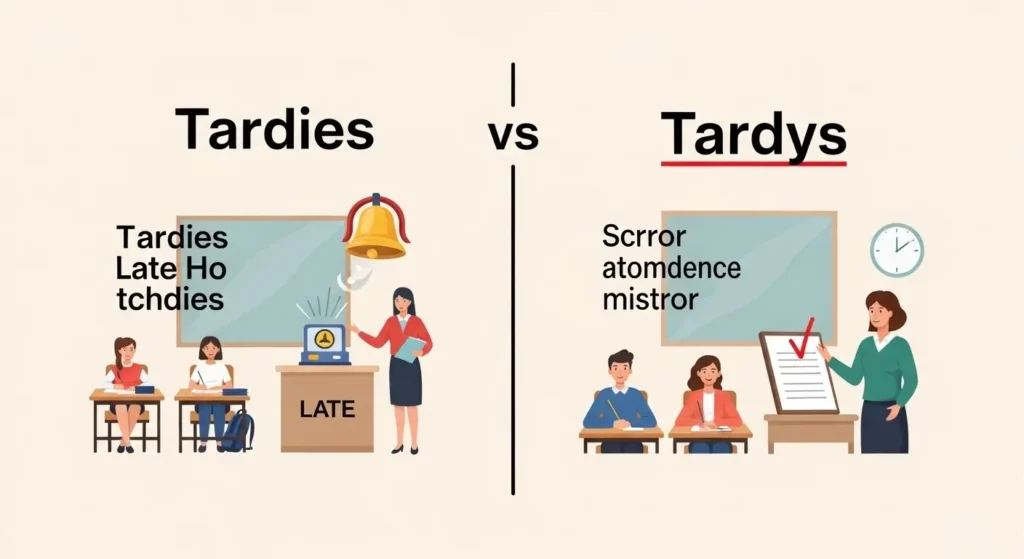
The correct spelling is “tardies.”
“Tardys” is incorrect and should not be used.
Meaning of “tardies”:
It is the plural form of “tardy,” which means late.
Examples:
- The student has five tardies this month.
- Excessive tardies may affect attendance records.
- Teachers record all tardies in the system.
👉 Simple rule:
✔ Tardy → Tardies (correct)
❌ Tardy → Tardys (wrong)
Anyways or Anyway : Which One Is Correct?
The Origin of Tardies
The word “tardy” comes from the Latin word “tardus,” meaning slow or delayed. It entered English through Old French as “tardi,” which also meant late or slow.
Over time, English added standard plural rules:
- Tardy → Tardies
- Candy → Candies
- City → Cities
The confusion with “tardys” likely comes from how people pronounce the word. Since “y” often changes in plurals, some assume it becomes “ys,” but English grammar replaces “y” with “ies.”
Himself or Hisself: Which One Is Correct and Why It Matters?
British English vs American English Spelling
Good news: British and American English use the same spelling here. There is no difference.
Both regions use:
- Tardy (singular)
- Tardies (plural)
Comparison Table
| Form Type | Correct Spelling | Example Sentence |
| Singular | Tardy | He was tardy to class. |
| Plural | Tardies | She has three tardies. |
| Incorrect | Tardys | ❌ Not used in English |
Which Spelling Should You Use?
Use “tardies” in all cases.
- USA (schools & offices): Always “tardies”
- UK & Commonwealth: Same usage
- Global English: “tardies” is standard
There is no situation where “tardys” is correct in formal writing.
Common Mistakes with Tardies
People often make these errors:
❌ Writing “tardys”
✔ Correct: “tardies”
❌ Using “tardy’s” for plural
✔ Correct: “tardies” (no apostrophe)
❌ Mixing singular and plural
✔ Correct: one tardy, many tardies
Tip: If you see an apostrophe, it usually means possession, not plural.
Tardies in Everyday Examples
School context:
- The student received three tardies this week.
Office email:
- Repeated tardies may affect your attendance record.
News report:
- The district reported a rise in student tardies this semester.
Social media:
- “I can’t afford any more tardies this month 😅”
Formal writing:
- Excessive tardies are subject to disciplinary action.
Tardies – Google Trends & Usage Data
Search interest for “tardies” is mainly high in:
- United States (schools and attendance systems)
- Canada (education context)
- Australia & UK (lower but still used in schools)
The incorrect form “tardys” appears mostly in:
- Misspelled search queries
- Social media posts
- Non-native English writing
Overall, “tardies” dominates all correct English usage globally.
Comparison Table: Tardies vs Tardys
| Feature | Tardies | Tardys |
| Correctness | ✔ Correct | ❌ Incorrect |
| Grammar Rule | Tardy + ies | No rule |
| Usage | Schools, offices | Not used |
| English Standard | Yes | No |
| Meaning | Multiple late arrivals | Invalid word |
FAQs
1. Is “tardys” a real word?
No, “tardys” is not correct English.
2. What does “tardies” mean?
It means multiple instances of being late.
3. Is it “tardy” or “tardie” in the singular?
The correct singular form is “tardy.”
4. Why do people write “tardys”?
It comes from misunderstanding how “y” changes to “ies.”
5. Is “tardies” used in British English?
Yes, it is used in both British and American English.
6. Can “tardies” be used in formal writing?
Yes, especially in schools, reports, and attendance records.
7. What is the opposite of “tardy”?
The opposite is “on time” or “punctual.”
Conclusion
The correct spelling is simple: “tardies” is right, and “tardys” is wrong. This confusion happens because English often changes “y” to “ies” in plural forms, and many learners assume the wrong pattern. However, in schools, workplaces, and formal writing, only “tardies” is accepted.
Understanding this small detail helps improve your grammar and avoids mistakes in attendance records, emails, and reports. Whether you are a student tracking school attendance or a teacher marking behavior logs, using the correct spelling ensures clear communication. English spelling rules may seem confusing at first, but once you learn patterns like this, they become easy to remember.
So next time you write it, just remember: tardy → tardies (always).