
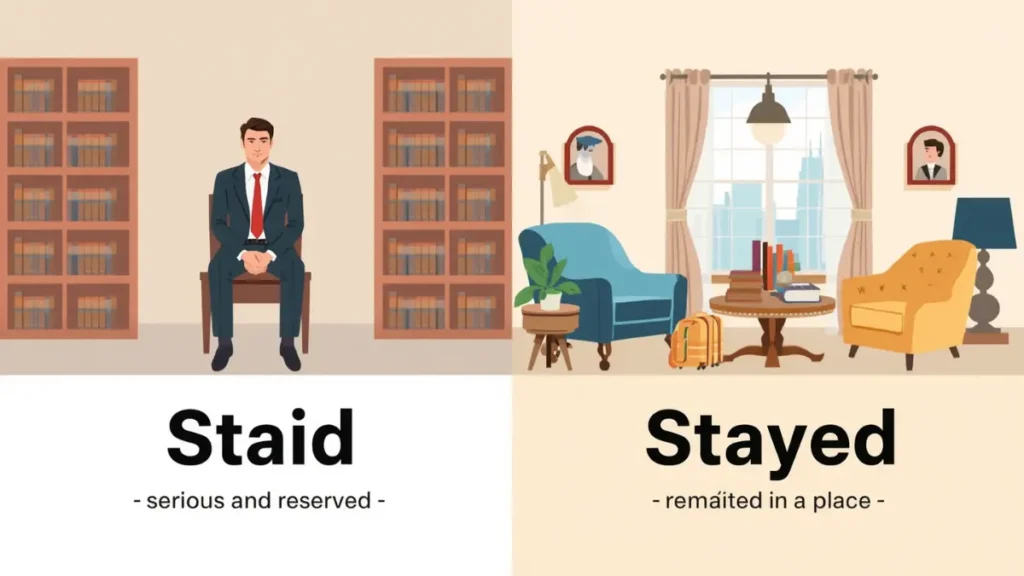
Many English learners and even native speakers often get confused between the words “staid” and “stayed.” At first glance, they look similar, but they are completely different in meaning, usage, and grammar.
This confusion is very common in writing, exams, emails, and online searches. People often type “staid meaning” when they actually mean “stayed,” or they see “staid” in old texts and think it is a spelling mistake.
This confusion matters because using the wrong word can change the meaning of your sentence or make your writing look incorrect or unprofessional. For example, “He staid at home” is wrong in modern English, while “He stayed at home” is correct. On the other hand, “staid” is a real English word, but it is rare and has a very different meaning.
In this article, you will clearly understand the difference between staid and stayed, their origin, usage, spelling rules, common mistakes, and real-life examples. By the end, you will never confuse these two words again.
Staid or Stayed – Quick Answer
“Stayed” is the correct past tense of stay, meaning to remain in a place.
“Staid” is an old adjective meaning serious, calm, or dull.
Examples:
- She stayed at her friend’s house last night. ✔️
- He has a staid personality and never jokes in meetings. ✔️
Aluminum or Aluminium – Which Spelling Is Correct?
The Origin of Staid and Stayed
The word “stay” comes from Old French estayer, meaning to support or stop. Over time, it became “stay” in English, and its past form became “stayed.”
The word “staid” comes from Middle English and is the past form of the old verb “staien.” Today, it is no longer used as a verb. Instead, it survives only as an adjective meaning serious, calm, or old-fashioned.
So:
- Stayed = modern verb form
- Staid = rare adjective form
British English vs American English Spelling
There is no spelling difference between British and American English for these words. The confusion is not regional but grammatical.
| Word | Type | Meaning (Simple) | Usage Today |
| Stayed | Verb | Remained in a place | Very common |
| Staid | Adjective | Serious or dull personality | Rare |
Both UK and US English use “stayed” for the verb.
Which Spelling Should You Use?
- USA English: Always use stayed (verb).
- UK English: Always use stayed (verb).
- Global writing (blogs, SEO, emails): Use stayed.
👉 Only use staid if you are describing a serious or formal personality in literature or academic writing.
Supercede or Supersede – Which Spelling Is Correct?
Common Mistakes with Staid or Stayed
- ❌ He staid at home yesterday.
✔️ He stayed at home yesterday. - ❌ I will staid there tonight.
✔️ I will stay there tonight. - ❌ She is very stayed.
✔️ She is very staid (rare, but correct if meaning serious). - ❌ Mixing both words as same meaning.
Staid or Stayed in Everyday Examples
- Emails:
“I stayed in the office late yesterday.” - News writing:
“The leader gave a staid and formal speech.” - Social media:
“Stayed home all weekend watching movies.” - Formal writing:
“The committee maintained a staid and professional tone.”
Staid or Stayed – Google Trends & Usage Data
Search behavior shows that “stayed” is widely searched because it is a common verb in daily communication. People often look for its correct grammar, spelling, and past tense usage.
On the other hand, “staid” has low search volume and is mostly searched by students, writers, or language learners trying to understand rare vocabulary.
Overall:
- “Stayed” = high usage, everyday English
- “Staid” = low usage, formal/rare word
Comparison Table: Staid vs Stayed
| Feature | Stayed | Staid |
| Word Type | Verb | Adjective |
| Meaning | Remain in a place | Serious or dull |
| Usage Level | Very common | Rare |
| Example | I stayed home | He has a staid nature |
| Modern Use | Everyday English | Literary/Formal only |
FAQs about Staid or Stayed
1. What is the correct word: staid or stayed?
“Stayed” is correct for actions. “Staid” is a rare adjective.
2. Is “staid” still used in English?
Yes, but only in formal or literary writing.
3. Can “staid” mean stayed?
No, they have completely different meanings.
4. What is the past tense of stay?
The past tense is “stayed.”
5. Why do people confuse staid and stayed?
Because they look similar in spelling.
6. Is “staid” old-fashioned?
Yes, it is mostly used in older or formal texts.
7. Can I use “staid” in daily conversation?
No, it is rarely used in spoken English.
Conclusion
The confusion between staid and stayed comes from their similar spelling, but their meanings are very different. “Stayed” is a common verb used in daily English to show that someone remained in a place. It is simple, modern, and widely used in speaking and writing. On the other hand, “staid” is an old and formal adjective that describes someone or something as serious, calm, or slightly dull.
Understanding this difference helps you avoid grammar mistakes in emails, exams, blogs, and professional writing. Always remember that if you are talking about staying somewhere, the correct word is “stayed.” If you are describing a personality or formal tone, you may use “staid,” but very rarely.
By practicing examples and remembering the comparison, you can easily master both words and improve your English accuracy. This small distinction can make your writing clearer, more professional, and easier to understand for readers worldwide.

Hi, I’m Henry James, the author behind GrammarTribe.com. I’m passionate about the English language and specialize in grammar, helping readers understand complex rules in a simple, clear way. Over the years, I’ve dedicated myself to creating content that makes learning grammar practical, fun, and accessible for everyone. If you’re a student, professional, or language enthusiast.
Through GrammarTribe.com, I share tips, guides, and examples to help people write confidently and correctly. My goal is to make grammar less intimidating and more useful in everyday writing, emails, social media, and professional communication. Writing and teaching grammar isn’t just my profession — it’s my passion.
When I’m not writing, I enjoy reading, exploring language trends, and discovering new ways to make English learning engaging and easy. My mission is to empower readers to communicate clearly and confidently, one grammar tip at a time.