Have you ever come across the words holistic and wholistic and wondered if they mean the same thing? Perhaps you saw one spelling on a wellness website and another in a healthcare article. This often leaves readers asking: Should I use holistic or wholistic?
The confusion is understandable because both words are closely related and are often used interchangeably. They describe an approach that looks at the whole person or the whole system rather than focusing on individual parts. However, one spelling is far more common and widely accepted than the other.
Understanding the difference between holistic or wholistic is important for students, writers, healthcare professionals, business leaders, and anyone creating content. Choosing the right spelling can make your writing appear more professional and align with your audience’s expectations.
In this guide, you’ll learn the meaning, origin, usage differences, common mistakes, and practical examples of both spellings. By the end, you’ll know exactly which version to use and when.
Holistic or Wholistic – Quick Answer
The short answer is:
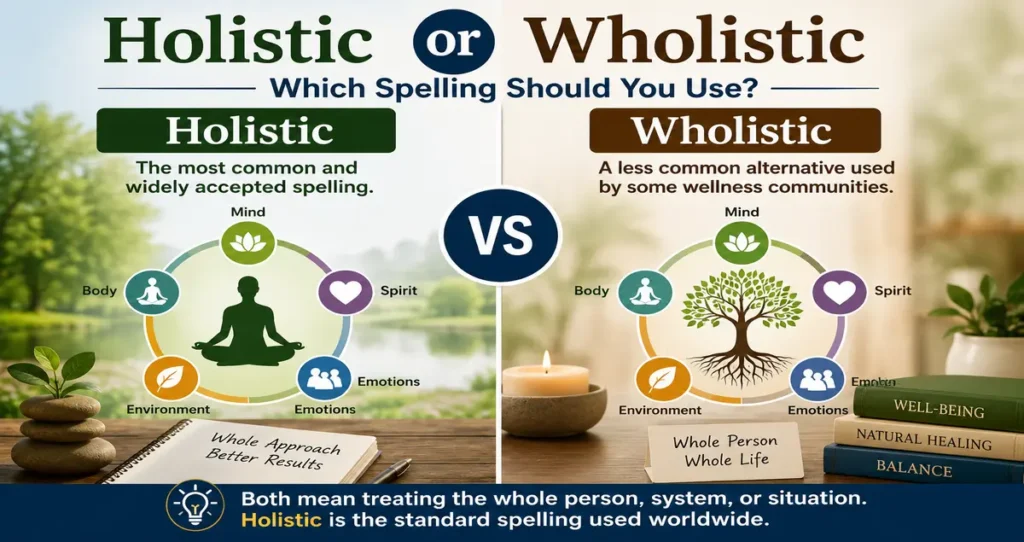
✅ Holistic is the standard and most widely accepted spelling.
✅ Wholistic is also used but is much less common.
Both words generally mean:
Considering the whole person, system, or situation rather than focusing on separate parts.
Examples
Most Common Usage
- The doctor takes a holistic approach to health.
- Holistic wellness focuses on mind, body, and spirit.
Less Common Usage
- The therapist offers a wholistic healing program.
- The center promotes wholistic well-being.
In most professional and academic writing, holistic is preferred.
Read more: Inclosed or Enclosed: Which Spelling Is Correct
The Origin of Holistic or Wholistic
The word holistic comes from the Greek word holos, meaning “whole” or “entire.”
The term was popularized in 1926 by South African statesman and philosopher Jan Smuts in his book Holism and Evolution.
The concept focused on the idea that systems should be understood as complete units rather than as isolated parts.
Where Did “Wholistic” Come From?
The spelling wholistic appeared later.
Some writers felt that adding “whole” to the beginning made the meaning more obvious. Since holistic already refers to the whole person or system, some practitioners adopted wholistic to emphasize completeness.
However, dictionaries and style guides generally recognize holistic as the standard form.
Read more:
Posted inGrammar Knowledge
Outting or Outing: Which Spelling Is Correct?
British English vs American English Spelling
Unlike many English words, there is no major British versus American spelling difference here.
Both countries primarily use holistic.
British English
Preferred spelling:
- Holistic
Example:
- A holistic approach to education benefits students.
American English
Preferred spelling:
- Holistic
Example:
- Holistic healthcare considers mental and physical health.
Comparison Table
| Feature | British English | American English |
| Common Spelling | Holistic | Holistic |
| Alternative Spelling | Wholistic (rare) | Wholistic (rare) |
| Professional Preference | Holistic | Holistic |
| Academic Usage | Holistic | Holistic |
There is no significant regional preference for wholistic.
Which Spelling Should You Use?
Use “Holistic” If:
- You are writing professionally.
- You are creating academic content.
- You work in healthcare.
- You publish online articles.
- You want the most recognized spelling.
Use “Wholistic” If:
- Your organization specifically prefers it.
- You want to emphasize the concept of “wholeness.”
- You are following branding guidelines that use the term.
For Global Audiences
Choose holistic.
It is the spelling most readers expect and recognize worldwide.
Common Mistakes with Holistic or Wholistic
Many writers make these mistakes.
Mistake 1: Thinking One Is Incorrect
❌ Wholistic is wrong.
✅ Wholistic is accepted but much less common.
Mistake 2: Mixing Spellings
❌ Our holistic program promotes wholistic wellness.
✅ Choose one spelling style and remain consistent.
Mistake 3: Assuming Regional Differences
❌ Holistic is British and wholistic is American.
✅ Both countries primarily use holistic.
Common Corrections Table
| Incorrect Assumption | Correct Information |
| Wholistic is wrong | It is accepted but uncommon |
| Holistic and wholistic have different meanings | Meanings are generally the same |
| Wholistic is American English | No major regional difference |
| Both should be mixed together | Use one style consistently |
Holistic or Wholistic in Everyday Examples
Emails
- We provide holistic wellness services for employees.
News Articles
- Experts recommend a holistic approach to healthcare.
Social Media
- Taking a holistic view of health changed my lifestyle.
Formal Writing
- The study examined holistic learning methods.
Healthcare
- The clinic uses holistic treatment plans.
Business
- A holistic strategy improves long-term growth.
Alternative Wellness
- The center promotes holistic healing practices.
In most cases, holistic is the preferred choice.
Holistic or Wholistic – Google Trends & Usage Data
Search data consistently shows that holistic is significantly more popular than wholistic.
Holistic
Commonly used in:
- Healthcare
- Education
- Psychology
- Business strategy
- Wellness industries
Wholistic
Usually appears in:
- Alternative healing communities
- Spiritual wellness branding
- Specialized organizations
Usage Comparison
| Term | Popularity |
| Holistic | Very High |
| Wholistic | Much Lower |
Online searches overwhelmingly favor holistic.
Holistic vs Wholistic Comparison Table
| Feature | Holistic | Wholistic |
| Meaning | Whole-system approach | Whole-system approach |
| Standard Spelling | Yes | No |
| Dictionary Preference | Yes | Sometimes |
| Academic Usage | Common | Rare |
| Professional Usage | Common | Limited |
| Search Popularity | Very High | Low |
| Recommended Choice | Yes | Occasionally |
FAQs
1. Is holistic or wholistic correct?
Both are correct, but holistic is the standard and more widely accepted spelling.
2. What is the difference between holistic and wholistic?
There is little difference in meaning. The main difference is spelling and frequency of use.
3. Which spelling is more professional?
Holistic is generally considered more professional and widely recognized.
4. Is wholistic a real word?
Yes. Wholistic is a recognized word, although it is less common than holistic.
5. Which spelling should I use in business writing?
Use holistic unless your company specifically prefers wholistic.
6. Do holistic and wholistic mean the same thing?
Yes. Both describe an approach that considers the whole rather than separate parts.
7. Why do some wellness brands use wholistic?
They often use it to emphasize the concept of wholeness and complete well-being.
Conclusion
When comparing holistic or wholistic, both spellings are technically correct, but holistic is the clear winner in terms of popularity, professional acceptance, and dictionary preference. It is the spelling most commonly used in healthcare, education, psychology, business, and wellness industries.
While wholistic is sometimes chosen to emphasize the idea of treating the whole person or system, it remains much less common. Most readers, editors, and professionals expect to see holistic and may view it as the more standard choice.
For academic papers, business documents, blog posts, and professional communication, holistic is usually the safest option. If your organization or brand specifically uses wholistic, consistency is the most important rule.
By understanding the difference between these spellings, you can write with greater confidence and ensure your message is clear, accurate, and professional.

Hi, I’m Henry William, the author of GrammarTribe.com. I’m passionate about the English language and have dedicated my career to helping people master grammar, spelling, and effective writing. Over the years, I’ve guided learners, writers, and professionals in understanding common mistakes, tricky rules, and nuances of English grammar in a simple and easy-to-follow way.
Through GrammarTribe.com, I aim to make grammar approachable and enjoyable for everyone. My work focuses on providing clear explanations, practical tips, and examples that readers can apply in everyday writing, whether it’s emails, essays, social media, or professional documents. I believe that strong grammar skills empower people to communicate confidently and professionally.
When I’m not writing or researching grammar, I enjoy reading, exploring language trends, and creating educational content that simplifies complex concepts. I’m committed to helping my audience write better, understand English deeply, and avoid common pitfalls, all while making learning grammar a fun and rewarding journey.