
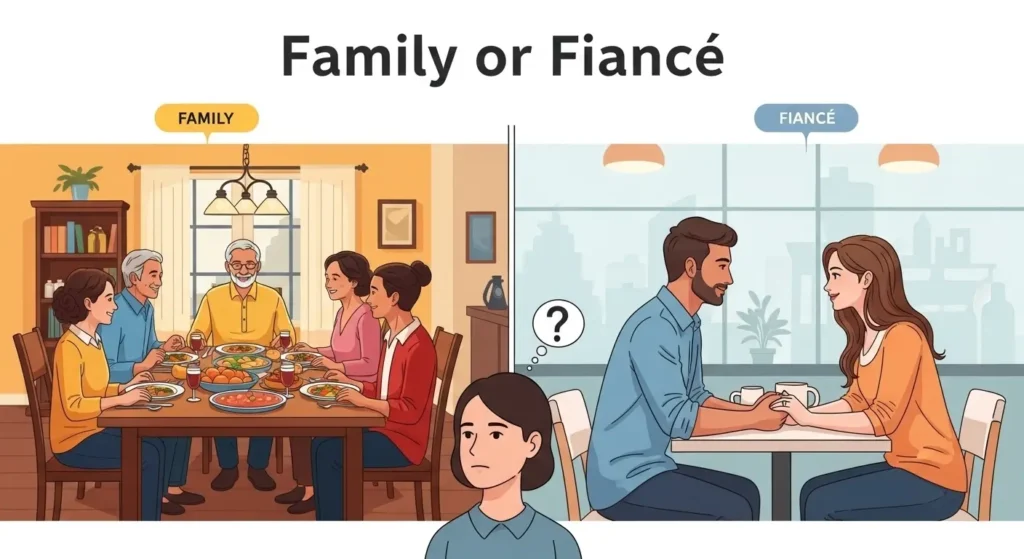
Have you ever paused while writing and wondered: Should I say family or fiancé? You’re not alone. Many people search for this keyword because these two words look simple but mean very different things. One relates to your loved ones, and the other to a future spouse.
The confusion often comes from pronunciation, spelling, and context. In fast typing or casual speech, people may mix them up. This can lead to awkward or even funny mistakes like calling your entire family your fiancé!
This article clears up the confusion. You’ll learn the meaning, origin, spelling differences, and correct usage of family or fiancé. We’ll also show real examples, common mistakes, and tips on which word to use in different situations.
Family or Fiancé – Quick Answer
Family refers to your relatives parents, siblings, children, and extended members.
Fiancé refers to a man who is engaged to be married (female: fiancée).
Examples:
- I am visiting my family this weekend.
- She introduced her fiancé at the party.
👉 Simple rule:
- Many people → Family
- One person you will marry → Fiancé
Break or Brake: What’s the Difference?
The Origin of Family or Fiancé
| Word | Origin | Meaning |
| Family | Latin familia | Household or relatives |
| Fiancé | French financier | To promise in marriage |
Family has ancient roots and has been used for centuries in English.
Fiancé comes from France. That’s why it has an accent (é). It also has gender forms:
- Fiancé → male
- Fiancée → female
British English vs American English Spelling
There is no major spelling difference between British and American English for these words. However, usage style may vary.
| Word | British English | American English |
| Family | Family | Family |
| Fiancé | Fiancé (accent often kept) | Fiancé (accent sometimes dropped informally) |
| Fiancée | Fiancée | Fiancée |
Example:
- UK: She met her fiancé last year.
- US: She met her fiance last year (accent may be dropped in casual writing).
Which Spelling Should You Use?
- United States:
You can use fiancé or fiance in casual writing. Formal writing prefers the accent. - UK & Commonwealth:
Use fiancé/fiancée with the accent. - Global audience:
Use fiancé/fiancée for clarity and correctness.
👉 Best advice: Always use the correct accented form in professional writing.
Common Mistakes with Family or Fiancé
❌ I met my family yesterday at dinner (when referring to partner).
✔️ I met my fiancé yesterday at dinner.
❌ My fiancé are coming over.
✔ ️ My family is coming over.
❌ She is my fiancee (male partner).
✔️ She is my fiancée (female).
👉 Tip:
- Plural or group → Family
- Romantic partner → Fiancé/Fiancée
Family or Fiancé in Everyday Examples
Emails:
- I will be on leave visiting my family.
- I am getting married to my fiancé next month.
Social Media:
- Dinner with the family ❤️
- Engaged to my fiancé 💍
News:
- The actor celebrated with his family.
- She appeared with her fiancé at the event.
Formal Writing:
- The candidate was supported by his family.
- She attended the ceremony with her fiancé.
Family or Fiancé – Google Trends & Usage Data
- Family is used worldwide and is extremely common.
- Fiancé is less common but spikes during wedding seasons.
By Country:
- USA, UK, Canada → high usage of both
- India, Pakistan → “family” is far more common
- Western countries → higher search for “fiancé” due to dating culture
Context:
- Daily life → Family
- Relationships & weddings → Fiancé
Comparison Table: Keyword Variations
| Term | Meaning | Usage | Example |
| Family | Group of relatives | Very common | My family lives here |
| Fiancé | Male engaged partner | Specific | My fiancé proposed |
| Fiancée | Female engaged partner | Specific | My fiancée said yes |
| Fiance (no accent) | Informal spelling | Casual | My fiance is kind |
FAQs
1. Is the fiancé part of the family?
Not yet. A fiancé becomes family after marriage.
2. What is the female form of fiancé?
Fiancée.
3. Can I write fiancé without the accent?
Yes, but only in informal writing.
4. Why do people confuse family and fiancé?
Because of similar sound and fast typing mistakes.
5. Is fiancé used in formal writing?
Yes, especially with the correct accent.
6. What does family include?
Parents, children, siblings, and relatives.
7. Is the fiancé always one person?
Yes, it refers to one engaged partner.
Conclusion
The difference between family or fiancé is simple but important. Family means your relatives, while fiancé refers to a person you plan to marry. Mixing them up can change the meaning of your sentence completely.
Understanding their origin also helps. “Family” comes from Latin and is widely used, while “fiancé” comes from French and has a more specific meaning. The spelling stays mostly the same in British and American English, though accents may be dropped in casual US writing.
To avoid mistakes, remember this: use family for groups and fiancé/fiancée for a romantic partner. In formal writing, always use the correct spelling with accents.
By following these simple rules, you can write clearly and confidently in any situation whether it’s an email, social post, or professional document.

Hi, I’m Henry William, the author of GrammarTribe.com. I’m passionate about the English language and have dedicated my career to helping people master grammar, spelling, and effective writing. Over the years, I’ve guided learners, writers, and professionals in understanding common mistakes, tricky rules, and nuances of English grammar in a simple and easy-to-follow way.
Through GrammarTribe.com, I aim to make grammar approachable and enjoyable for everyone. My work focuses on providing clear explanations, practical tips, and examples that readers can apply in everyday writing, whether it’s emails, essays, social media, or professional documents. I believe that strong grammar skills empower people to communicate confidently and professionally.
When I’m not writing or researching grammar, I enjoy reading, exploring language trends, and creating educational content that simplifies complex concepts. I’m committed to helping my audience write better, understand English deeply, and avoid common pitfalls, all while making learning grammar a fun and rewarding journey.