
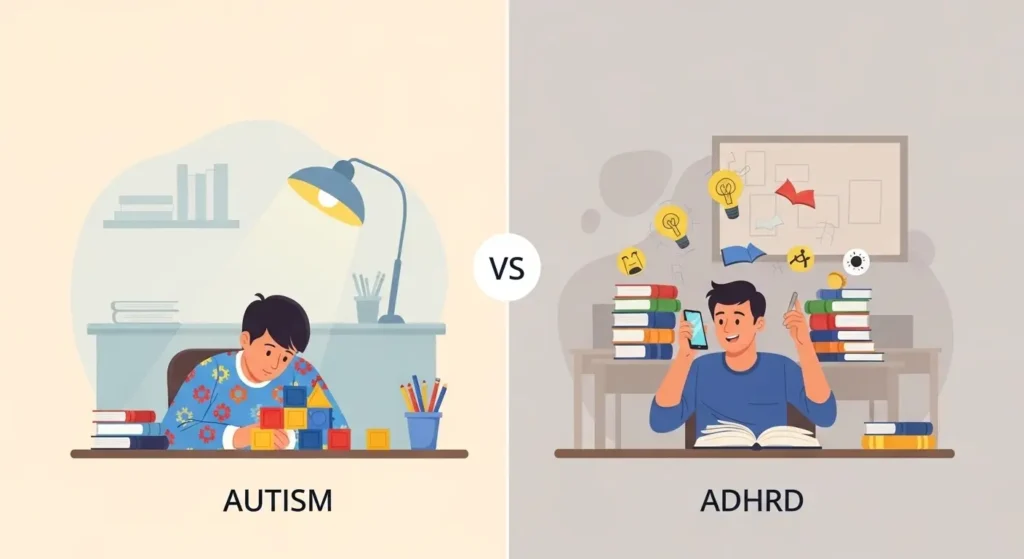
Many parents, teachers, and adults search for autism or ADHD when they notice behavior that feels different. A child may not sit still, avoid eye contact, or struggle to focus. This leads to a common question: is it autism or ADHD? The confusion is real because both conditions can affect attention, behavior, and social skills. People often search autism or ADHD to find quick answers, clear signs, and the right support.
Understanding autism or ADHD helps families make better decisions. It can guide school support, therapy, and daily care. Without clear knowledge, people may misunderstand behaviors or delay help. This article explains autism or ADHD in simple terms, shows the key differences, and helps you decide what to do next.
Autism or ADHD – Quick Answer
Autism (ASD) and ADHD (Attention-Deficit/Hyperactivity Disorder) are different conditions, but they can look similar.
- Autism: Affects social skills, communication, and behavior patterns.
- Example: Avoids eye contact, prefers routines
- ADHD: Affects attention, focus, and impulse control
- Example: Cannot sit still, gets distracted easily
👉 Simple idea:
- Autism = social + communication differences
- ADHD = attention + hyperactivity problems
The Origin of Autism or ADHD
- Autism
- First described in the 1940s
- The word comes from Greek “autos” meaning “self”
- It refers to being focused inward
- ADHD
- Studied since early 1900s
- The term ADHD became official in the late 20th century
- It focuses on attention and behavior control
👉 There are no spelling differences for these terms. The confusion comes from overlapping symptoms, not language.
British English vs American English Spelling
There is no spelling difference between autism or ADHD in British and American English.
| Term | US Spelling | UK Spelling |
| Autism | Autism | Autism |
| ADHD | ADHD | ADHD |
👉 Both regions use the same medical terms.
Which Term Should You Use?
Use autism or ADHD based on the condition, not location.
- Use autism if the main issue is social interaction and communication
- Use ADHD if the main issue is focus, hyperactivity, or impulsiveness
- In global writing, use both clearly: “autism or ADHD” when unsure
Common Mistakes with Autism or ADHD
❌ Mistake 1: Thinking they are the same
✔️ Correction: They are different conditions
❌ Mistake 2: Assuming all hyper kids have ADHD
✔️ Correction: Behavior must meet medical criteria
❌ Mistake 3: Believing autism means low intelligence
✔️ Correction: Many autistic people have average or high intelligence
❌ Mistake 4: Ignoring overlap
✔️ Correction: A person can have both autism and ADHD
Autism or ADHD in Everyday Examples
- Email:
“The child shows signs of ADHD, such as lack of focus.” - News:
“Awareness about autism and ADHD is increasing worldwide.” - Social Media:
“Do I have autism or ADHD? I relate to both!” - Formal Writing:
“Autism and ADHD are neurodevelopmental conditions affecting behavior and cognition.”
Autism or ADHD – Google Trends & Usage Data
- ADHD searches are higher in countries like the USA and Canada
- Autism searches are growing worldwide due to awareness campaigns
- “Autism or ADHD” is often searched by parents and young adults
👉 This shows people are trying to understand differences, not just definitions.
Comparison Table: Autism vs ADHD
| Feature | Autism | ADHD |
| Main Issue | Social & communication | Attention & hyperactivity |
| Behavior | Repetitive actions | Impulsive actions |
| Focus | Deep focus on interests | Easily distracted |
| Social Skills | Difficulty understanding others | Talks a lot, interrupts |
| Routine | Loves routine | Dislikes structure |
| Similarity | Both affect behavior and learning |
FAQs
1. Can someone have autism and ADHD together?
Yes, many people have both conditions.
2. Which is more common, autism or ADHD?
ADHD is more common than autism.
3. Is autism more serious than ADHD?
Not always. It depends on the individual.
4. Can adults have autism or ADHD?
Yes, both can continue into adulthood.
5. How can I tell if it’s autism or ADHD?
A professional diagnosis is the best way.
6. Do both affect school performance?
Yes, both can affect learning and behavior.
7. Can they be treated?
They cannot be “cured,” but support and therapy help a lot.
Conclusion
Understanding autism or ADHD is important for making the right decisions in life. While both conditions may seem similar, they affect people in different ways. Autism focuses more on social interaction and communication, while ADHD is about attention and hyperactivity. Knowing the difference helps parents, teachers, and individuals respond better and provide the right support.
Early awareness can improve learning, relationships, and confidence. It also reduces misunderstanding and stigma in society. If you are unsure whether it is autism or ADHD, the best step is to consult a professional.
With the right guidance, both conditions can be managed successfully, allowing individuals to live happy and productive lives.

Hi, I’m Henry William, the author of GrammarTribe.com. I’m passionate about the English language and have dedicated my career to helping people master grammar, spelling, and effective writing. Over the years, I’ve guided learners, writers, and professionals in understanding common mistakes, tricky rules, and nuances of English grammar in a simple and easy-to-follow way.
Through GrammarTribe.com, I aim to make grammar approachable and enjoyable for everyone. My work focuses on providing clear explanations, practical tips, and examples that readers can apply in everyday writing, whether it’s emails, essays, social media, or professional documents. I believe that strong grammar skills empower people to communicate confidently and professionally.
When I’m not writing or researching grammar, I enjoy reading, exploring language trends, and creating educational content that simplifies complex concepts. I’m committed to helping my audience write better, understand English deeply, and avoid common pitfalls, all while making learning grammar a fun and rewarding journey.