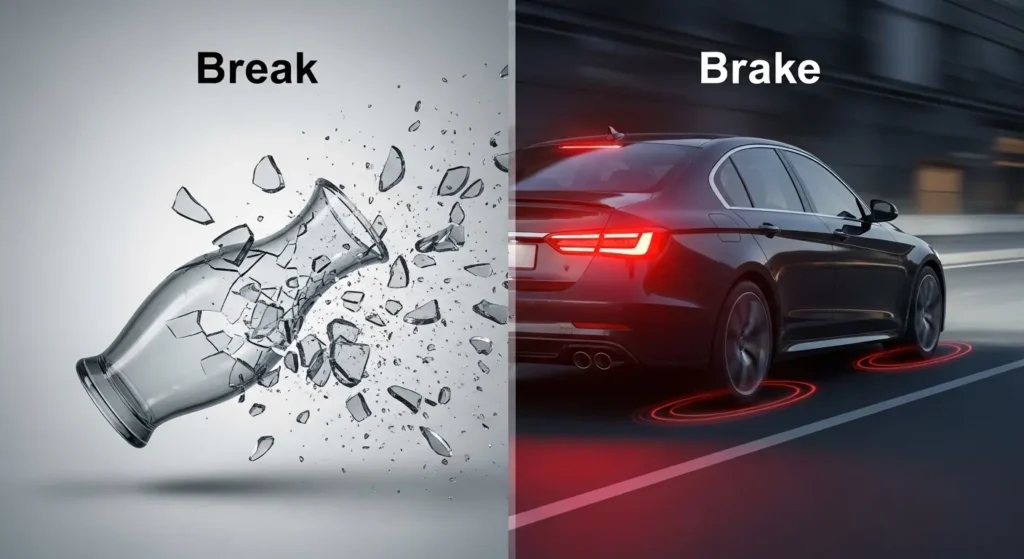
Have you ever paused while typing and wondered: Is it “break” or “brake”? You’re not alone. These two words sound exactly the same, but they have completely different meanings. That’s why people often search for “break or break” to avoid embarrassing mistakes in writing, emails, or even exams.
The confusion usually happens because English has many homophones (words that sound alike but differ in meaning and spelling). “Break” and “brake” are perfect examples. One relates to stopping or slowing down a vehicle, while the other has broader meanings like separating or damaging something.
This article clears up the confusion in a simple way. You’ll learn the quick difference, the history behind the words, how they are used in different English styles, and how to avoid common mistakes. By the end, you’ll feel confident using “break” and “brake” correctly in any situation.
Break or Brake – Quick Answer
Break = to damage, split, or pause something
Brake = a device used to slow or stop a vehicle
Examples:
- I don’t want to break my phone.
- Press the brake to stop the car.
- Let’s take a break from work.
- The driver hit the brake suddenly.
👉 Simple tip:
- If it’s about stopping a car → brake
- If it’s about damage or pause → break
True or False: Meaning, Usage, and Common Confusion Explained
The Origin of Break or Brake
Break
The word “break” comes from Old English brecan, meaning “to shatter or divide.” It has been used for over 1,000 years and has many meanings today, like stopping, damaging, or interrupting.
Brake
The word “brake” comes from a different root. It originally meant a tool used for crushing or slowing things. Later, it became the word for the device used to stop vehicles.
Why the confusion?
Both words sound the same (homophones), but they evolved from different origins. Over time, their meanings stayed separate, but pronunciation became identical.
Truth or Lie: Understanding the Real Difference ?
British English vs American English Spelling
Good news: There is no spelling difference between British and American English for these words. Both use “break” and “brake” in the same way.
Comparison Table:
| Word | Meaning | British English | American English |
| Break | Damage, pause, separate | Break | Break |
| Brake | Stop or slow a vehicle | Brake | Brake |
👉 Unlike words like color/colour, these remain the same worldwide.
Which Spelling Should You Use?
It’s not about the country, it’s about the context.
- Use break when talking about:
- Damage → “The glass will break.”
- Rest → “Take a break.”
- Separation → “Break the stick.”
- Use brake when talking about:
- Cars or bikes → “Apply the brake.”
- Slowing down → “Brake gently.”
Audience Tip:
- US, UK, Australia, Canada → Same rule applies
- Global writing (blogs, SEO) → Focus on meaning, not region
Common Mistakes with Break or Brake
Here are frequent errors people make:
❌ I need to brake my phone
✔️ I need to break my phone
❌ Take a brake from work
✔️ Take a break from work
❌ The car will break suddenly
✔️ The car will brake suddenly
👉 Quick memory trick:
- Brake = car (both have “a”)
- Break = everything else
Break or Brake in Everyday Examples
Emails
- Let’s take a break and continue later.
- Please check the car’s brake system.
News
- The company plans to break the record this year.
- Faulty brakes caused the accident.
Social Media
- “I need a coffee break ☕”
- “Hit the brake before it’s too late!”
Formal Writing
- The contract may break under pressure.
- Drivers must use the brake safely.
Break or Brake – Google Trends & Usage Data
- “Break” is far more common because it has many meanings (rest, damage, pause).
- “Brake” is mostly used in driving or mechanical contexts.
Usage by Context:
| Word | Popular In | Usage Frequency |
| Break | Global, all writing | Very High |
| Brake | Driving, transport | Moderate |
By Country:
- USA & UK → Same usage pattern
- India & Pakistan → “Break” used more due to general meaning
- Global SEO → “Break” dominates search volume
Comparison Table (Side by Side)
| Feature | Break | Brake |
| Meaning | Damage, pause, separate | Slow or stop a vehicle |
| Usage | General | Mechanical/driving |
| Example | Take a break | Press the brake |
| Frequency | Very common | Less common |
| Context | Everyday language | Vehicles, machines |
FAQs About Break or Brake
1. Is it “take a break” or “take a brake”?
✔️ Correct: take a break
2. Is “brake” only used for cars?
Mostly yes. It’s used for anything that slows motion (cars, bikes, machines).
3. Why do break and brake sound the same?
They are homophones with different words with the same pronunciation.
4. Can “break” mean stopping something?
Yes, like “take a break,” meaning pause.
5. How do I remember the difference?
Think: brake = vehicle, break = rest or damage
6. Are these spellings different in the UK and US?
No, both use the same spelling.
7. Which word is more common?
“Break” is more common because it has many meanings.
Conclusion
Understanding the difference between “break” and “brake” is simple once you focus on context. While they sound the same, their meanings are completely different. “Break” is a versatile word used for damage, rest, or separation, making it very common in everyday language. On the other hand, “brake” is specific and mainly used when talking about stopping or slowing vehicles.
There is no difference between British and American English for these words, which makes things easier. The key is to remember their function: if it involves a vehicle, use “brake”; if it involves anything else like pausing or breaking something, use “break.”
By learning a few simple examples and tricks, you can avoid common mistakes and write with confidence. Whether you’re writing emails, social posts, or professional content, choosing the correct word helps you sound clear and accurate.

I am James Wilson, an author at GrammarTribe.com, specializing in English grammar and clear communication.
I create expert, reliable content to help learners write with confidence and accuracy.