
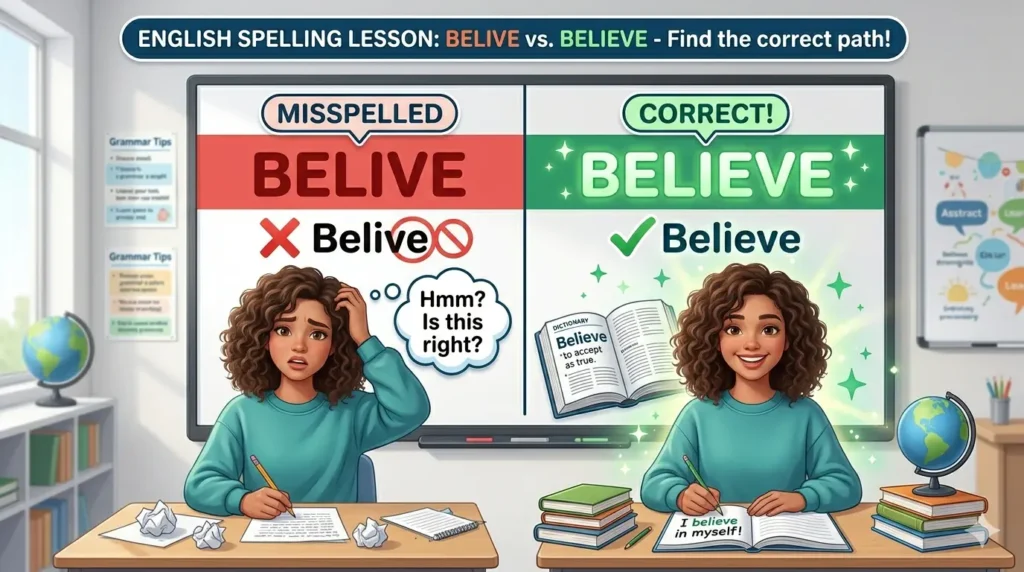
Many people search for “belive or believe” because both words look almost the same, but only one is correct in English. This small spelling difference often causes confusion in writing, typing, and exams.
When people write quickly on mobile phones or social media, they often miss the second “e” and type “belive” instead of “believe.” This leads to doubt: Is “belive” a different word? Is it acceptable in British or American English? Or is it simply wrong?
The truth is simple but important. “Believe” is the correct spelling used in all forms of English, while “belive” is a common spelling mistake. Understanding this helps improve writing accuracy, especially in professional emails, academic work, and online content. Many learners, students, and even native speakers get confused because English spelling rules are not always phonetic.
This article will clearly explain the difference, origin, usage, and correct spelling rules. It will also show real examples, common mistakes, and global usage patterns so you never get confused again.
Belive or Believe – Quick Answer
Correct spelling: Believe
Incorrect spelling: Belive
“Believe” means to accept something as true or real.
Examples:
- I believe in hard work.
- She believes in honesty.
- Do you believe this story?
Read more :Stem or Steam: What’s the Difference?
“Belive” is not a real English word. It is simply a typo or spelling mistake caused by fast typing or confusion.
The Origin of Believe
The word “believe” comes from Old English “belyfan” and earlier Germanic roots. Over time, the spelling changed as English evolved.
The word combines ideas of:
- Trust
- Faith
- Acceptance of truth
In Middle English, spellings were not fixed. Words were written in different ways depending on pronunciation. Eventually, standard English fixed the spelling as “believe”, keeping the double “e” pattern.
The mistake “belive” likely appears because:
- People pronounce it quickly
- The “e” sound is soft and often missed
- Typing errors drop one letter
Chili or Chile: Which Spelling Is Correct?
British English vs American English Spelling
Good news: there is no difference between British and American spelling for this word. Both use “believe.”
However, confusion still happens because English has many spelling differences overall (like colour/color, centre/center).
Comparison Table
| Word Type | Correct Spelling | Incorrect Spelling | Notes |
| Verb | believe | belive | Only one correct form |
| Past tense root | believed | belived | Always keep “e” |
| Present form | believes | belives | Always double “e” |
| Gerund form | believing | beliving | Maintain “ie” pattern |
👉 Key rule: “Believe” always keeps the “ie” or double “e” pattern.
Which Spelling Should You Use?
You should always use “believe” in all situations:
For US English:
- Use “believe” in schools, emails, business writing, and social media.
For UK/Commonwealth English:
- The same rule applies: “believe” is correct everywhere.
For Global English:
- International English standards (IELTS, TOEFL, academic writing) always require “believe.”
✔ Safe rule: If you are unsure, always use believe.
Common Mistakes with Believe
Here are the most frequent errors:
1. Dropping the second “e”
- ❌ I belive you
- ✔ I believe you
2. Wrong verb forms
- ❌ beliving
- ✔ believing
3. Confusing pronunciation spelling
People write what they hear, but English is not always phonetic.
4. Auto-correct overreliance
Sometimes devices “correct” believe into belive due to typing speed.
5. Informal texting habits
Fast typing on mobile often leads to missing letters.
Believe in Everyday Examples
1. Emails
- I believe this report is ready for review.
- We believe the project will succeed.
2. Social Media
- I believe in positivity every day.
- Do you believe in dreams coming true?
3. News Writing
- Experts believe the economy will improve.
- Scientists believe climate change is real.
4. Academic Writing
- Researchers believe the data supports the theory.
- Students believe practice improves performance.
5. Business Communication
- We believe this strategy will increase sales.
- The company believes in innovation.
Belive or Believe – Google Trends & Usage Data
Search behavior shows that:
- “believe” is widely used globally in English writing
- “belive” appears mostly as a misspelling search query
- High search interest comes from:
- Students checking spelling
- ESL (English as Second Language) learners
- Mobile users typing quickly
Key Insight:
- “belive” has no official meaning
- It only appears because users want to confirm correct spelling
Usage Context:
- Education → high correction searches
- Social media → typo frequency
- SEO/content writing → grammar validation
Comparison Table: Believe vs Belive
| Feature | Believe (Correct) | Belive (Incorrect) |
| Dictionary word | Yes | No |
| Meaning | To accept truth | No meaning |
| Usage | Formal & informal | Not valid |
| Grammar status | Correct verb | Spelling mistake |
| English standard | Universal | Invalid |
FAQs about Belive or Believe
1. Is “belive” a real English word?
No, “belive” is not a real word. It is a spelling mistake.
2. What is the correct spelling: belive or believe?
The correct spelling is believe.
3. Why do people write belive?
It happens due to fast typing, pronunciation confusion, or missing letters.
4. Does British English use belive?
No. Both British and American English use believe.
5. What does believe mean?
It means to accept something as true or real.
6. How do I remember the correct spelling?
Remember: “I believe there are two E’s in truth.”
7. Is belive acceptable in exams?
No. It is always marked wrong in academic writing.
Conclusion
The confusion between “belive or believe” is very common, but the answer is simple. The correct spelling is believe, used in all forms of English worldwide. “Belive” is only a typing error and has no meaning in dictionaries or formal writing.
Understanding this difference improves your writing accuracy, especially in school, exams, emails, and professional communication. English spelling can be tricky because it is not always phonetic, but small rules like this make a big difference in clarity and confidence.
Always remember: if you are unsure, choose to believe. It is universally accepted in British, American, and global English. With practice, you will stop making this mistake and write more professionally.

Hi, I’m Henry William, the author of GrammarTribe.com. I’m passionate about the English language and have dedicated my career to helping people master grammar, spelling, and effective writing. Over the years, I’ve guided learners, writers, and professionals in understanding common mistakes, tricky rules, and nuances of English grammar in a simple and easy-to-follow way.
Through GrammarTribe.com, I aim to make grammar approachable and enjoyable for everyone. My work focuses on providing clear explanations, practical tips, and examples that readers can apply in everyday writing, whether it’s emails, essays, social media, or professional documents. I believe that strong grammar skills empower people to communicate confidently and professionally.
When I’m not writing or researching grammar, I enjoy reading, exploring language trends, and creating educational content that simplifies complex concepts. I’m committed to helping my audience write better, understand English deeply, and avoid common pitfalls, all while making learning grammar a fun and rewarding journey.