
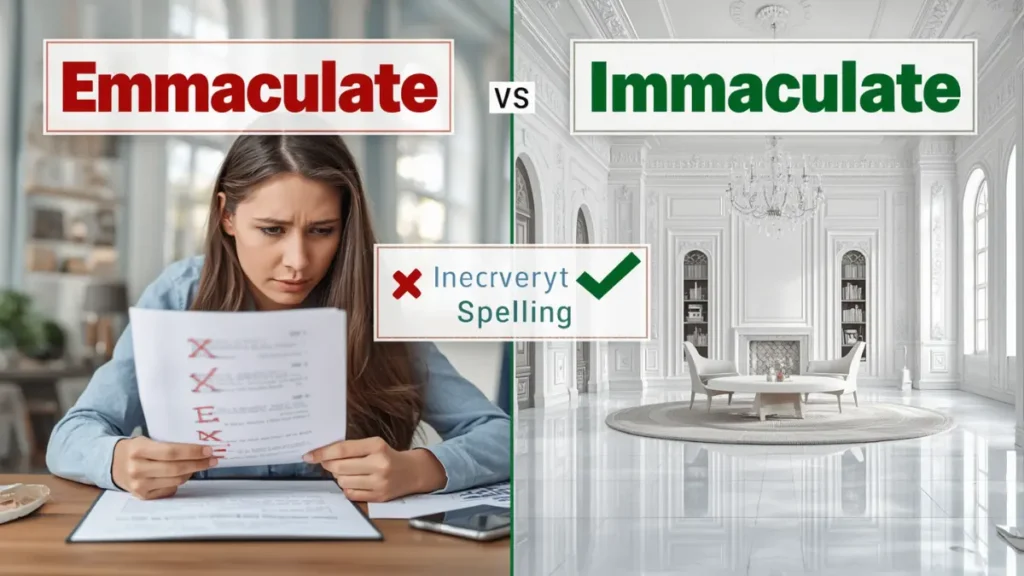
Many people search for “emmaculate or immaculate” because they are unsure about the correct spelling and meaning of the word. This confusion often happens when writing formal emails, school assignments, social media captions, or professional documents.
The word sounds smooth and elegant when spoken, but its spelling can easily be misheard or mistyped. As a result, “emmaculate” appears often online, even though it is incorrect.
The correct word is “immaculate.” It is commonly used to describe something perfectly clean, flawless, or without mistakes. For example, a spotless room, a perfect performance, or a carefully designed website can all be described as immaculate.
This confusion solves an important language problem: how one small spelling mistake can change the credibility of your writing. Knowing the correct form helps you write more professionally and avoid grammar errors that can affect your message.
In this article, you will learn the correct spelling, origin, usage, differences (if any), and real-life examples. You will also see common mistakes and simple explanations to help you remember it forever.
Emmaculate or Immaculate – Quick Answer
The correct spelling is immaculate, not “emmaculate.”
- Immaculate (correct): means perfectly clean, pure, or flawless
- Emmaculate (incorrect): not a real English word
Examples:
- Her house is immaculate and well-organized.
- The player gave an immaculate performance.
- His grammar is immaculate in every essay.
👉 Simple rule: Always use I-M-M-A-C-U-L-A-T-E
Read more: Agree or Disagree: Meaning, Usage, Grammar Rules?
The Origin of Immaculate
The word immaculate comes from the Latin word immaculatus.
- “in” = not
- “maculatus” = spotted or stained
So the original meaning is “without stains” or “completely clean.”
The word entered English through religious and literary use, often describing purity and perfection. Over time, it expanded beyond physical cleanliness to include ideas like perfect work, behavior, and appearance.
“Emmaculate” likely appeared due to pronunciation confusion, where the double “m” sound leads people to spell it incorrectly.
British English vs American English Spelling
Good news: there is no difference between British and American English for this word.
Both use:
- Immaculate (UK)
- Immaculate (US)
The confusion comes only from spelling mistakes, not regional differences.
Read more: Site or Cite: What’s the Difference?
Comparison Table
| Form Type | Spelling | Status | Meaning |
| Correct (Global) | immaculate | ✔ Correct | Perfectly clean/flawless |
| Misspelling | emmaculate | ✖ Incorrect | Not a real word |
| British English | immaculate | ✔ Correct | Same meaning |
| American English | immaculate | ✔ Correct | Same meaning |
Which Spelling Should You Use?
You should always use “immaculate” in all contexts:
- USA English: immaculate
- UK English: immaculate
- Canada, Australia, India, Pakistan: immaculate
- Formal writing everywhere: immaculate
There is no alternative spelling accepted in modern English.
👉 Tip: If you see “emmaculate,” treat it as a typo and correct it immediately.
Common Mistakes with Immaculate
People often make these errors:
1. Wrong spelling
- ❌ emmaculate house
- ✔ immaculate house
2. Wrong pronunciation spelling confusion
People write it as they hear it.
3. Double “e” mistake
- ❌ emmaculate
- ✔ immaculate
4. Overuse in informal writing
Using it for everything, even when “clean” is enough.
Immaculate in Everyday Examples
1. Emails (Formal Writing)
- “Your report is immaculate. Excellent work.”
2. News Writing
- “The stadium was kept in an immaculate condition.”
3. Social Media
- “Feeling immaculate after a fresh haircut ✨”
4. Academic Writing
- “The experiment results were immaculate and error-free.”
5. Business Communication
- “We maintain an immaculate standard of customer service.”
Immaculate – Google Trends & Usage Data
The keyword “immaculate” is widely used in:
- United States: High usage in formal writing and sports commentary
- United Kingdom: Common in academic and literary English
- India & Pakistan: Frequently used in education and English exams
- Australia & Canada: Used in both formal and informal contexts
The misspelling “emmaculate” appears mostly in:
- Social media posts
- Search engine typos
- Speech-to-text errors
👉 Insight: The correct spelling dominates official content, while the incorrect version appears mostly due to typing mistakes.
Keyword Comparison Table
| Variation | Type | Correct? | Usage Level |
| immaculate | Correct word | ✔ Yes | Very High |
| emmaculate | Misspelling | ✖ No | Low |
| imaculate | Misspelling | ✖ No | Low |
| immacualte | Misspelling | ✖ No | Low |
FAQs About Immaculate
1. What is the correct spelling, emmaculate or immaculate?
The correct spelling is immaculate.
2. Is emmaculate a real word?
No, emmaculate is not a real English word.
3. What does immaculate mean?
It means perfectly clean, flawless, or pure.
4. Why do people write emmaculate?
Because of pronunciation confusion and typing errors.
5. Is immaculate used in British and American English?
Yes, both use the same spelling: immaculate.
6. Can immaculate describe people?
Yes, it can describe appearance, behavior, or performance.
7. How can I remember the spelling?
Think: “im + maculate = not stained”
Conclusion
The confusion between “emmaculate or immaculate” is very common, but the answer is simple. The correct and only accepted spelling in English is immaculate. The word describes something that is perfectly clean, flawless, or without errors. The incorrect version “emmaculate” does not exist in standard English and usually appears due to pronunciation mistakes or typing errors.
Understanding this difference is important for students, professionals, and writers because spelling mistakes can reduce the quality and credibility of your writing. Whether you are writing an email, essay, social media post, or business document, using the correct word helps you communicate more clearly and professionally.
The origin of “immaculate” shows its deep meaning of purity and being stain-free, which makes it a powerful word in both formal and informal contexts. The best way to avoid mistakes is to remember its structure: im + maculate.
In short, always choose immaculate, avoid the incorrect “emmaculate,” and your writing will remain polished, correct, and professional in any situation.

I am James Wilson, an author at GrammarTribe.com, specializing in English grammar and clear communication.
I create expert, reliable content to help learners write with confidence and accuracy.