Many English learners often pause while writing a simple sentence like “He his best” and wonder: should it be tries or trys? This small confusion creates big doubt, especially for students, bloggers, and non-native English writers. The keyword tries or trys is commonly searched because people want a quick and correct answer before making grammar mistakes in exams, emails, or professional writing.
The confusion happens because English spelling rules change when verbs end in -y. Some words take “-ies,” while others simply add “-s.” This is where the debate of tries or trys begins.
Understanding tries or trys is important because incorrect spelling can affect writing quality and credibility. Whether you are writing academically, posting on social media, or preparing professional documents, using the correct form matters. In this article, we will clearly explain tries or trys, why the confusion exists, and how to always choose the correct spelling with confidence.
“Tries or Trys” – Quick Answer
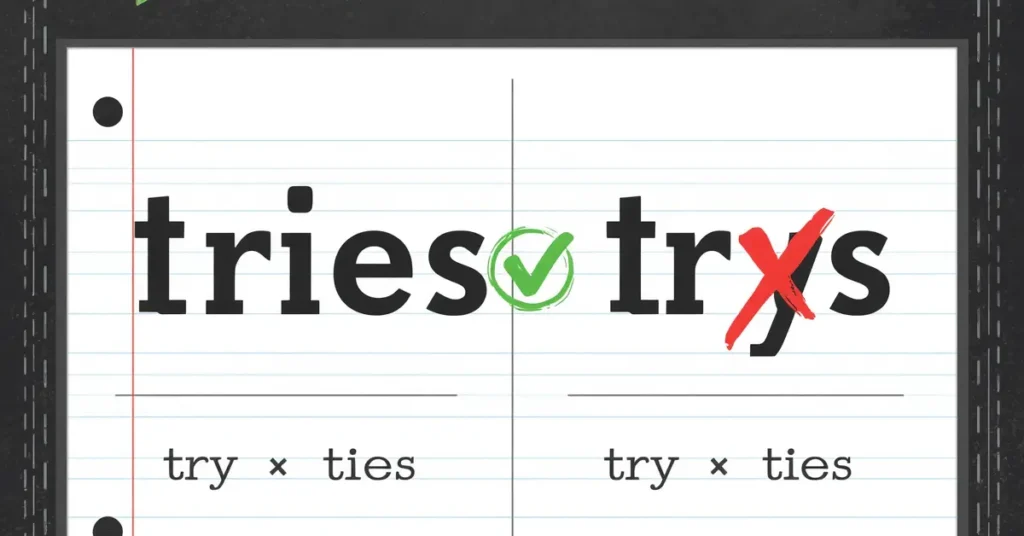
The correct spelling is tries.
- ✔ Correct: He tries to study every day.
- ❌ Incorrect: He trys to study every day.
Simple Rule
When a verb ends in “y” after a consonant, change y → i + es in third-person singular.
Examples
- He tries hard in school.
- She tries to understand grammar.
- It tries to work properly.
While or Whilst: What’s the Difference?
The Origin of “Tries”
The word “try” comes from Old French “trier”, meaning to sort or test. Over time, English adapted it into “try,” meaning to attempt something.
As English grammar rules developed, verbs ending in -y followed a pattern:
- Cry → cries
- Fly → flies
- Try → tries
The incorrect form “trys” appears due to misunderstanding modern spelling rules or influence from spoken language.
British English vs American English Spelling
In this case, British and American English use the same spelling: “tries.”
The difference is not in spelling but in usage patterns and vocabulary in other words.
Comparison Table
| Word Type | British English | American English | Correct Form |
| Try (3rd person) | tries | tries | ✔ tries |
| Fly | flies | flies | ✔ flies |
| Cry | cries | cries | ✔ cries |
👉 Conclusion: There is no difference between US and UK spelling for “tries.”
Trust or Will: Which One Should You Choose for Estate Planning?
Which Spelling Should You Use?
- Students & Exams: Always use tries
- Professional Writing: Use tries in all regions
- Blogging & SEO: Use tries for global readability
- Social Media: “tries” is standard and widely accepted
👉 “Trys” is always incorrect in modern English writing.
Common Mistakes with “Tries”
- ❌ He trys to help
✔ He tries to help - ❌ She trys hard
✔ She tries hard - ❌ It trys again
✔ It tries again - ❌ They trys their best
✔ They try their best - ❌ Mistaking “try’s” (possessive form)
✔ “try’s” is only correct for possession, not verbs
“Tries” in Everyday Examples
Emails
- “She always tries to respond quickly to emails.”
News Writing
- “The company tries new strategies every year.”
Social Media
- “He tries his best every single day 💪”
Formal Writing
- “The student tries to improve academic performance through practice.”
“Tries” – Google Trends & Usage Data
- Most searches come from India, Pakistan, Bangladesh, and Southeast Asia
- High confusion among ESL (English as Second Language) learners
- Commonly searched during exam seasons
- “trys” appears mostly as a misspelling query
- “tries” dominates official dictionaries and writing platforms
👉 Insight: The confusion is global but strongest in non-native English regions.
Comparison Table: Tries vs Trys
| Feature | Tries | Trys |
| Correctness | ✔ Correct | ❌ Incorrect |
| Grammar Rule | try → tries | No rule supports it |
| Usage | Standard English | Common mistake |
| Dictionary Status | Listed | Not valid |
| Acceptance | Global | Rejected |
FAQs
1. Is “trys” ever correct?
No, “trys” is never correct in modern English.
2. Why do people write “trys”?
Because they incorrectly apply regular “-s” rules instead of “-ies” rule.
3. Is “tries” British or American?
Both. It is used in both British and American English.
4. What is the rule for “try” in third person?
Try → tries (change y to i + es).
5. Can I use “trys” in informal writing?
No, it is still considered wrong.
6. Is “try’s” correct?
Only as possession (e.g., “the try’s result”), not as a verb.
7. What are similar words?
Cry → cries, fly → flies, carry → carries.
Conclusion
The confusion between tries or trys is very common, especially among English learners. However, the rule is simple once understood: the correct spelling is always tries. The form “trys” is incorrect and does not exist in standard English grammar.
This spelling follows a basic rule where verbs ending in a consonant + “y” change to “i + es” in the third-person singular form. Words like “cry,” “fly,” and “try” all follow this pattern. Both British and American English use the same spelling, making it easier for global communication.https://dictionary.cambridge.org/dictionary/english/credibility
Using the correct form improves writing quality, academic performance, and professional credibility. Whether you are writing an email, essay, blog, or social media post, choosing tries ensures clarity and correctness. Avoiding the mistake “trys” will instantly make your English more polished and natural.
In short, remember this simple rule and you will never be confused again: try becomes tries — always.

Hi, I’m Henry William, the author of GrammarTribe.com. I’m passionate about the English language and have dedicated my career to helping people master grammar, spelling, and effective writing. Over the years, I’ve guided learners, writers, and professionals in understanding common mistakes, tricky rules, and nuances of English grammar in a simple and easy-to-follow way.
Through GrammarTribe.com, I aim to make grammar approachable and enjoyable for everyone. My work focuses on providing clear explanations, practical tips, and examples that readers can apply in everyday writing, whether it’s emails, essays, social media, or professional documents. I believe that strong grammar skills empower people to communicate confidently and professionally.
When I’m not writing or researching grammar, I enjoy reading, exploring language trends, and creating educational content that simplifies complex concepts. I’m committed to helping my audience write better, understand English deeply, and avoid common pitfalls, all while making learning grammar a fun and rewarding journey.