
Many English learners get confused when writing words like “mondays or monday’s”, especially in emails, social media posts, or school writing. At first glance, they look similar, but they have completely different meanings. One refers to multiple Mondays, while the other shows possession.
This confusion is very common because English uses apostrophes in different ways sometimes for possession and sometimes for contractions. People often search “mondays or monday’s” to understand which form is correct in a sentence.
The keyword “mondays or monday’s” solves a real grammar problem that affects everyday communication. The keyword “mondays or monday’s” is especially important in professional writing where small mistakes can change meaning. The keyword “mondays or monday’s” helps learners avoid errors and improve clarity in writing. Understanding this difference makes your English more accurate, natural, and confident.
Mondays or Monday’s – Quick Answer
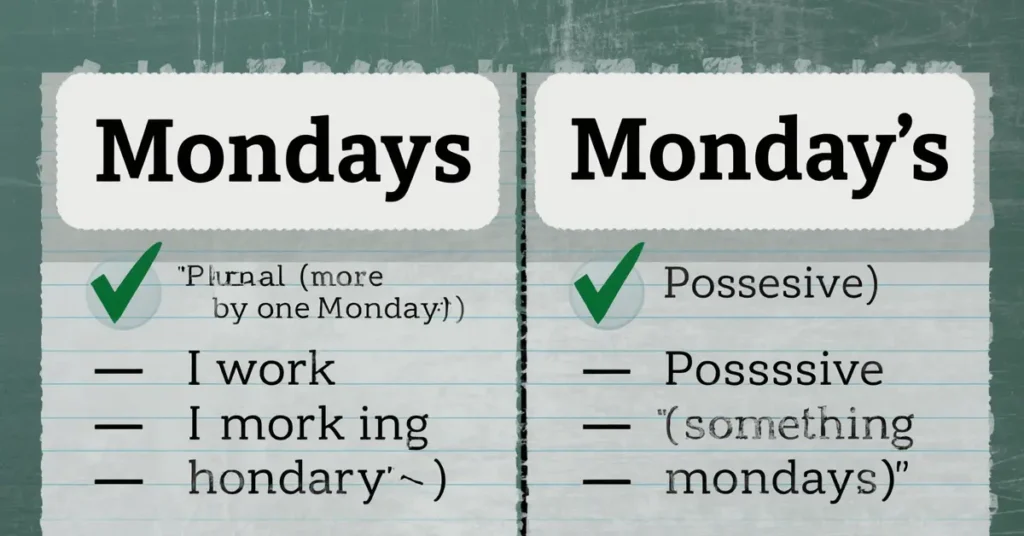
- Mondays = plural form (more than one Monday)
- Example: I work late on Mondays.
- Monday’s = possessive form (something belonging to Monday)
- Example: Monday’s meeting was canceled.
👉 Simple rule:
- No apostrophe = plural
- Apostrophe + s = possession
Posted inGrammar Knowledge
Lended or Lent: What’s the Correct?
The Origin of Mondays or Monday’s
The word “Monday” comes from Old English Monandæg, meaning “Moon’s day.” Over time, English grammar rules introduced apostrophes to show possession and contractions. This is why “Monday’s” exists: it shows ownership or relation to Monday. Meanwhile, “Mondays” became the standard plural form when referring to repeated weekly events. The confusion comes from the fact that English uses apostrophes in multiple ways, unlike many simpler languages.
British English vs American English Spelling
Both British and American English use “Mondays” and “Monday’s” in the same grammatical way. The difference is not in meaning but in usage frequency and style preference.
| Form | Meaning | Example (UK/US) |
| Mondays | Repeated days | We have classes on Mondays. |
| Monday’s | Possession | Monday’s schedule is full. |
👉 Key point: No spelling difference exists between UK and US English for this keyword.
Sub or Dub: Meaning, Differences ?
Which Spelling Should You Use?
- US English: Use “Mondays” and “Monday’s” normally
- UK English: Same usage rules apply
- Global writing: Follow grammar meaning, not region
👉 Best advice: Focus on grammar, not location. The rule is universal.
Common Mistakes with Mondays or Monday’s
- ❌ Monday’s (when talking about multiple Mondays)
✔ Mondays are busy days - ❌ Mondays (when showing possession)
✔ Monday’s meeting was long - ❌ Using apostrophe for plural
✔ Plurals do NOT need apostrophes - ❌ Forgetting apostrophe for possession
✔ Correct: Monday’s report - ❌ Mixing both in one sentence incorrectly
✔ Mondays’ schedule (plural possessive, rare)
Mondays or Monday’s in Everyday Examples
Emails:
- Mondays are our busiest days in the office.
- Monday’s report has been submitted.
Social Media:
- Mondays feel so long 😩
- Monday’s vibes are strong today.
News Writing:
- Mondays often see higher traffic congestion.
- Monday’s announcement shocked everyone.
Formal Writing:
- Meetings are scheduled on Mondays.
- Monday’s agenda includes budget review.
Mondays or Monday’s – Google Trends & Usage Data
Search trends show that “Mondays” is more commonly used globally because people talk about routines and habits. The form “Monday’s” appears less often but is important in formal writing, business communication, and news reporting. Countries like the US, UK, India, and Pakistan show similar confusion in search behavior, especially among students and ESL learners. This proves the keyword is mainly searched for grammar clarification, not regional differences.
Comparison Table: Mondays vs Monday’s
| Feature | Mondays | Monday’s |
| Type | Plural | Possessive |
| Meaning | Repeated Mondays | Belonging to Monday |
| Apostrophe | No | Yes |
| Example | Mondays are busy | Monday’s meeting |
| Usage | Routine/events | Specific item/event |
FAQs
1. Is “Mondays” correct English?
Yes, it is the correct plural form of Monday.
2. When do we use Monday’s?
When something belongs to or is related to Monday.
3. Why is the apostrophe confusing here?
Because apostrophes show possession, not plurals.
4. Can I write “Mondays’”?
Yes, but only when showing possession of multiple Mondays.
5. What is the most common mistake?
Using apostrophe in plural form like “Monday’s” instead of “Mondays.”
6. Is there a UK vs US difference?
No, both use the same rules.
7. Which is more common in writing?
“Mondays” is more common in general usage.
Conclusion
The difference between Mondays or Monday’s is small in spelling but very important in grammar. “Mondays” is used when talking about multiple Mondays or repeated events, while “Monday’s” shows possession or something related to a specific Monday. Many learners confuse these forms because English apostrophe rules are not always simple. However, the rule is clear: no apostrophe means plural, and apostrophe means ownership.
Understanding this difference helps improve clarity in writing, especially in emails, academic work, and professional communication. It also reduces grammar mistakes that can change meaning or create confusion. Whether you are writing casually on social media or formally in business reports, using the correct form shows strong language skills. By practicing examples and remembering the simple rule, you can easily master Mondays or Monday’s. This small grammar detail makes a big difference in how natural and correct your English sounds.

Hi, I’m Henry James, the author behind GrammarTribe.com. I’m passionate about the English language and specialize in grammar, helping readers understand complex rules in a simple, clear way. Over the years, I’ve dedicated myself to creating content that makes learning grammar practical, fun, and accessible for everyone. If you’re a student, professional, or language enthusiast.
Through GrammarTribe.com, I share tips, guides, and examples to help people write confidently and correctly. My goal is to make grammar less intimidating and more useful in everyday writing, emails, social media, and professional communication. Writing and teaching grammar isn’t just my profession — it’s my passion.
When I’m not writing, I enjoy reading, exploring language trends, and discovering new ways to make English learning engaging and easy. My mission is to empower readers to communicate clearly and confidently, one grammar tip at a time.