Have you ever seen the word theirselves and wondered if it is correct? Maybe you heard someone say it in conversation or spotted it online and questioned whether it should be themselves instead. This is a common grammar question because both words seem logical at first glance.
English contains many reflexive pronouns, such as myself, yourself, ourselves, and themselves. Because of this pattern, some people assume that theirselves should also be a standard word. However, modern English grammar follows a specific rule regarding reflexive pronouns.
Understanding the difference between theirselves or themselves can help you avoid mistakes in school assignments, professional writing, emails, and everyday communication. In this guide, you’ll learn which word is considered correct, why the confusion exists, how the words developed historically, and which form you should use in modern English.
If you’ve ever wondered whether theirselves belongs in standard English, this article provides a quick answer and a complete explanation.
Theirselves or Themselves – Quick Answer
The quick answer is:
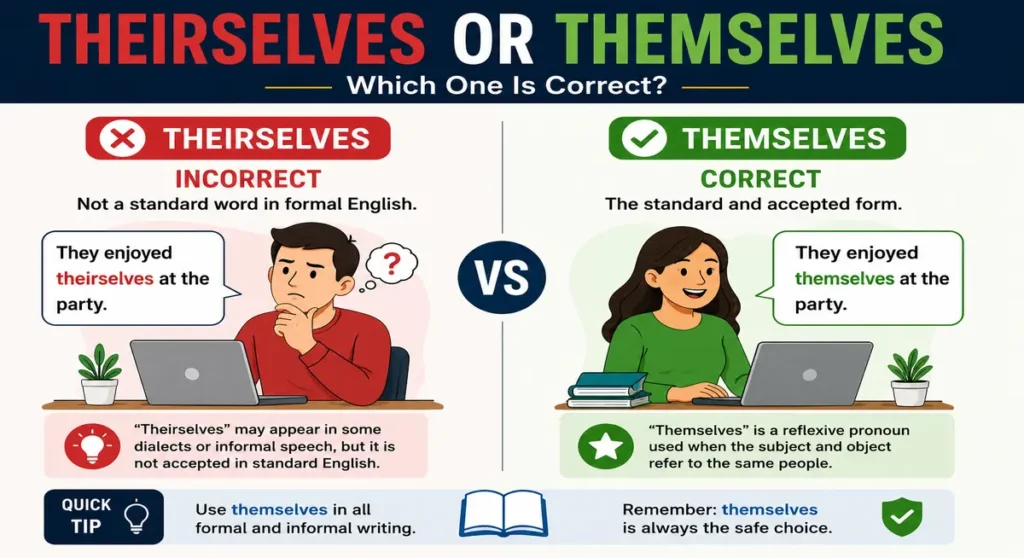
✅ Themselves is the correct standard English word.
❌ Theirselves is generally considered nonstandard English.
Examples
Correct:
- They taught themselves how to play guitar.
- The children enjoyed themselves at the park.
- The employees prepared themselves for the meeting.
Incorrect in standard English:
- They taught theirselves how to play guitar.
- The children enjoyed theirselves.
In modern English, themselves is the accepted reflexive pronoun.
Read more;
Posted inGrammar Knowledge UK Spelling Grammar
Aluminum or Aluminium – Which Spelling Is Correct?
The Origin of Theirselves or Themselves
The word themselves developed from older forms of English.
Historically, English reflexive pronouns evolved over centuries:
- Myself
- Yourself
- Himself
- Herself
- Ourselves
- Yourselves
- Themselves
The word theirselves has existed in some regional dialects and informal speech. In earlier forms of English, people occasionally created reflexive pronouns based on possessive forms such as their.
However, standard English eventually settled on themselves as the correct reflexive form.
Why Does “Theirselves” Exist?
People often form it by analogy:
- Myself ← my
- Yourself ← your
- Ourselves ← our
So some speakers naturally assume:
- Their + selves = theirselves
While this seems logical, modern grammar recognizes themselves as the standard form.
Read more: Supercede or Supersede – Which Spelling Is Correct?
British English vs American English Spelling
Unlike many English words, there is no major British-American spelling difference here.
Both versions of English use themselves.
British English
- Themselves
American English
- Themselves
Comparison Table
| Usage | British English | American English |
| Standard Form | Themselves | Themselves |
| Theirselves | Nonstandard | Nonstandard |
| Formal Writing | Themselves | Themselves |
| Academic Writing | Themselves | Themselves |
The grammar rule is the same in both regions.
Which Spelling Should You Use?
The answer is straightforward.
Use “Themselves”
Use themselves in:
- School assignments
- Business writing
- Academic papers
- Emails
- News articles
- Professional communication
Avoid “Theirselves”
Although it may appear in:
- Regional dialects
- Informal speech
- Literary dialogue
It is not considered standard English.
For Global Audiences
Always use themselves.
It is understood and accepted worldwide.
Common Mistakes with Theirselves or Themselves
Here are the most common errors.
Mistake 1: Using Theirselves in Formal Writing
❌ The students prepared theirselves for the test.
✅ The students prepared themselves for the test.
Mistake 2: Confusing Reflexive Pronouns
❌ They blamed theirselves for the mistake.
✅ They blamed themselves for the mistake.
Mistake 3: Following Spoken Dialects
Some regional dialects use theirselves in conversation, but formal writing should use themselves.
Common Corrections Table
| Incorrect | Correct |
| Theirselves | Themselves |
| They enjoyed theirselves | They enjoyed themselves |
| They taught theirselves | They taught themselves |
| Theirselves were ready | They themselves were ready |
Theirselves or Themselves in Everyday Examples
Emails
Correct:
- The team organized themselves efficiently.
News Articles
Correct:
- The athletes prepared themselves for the competition.
Social Media
Correct:
- They treated themselves to a nice dinner.
Formal Writing
Correct:
- Participants introduced themselves before the event.
Academic Writing
Correct:
- Students should challenge themselves to improve their skills.
In all standard contexts, themselves is the preferred choice.
Theirselves or Themselves – Google Trends & Usage Data
Search patterns show that many people look up theirselves or themselves because they are unsure which word is grammatically correct.
Themselves
Most common in:
- Books
- Newspapers
- Academic writing
- Professional communication
- Educational materials
Theirselves
Usually appears in:
- Regional speech
- Informal conversations
- Historical texts
- Dialect writing
Usage Comparison
| Word | Usage Level |
| Themselves | Extremely common |
| Theirselves | Rare and nonstandard |
Modern dictionaries overwhelmingly favor themselves.
Theirselves vs Themselves Comparison Table
| Feature | Theirselves | Themselves |
| Standard English | No | Yes |
| Dictionary Preferred | No | Yes |
| Formal Writing | Not Recommended | Recommended |
| Academic Writing | Incorrect | Correct |
| Common Usage | Regional dialects | Worldwide |
| Grammar Acceptance | Limited | Universal |
FAQs
1. Is theirselves a real word?
Yes, it exists in some dialects and informal speech, but it is not considered standard English.
2. Which is correct: theirselves or themselves?
Themselves is the correct standard English form.
3. Why do some people say theirselves?
It developed naturally in certain dialects because speakers follow patterns found in other reflexive pronouns.
4. Can I use theirselves in formal writing?
No. Formal writing should use themselves.
5. Do British people use theirselves?
Some regional dialects may use it, but standard British English uses themselves.
6. Is theirselves grammatically wrong?
In standard English grammar, it is generally considered incorrect.
7. What type of word is themselves?
Themselves is a reflexive pronoun used when the subject and object are the same people.
Conclusion
When comparing theirselves or themselves, the correct choice in standard English is clear: themselves. It is the accepted reflexive pronoun in both British and American English and appears in formal, academic, and professional writing around the world.
Although theirselves exists in some regional dialects and informal speech, it is generally considered nonstandard and should be avoided in most writing situations. Understanding this distinction helps improve grammar accuracy and ensures your communication looks polished and professional.
A simple way to remember the rule is that dictionaries, schools, publishers, and style guides all prefer themselves. Whether you’re writing an email, article, essay, or social media post, using themselves is the safest and most widely accepted option.
The next time you wonder whether to use theirselves or themselves, choose themselves with confidence.

Hi, I’m Henry James, the author behind GrammarTribe.com. I’m passionate about the English language and specialize in grammar, helping readers understand complex rules in a simple, clear way. Over the years, I’ve dedicated myself to creating content that makes learning grammar practical, fun, and accessible for everyone. If you’re a student, professional, or language enthusiast.
Through GrammarTribe.com, I share tips, guides, and examples to help people write confidently and correctly. My goal is to make grammar less intimidating and more useful in everyday writing, emails, social media, and professional communication. Writing and teaching grammar isn’t just my profession — it’s my passion.
When I’m not writing, I enjoy reading, exploring language trends, and discovering new ways to make English learning engaging and easy. My mission is to empower readers to communicate clearly and confidently, one grammar tip at a time.