Have you ever typed “scarey” and wondered if it was actually correct? You are not alone. Many English learners, writers, students, and even native speakers get confused between scarey and scary. Since both words look similar and sound almost the same, it is easy to assume they are interchangeable.
People often search for “scarey or scary” because they want to know which spelling is accepted in formal writing, school assignments, business emails, and online content. The confusion comes from the root word “scare.” Many assume that adding a “y” should create “scarey,” but English spelling rules do not always work that way.
The good news is that the answer is simple. One spelling is recognized as standard English, while the other is generally considered a spelling mistake. In this guide, you’ll learn the correct spelling, its history, differences between British and American English, common mistakes, real-world examples, and usage trends so you can write with confidence.
Scarey or Scary – Quick Answer
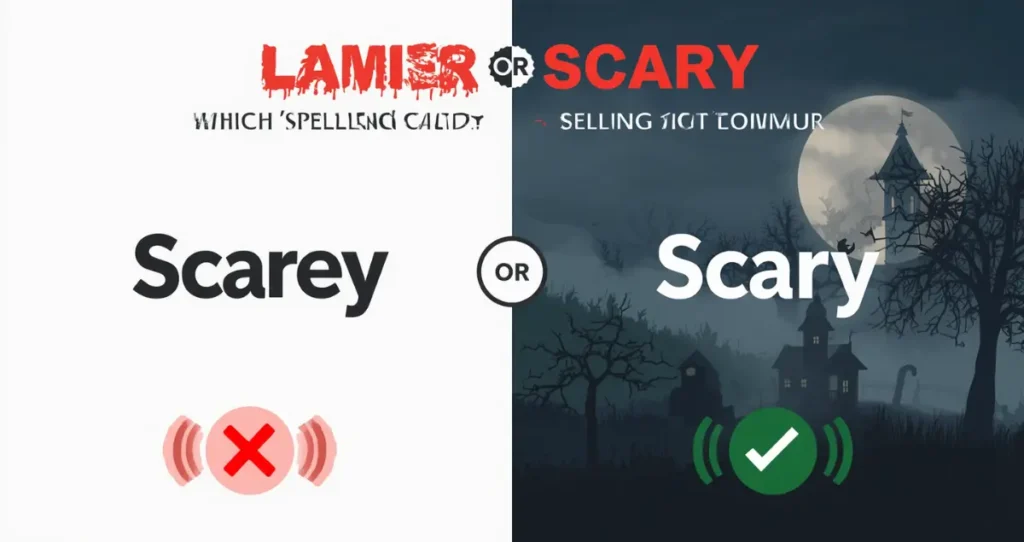
The correct spelling is scary.
Scary means something that causes fear, fright, or anxiety.
Examples
✅ The movie was very scary.
✅ I heard a scary noise outside last night.
✅ That was a scary experience.
❌ The movie was very scarey.
❌ I heard a scarey noise outside.
While scarey occasionally appears online, it is considered a misspelling in standard English.
Read more: Gem or Jem: Which Spelling Is Correct?
The Origin of Scarey or Scary
The word scary comes from the verb scare, which means to frighten someone.
The term developed in English by adding the suffix -y, which often turns nouns and verbs into adjectives. Over time, the accepted spelling became scary rather than scarey.
Word History
| Word | Meaning |
| Scare | To frighten |
| Scary | Causing fear |
| Scarey | Nonstandard spelling |
The confusion exists because many English words keep the silent “e” before adding a suffix. However, in the case of scary, the final “e” is dropped before adding “y.”
This follows a common English spelling pattern.
Read more: Madame or Madam: Which One Is Correct?
Similar Examples
| Base Word | Correct Form |
| Ice | Icy |
| Noise | Noisy |
| Taste | Tasty |
| Scare | Scary |
This is why scary became the standard spelling.
British English vs American English Spelling
Unlike many English words, there is no difference between British English and American English for scary.
Both varieties use the same spelling.
Comparison Table
| Meaning | American English | British English |
| Causing fear | Scary | Scary |
| Alternative spelling | Not accepted | Not accepted |
| Formal writing | Scary | Scary |
Examples
American English
- That horror film was scary.
- It was a scary situation.
British English
- That haunted house was scary.
- The storm looked scary.
In both countries, scary is the correct choice.
Which Spelling Should You Use?
The answer is simple: use scary in every situation.
If Your Audience Is in the United States
Use scary.
If Your Audience Is in the United Kingdom
Use scary.
If Your Audience Is in Australia, Canada, New Zealand, or Other Commonwealth Countries
Use scary.
If You Write for a Global Audience
Use scary.
There is no professional, academic, or regional situation where scarey is preferred over scary.
Common Mistakes with Scarey or Scary
Many writers make spelling mistakes because the root word is scare.
Mistake 1: Keeping the Silent E
❌ Scarey movie
✅ Scary movie
Mistake 2: Assuming Both Spellings Are Correct
❌ Scarey and scary mean the same thing and are equally accepted.
✅ Only scary is standard English.
Mistake 3: Using Scarey in Professional Writing
❌ The report described a scarey event.
✅ The report described a scary event.
Mistake 4: Trusting Informal Internet Usage
Sometimes users write scarey on social media or forums.
Informal use does not make it correct.
Scarey or Scary in Everyday Examples
Here is how the correct spelling appears in everyday communication.
In Emails
✅ The situation became scary during the storm.
In News Articles
✅ Residents described the earthquake as a scary experience.
On Social Media
✅ That was the scariest video I’ve seen all week!
In Academic Writing
✅ Researchers examined the effects of scary imagery on viewers.
In Business Communication
✅ The sudden market drop created a scary situation for investors.
In Casual Conversation
✅ That haunted house was really scary.
Scarey or Scary – Google Trends & Usage Data
Search and usage patterns show that scary is overwhelmingly more popular than scarey.
Popularity by Country
| Country | Common Usage |
| United States | Scary |
| United Kingdom | Scary |
| Canada | Scary |
| Australia | Scary |
| India | Scary |
Why People Search for “Scarey”
Most searches happen because:
- People hear the word but have never seen it written.
- The root word “scare” causes confusion.
- Autocorrect flags the spelling.
- Writers want to verify the correct version.
Usage Contexts
| Context | Preferred Form |
| School writing | Scary |
| Books | Scary |
| Journalism | Scary |
| Websites | Scary |
| Social media | Mostly scary |
The evidence clearly shows that scary dominates modern English usage.
Comparison Table: Scarey vs Scary
| Feature | Scarey | Scary |
| Standard English | No | Yes |
| Dictionary Accepted | Rarely | Yes |
| Used in Formal Writing | No | Yes |
| Used in Academic Writing | No | Yes |
| British English | No | Yes |
| American English | No | Yes |
| Recommended Choice | No | Yes |
FAQs
1. Is scarey a real word?
Scarey appears occasionally in informal writing, but it is not the standard spelling accepted by most dictionaries.
2. Which is correct, scarey or scary?
Scary is the correct spelling.
3. Why do people write scarey?
People often keep the “e” from the root word scare, which leads to the misspelling.
4. Is scarey accepted in British English?
No. British English uses scary, just like American English.
5. Can I use scarey in professional writing?
No. Use scary in all professional, academic, and formal contexts.
6. Is scary an adjective?
Yes. It is an adjective that describes something frightening or fear-inducing.
7. What is the comparative form of scary?
The comparative form is scarier, and the superlative form is scariest.
Conclusion
The debate over scarey or scary has a clear answer. Scary is the correct and universally accepted spelling in modern English. Whether you are writing for readers in the United States, the United Kingdom, Canada, Australia, or anywhere else, scary is the form you should use.
The confusion usually comes from the root word scare, leading some writers to believe the adjective should be spelled scarey. However, English spelling rules drop the silent “e” before adding the “y,” creating the standard form scary. This pattern is similar to words like icy, noisy, and tasty.
For formal writing, school assignments, professional emails, articles, and online content, always choose scary. Using the correct spelling helps maintain credibility and ensures your writing looks polished and professional. If you ever hesitate between the two spellings, remember one simple rule: scary is correct, scarey is not.

I am James Wilson, an author at GrammarTribe.com, specializing in English grammar and clear communication.
I create expert, reliable content to help learners write with confidence and accuracy.