
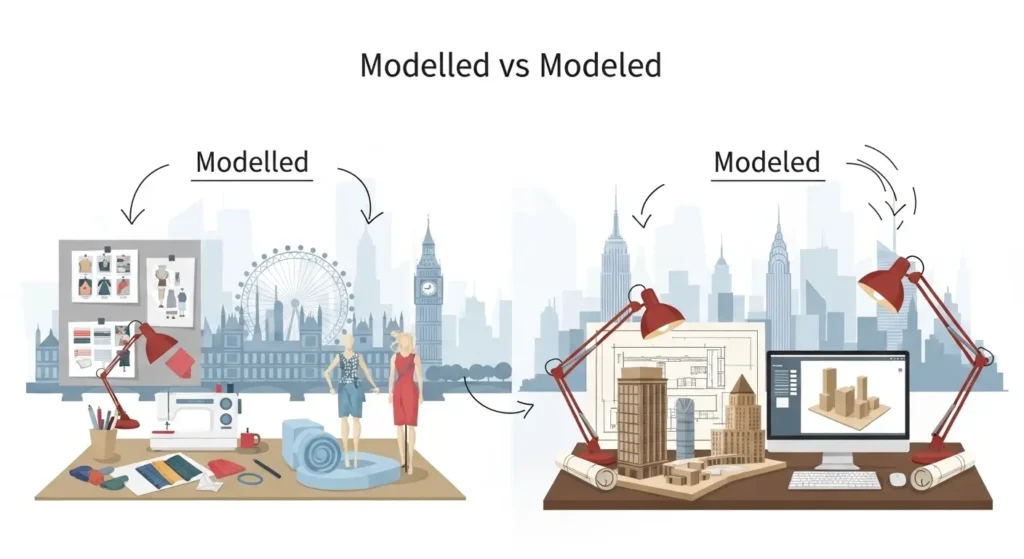
Have you ever paused while writing and wondered, “Is it modelled or modeled?” You’re not alone. This small spelling difference confuses students, bloggers, and even professionals. The words look almost the same, but the extra “l” makes people second-guess their writing.
The confusion comes from differences between British English and American English. Many English words change spelling depending on the region, and modelled/modeled is one of them. If you write for a global audience, picking the right version becomes even more important.
This article clears up the confusion in a simple way. You’ll learn the correct spelling, why both forms exist, and how to choose the right one for your audience. By the end, you’ll feel confident using modelled or modeled in any situation whether it’s an email, blog post, or formal document.
Modelled or Modeled – Quick Answer
Both modelled and modeled are correct. The difference depends on the type of English you use.
- Modelled → British English
- Modeled → American English
Examples:
- 🇬🇧 She modelled the new dress at the event.
- 🇺🇸 She modeled the new dress at the event.
They have the same meaning: to display, represent, or create a model of something.
Behavior or Behaviour – Which Spelling Is Correct?
The Origin of Modelled or Modeled
The word “model” comes from the Latin word modulus, meaning “small measure” or “pattern.” Over time, it entered French as modèle and then English.
When English spread across countries, spelling rules changed:
- British English kept traditional forms and often doubles consonants (model → modelled)
- American English simplified spellings by dropping extra letters (model → modeled)
This is why both versions exist today.
British English vs American English Spelling
A key difference is how each version handles double consonants when adding endings like -ed or -ing.
| Feature | British English | American English |
| Base word | Model | Model |
| Past tense | Modelled | Modeled |
| Rule | Double “l” | Single “l” |
| Example sentence | He modelled it | He modeled it |
More examples:
- Travelled vs Traveled
- Cancelled vs Canceled
- Labelled vs Labeled
Flavor or Flavour – Which Spelling Is Correct?
Which Spelling Should You Use?
Choosing the right spelling depends on your audience:
- Use modelled → If your audience is in the UK, Australia, or Commonwealth countries
- Use modeled → If your audience is in the United States
- For global content → Pick one style and stay consistent
Pro Tip:
If your website targets US traffic, use modeled for better SEO results.
Common Mistakes with Modelled or Modeled
Here are mistakes people often make:
- ❌ Mixing both spellings in one article
- ❌ Thinking one version is incorrect
- ❌ Using British spelling for an American audience
Correct usage:
- ✔ Choose one version and stick to it
- ✔ Match spelling with your audience
- ✔ Follow style guides (APA = American, Oxford = British)
Modelled or Modeled in Everyday Examples
Emails:
- The system was modeled to predict results. (US)
- The system was modelled to predict results. (UK)
News:
- The design was modeled after ancient art.
Social Media:
- She modeled the outfit beautifully!
Formal Writing:
- The scientist modeled climate changes using data.
Modelled or Modeled – Google Trends & Usage Data
- Modeled is more popular in the United States
- Modelled is common in the UK and Commonwealth countries
- Globally, modeled often appears more due to US content dominance online
Where each is used most:
- Modeled → USA, tech blogs, academic papers (APA style)
- Modelled → UK media, education, formal British writing
Comparison Table – Modelled vs Modeled
| Aspect | Modelled | Modeled |
| Region | British English | American English |
| Spelling Style | Double “l” | Single “l” |
| Usage | UK, Australia | USA |
| Meaning | Same | Same |
| Correct? | Yes | Yes |
FAQs
1. Is modelled or modeled correct?
Both are correct. It depends on British or American English.
2. Why does British English use “modelled”?
Because it follows a rule of doubling consonants before adding -ed.
3. Why does American English use “modeled”?
It simplifies spelling by using a single “l”.
4. Can I use both in the same article?
No, it’s better to stay consistent.
5. Which spelling is better for SEO?
Used modeled for US audiences and modelled for UK audiences.
6. Do they have different meanings?
No, both mean the same thing.
7. What about “modelling” vs “modeling”?
The same rule applies: British uses double “l”, American uses one.
Conclusion
The difference between modelled and modeled is simple once you understand it. Both words mean the same thing, and both are correct. The only difference is where they are used. British English prefers modelled with a double “l,” while American English uses modeled with a single “l.”
This small spelling change reflects a bigger pattern in English. British English keeps traditional spelling rules, while American English often simplifies them. Knowing this helps you avoid mistakes and write with confidence.
If you’re writing for a specific audience, always match their language style. For global content, consistency matters more than the choice itself. Pick one version and stick with it throughout your writing.
By understanding this difference, you improve clarity, professionalism, and even SEO performance. Now you can confidently choose between modelled and modeled in any context.

Hi, I’m Henry William, the author of GrammarTribe.com. I’m passionate about the English language and have dedicated my career to helping people master grammar, spelling, and effective writing. Over the years, I’ve guided learners, writers, and professionals in understanding common mistakes, tricky rules, and nuances of English grammar in a simple and easy-to-follow way.
Through GrammarTribe.com, I aim to make grammar approachable and enjoyable for everyone. My work focuses on providing clear explanations, practical tips, and examples that readers can apply in everyday writing, whether it’s emails, essays, social media, or professional documents. I believe that strong grammar skills empower people to communicate confidently and professionally.
When I’m not writing or researching grammar, I enjoy reading, exploring language trends, and creating educational content that simplifies complex concepts. I’m committed to helping my audience write better, understand English deeply, and avoid common pitfalls, all while making learning grammar a fun and rewarding journey.