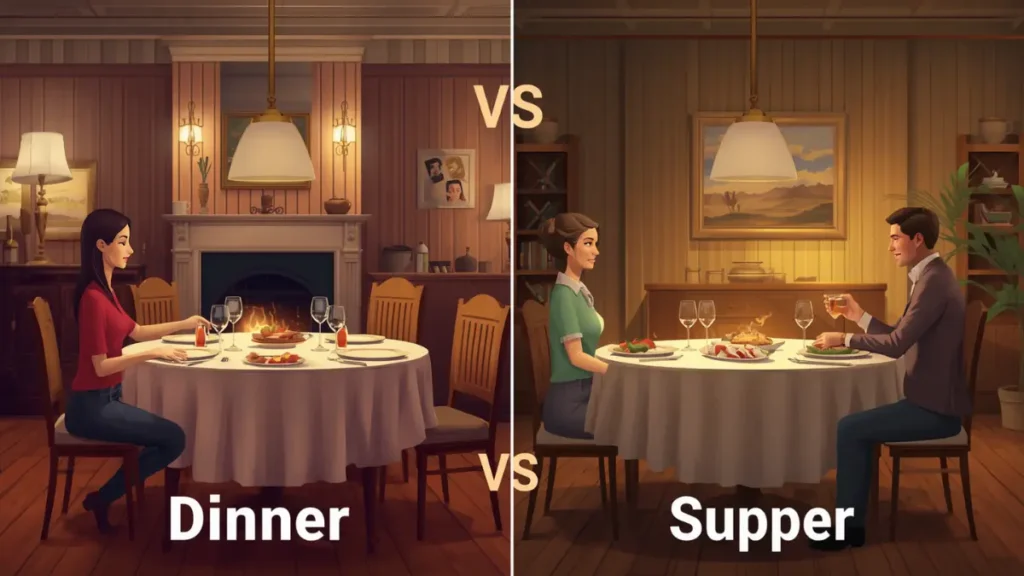
Have you ever heard someone say, “What’s for supper?” while another person asks, “What’s for dinner?” If both people are talking about the evening meal, which word is correct?
The question dinner or supper confuses many English learners and even native speakers. The confusion exists because the meanings of these words have changed over time and can vary by region, culture, and family tradition. In some places, dinner is the largest meal of the day, while in others, it is simply the evening meal. Likewise, supper may refer to a light evening meal or be used as another word for dinner.
Understanding the difference between dinner and supper can help you communicate more naturally in conversations, writing, travel, and professional settings. In this guide, you’ll learn the origins of both words, how they are used in British and American English, common mistakes people make, and which term is best for different audiences. By the end, you’ll know exactly when to use dinner and when to use supper.
Dinner or Supper – Quick Answer
Both dinner and supper can refer to a meal, but they are not always the same.
Dinner
Dinner is usually the main meal of the day. In modern usage, it often means the evening meal.
Supper
Supper usually refers to a lighter evening meal or an informal meal eaten later in the day.
Examples
✅ We are having dinner at 7 p.m.
✅ The family gathered for Sunday dinner.
✅ I had a light supper before bed.
✅ Grandma called the evening meal supper.
The correct choice often depends on where you live and how the word is used in your culture.
Read more: Congradulations or Congratulations: Which Spelling Is Correct ?
The Origin of Dinner or Supper
The words have different historical origins.
Origin of Dinner
The word dinner comes from the Old French word disner, meaning “to break a fast.”
Centuries ago, dinner was often eaten around midday because it was the largest meal of the day.
Origin of Supper
The word supper comes from the Old French word soper, meaning “evening meal.”
Traditionally, supper was a lighter meal eaten later in the evening after the main meal.
Why the Difference Exists
As work schedules and lifestyles changed, many people moved their largest meal to the evening. As a result, dinner became associated with the evening meal in many countries.
British English vs American English Spelling
There is no spelling difference between British and American English.
However, usage differences do exist.
Read more: Edgewater or Deserters: Meaning and Differences?
Comparison Table
| Meaning | British English | American English |
| Main evening meal | Dinner | Dinner |
| Light evening meal | Supper | Supper |
| Formal meal | Dinner | Dinner |
| Traditional rural usage | Supper often used | Supper sometimes used |
Examples
British English
- We’re having dinner at eight.
- Would you like some supper later?
American English
- Dinner will be ready soon.
- My grandparents still call it supper.
Both terms are correct, but their popularity varies by region and generation.
Which Spelling Should You Use?
Since both words are correctly spelled, the question is really about usage.
For US Audiences
Use dinner in most situations.
For UK Audiences
Use dinner for the main meal. Use supper when referring to a lighter evening meal.
For Canada, Australia, and New Zealand
Both words are understood, though dinner is generally more common.
For Global Audiences
Use dinner because it is widely recognized worldwide.
Professional Advice
When writing for a broad audience, dinner is usually the safest choice.
Common Mistakes with Dinner or Supper
Mistake 1: Assuming They Mean Exactly the Same Thing
❌ Dinner and supper always mean the same thing.
✅ Their meanings can vary by region and context.
Mistake 2: Using Supper in Formal Business Writing
❌ Corporate supper meeting
✅ Corporate dinner meeting
Mistake 3: Ignoring Regional Differences
❌ Everyone uses dinner the same way.
✅ Usage depends on local customs and traditions.
Mistake 4: Thinking One Word Is Incorrect
❌ Supper is wrong.
✅ Both dinner and supper are correct.
Dinner or Supper in Everyday Examples
“Please join us for dinner at 6:30 p.m.”
News Article
“The charity dinner raised thousands of dollars.”
Social Media
“What’s everyone having for supper tonight?”
Formal Writing
“The guests attended an official dinner hosted by the organization.”
Family Conversation
“Dinner is ready.”
or
“Supper is on the table.”
Restaurant Advertisement
“Join us for a special dinner menu this weekend.”
Dinner or Supper – Google Trends & Usage Data
Search trends show that dinner is far more common globally than supper.
Usage by Country
| Country | More Common Term |
| United States | Dinner |
| United Kingdom | Dinner |
| Canada | Dinner |
| Australia | Dinner |
| New Zealand | Dinner |
Where Supper Remains Popular
Supper is still commonly used:
- In rural communities
- Among older generations
- In religious settings
- In family traditions
- In some parts of the UK, Canada, and the US South
Why Dinner Dominates
- It is widely understood.
- Restaurants use it frequently.
- Media and advertising favor it.
- It works in both formal and informal contexts.
Dinner vs Supper Comparison Table
| Feature | Dinner | Supper |
| Main meal of the day | ✅ Yes | Sometimes |
| Evening meal | ✅ Often | ✅ Often |
| Formal events | ✅ Common | ❌ Rare |
| Restaurant usage | ✅ Common | ❌ Rare |
| Family meal term | ✅ Yes | ✅ Yes |
| Global recognition | ✅ High | Moderate |
| Traditional usage | Yes | Yes |
Frequently Asked Questions (FAQs)
1. Is dinner or supper correct?
Both are correct. The choice depends on context, region, and tradition.
2. What is the difference between dinner and supper?
Dinner is usually the main meal of the day, while supper is often a lighter evening meal.
3. Do Americans say dinner or supper?
Most Americans use dinner, although some regions still use supper.
4. Do British people say supper?
Yes. Many British speakers use both words depending on the situation.
5. Is supper old-fashioned?
In some areas it may sound traditional, but it is still widely understood.
6. Which word should I use in professional writing?
Dinner is generally the better choice for professional and formal writing.
7. Can dinner be eaten at lunchtime?
Historically, yes. In some cultures, dinner can still refer to the main meal eaten earlier in the day.
Conclusion
The debate between dinner or supper is not about right or wrong. Both words are correct, but they carry different meanings depending on location, tradition, and context. Today, dinner is the more common and widely recognized term, especially when referring to the main evening meal. It is also the preferred choice in formal writing, restaurants, business communication, and global content.
Supper, however, remains an important part of many regional dialects and family traditions. For some people, it refers to a lighter meal eaten later in the evening. For others, it is simply another word for dinner.
When writing for an international audience, using dinner will usually be the safest option. If you are speaking with family, friends, or people from regions where the term is common, supper can feel warm, familiar, and natural.
Understanding these differences allows you to communicate more clearly and appreciate the rich history behind everyday English words.

Hi, I’m Henry James, the author behind GrammarTribe.com. I’m passionate about the English language and specialize in grammar, helping readers understand complex rules in a simple, clear way. Over the years, I’ve dedicated myself to creating content that makes learning grammar practical, fun, and accessible for everyone. If you’re a student, professional, or language enthusiast.
Through GrammarTribe.com, I share tips, guides, and examples to help people write confidently and correctly. My goal is to make grammar less intimidating and more useful in everyday writing, emails, social media, and professional communication. Writing and teaching grammar isn’t just my profession — it’s my passion.
When I’m not writing, I enjoy reading, exploring language trends, and discovering new ways to make English learning engaging and easy. My mission is to empower readers to communicate clearly and confidently, one grammar tip at a time.