
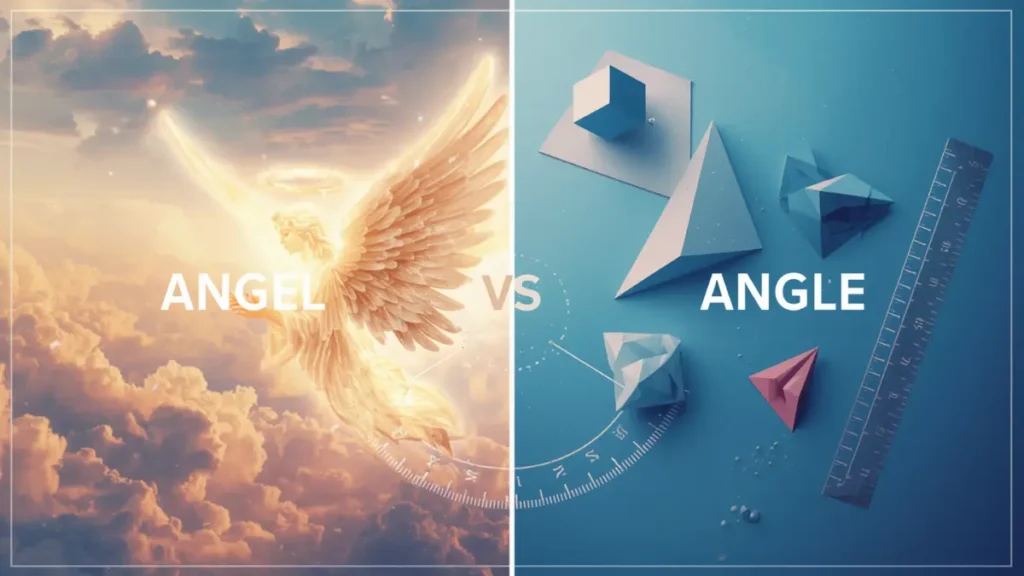
Many English learners get confused between angel or angle because the words look almost the same, but their meanings are completely different. This small spelling difference can change the whole meaning of a sentence. For example, “I saw an angel in my dream” is very different from “I drew a 90-degree angle in math.”
People often search for angel or angle because both words appear in school, religious texts, conversations, and even exams. The confusion usually happens when typing quickly or relying on spell-check tools. Since both words are real English words, autocorrect does not always catch the mistake.
Understanding angel or angle is important for clear communication in writing and speaking. One word is connected to spirituality and religion, while the other is used in mathematics and geometry. This guide explains the difference in simple terms, with examples, usage rules, tables, and FAQs so you never confuse them again.
Angel or Angle – Quick Answer
Quick Rule
- Angel = a spiritual or divine being
- Angle = a shape or measurement in geometry
Examples
| Word | Example |
| Angel | She believes in guardian angels. |
| Angle | A triangle has three angles. |
Easy Trick
- Angel = Heaven / Spiritual being
- Angle = Math / Geometry
Read more: Counsel or Council: What’s the Difference?
The Origin of Angel or Angle
Angel
The word angel comes from the Greek word angelos, meaning “messenger.” It was later used in religious texts to describe divine beings who deliver messages from God.
Angle
The word angle comes from the Latin angulus, meaning “corner.” It is used in mathematics and geometry to describe the space between two lines.
Word Origins Table
| Word | Origin | Meaning |
| Angel | Greek “angelos” | Divine messenger |
| Angle | Latin “angulus” | Corner or space between lines |
Although they sound similar, their meanings developed in completely different directions.
British English vs American English Spelling
There is no difference between British and American English for angel or angle. Both spellings remain the same worldwide.
Read more: Favour or Favor: What’s the Correct Spelling?
Comparison Table
| Word | British English | American English |
| Angel | angel | angel |
| Angle | angle | angle |
Examples
| Context | Example |
| Religion | Angels are spiritual beings. |
| Math | This angle measures 45 degrees. |
Which Spelling Should You Use?
Use “Angel” When:
- Talking about religion or spirituality
- Describing kindness or purity
- Referring to dreams or beliefs
Examples
- She looks like an angel.
- I saw an angel in my dream.
Use “Angle” When:
- Talking about geometry or math
- Measuring shapes or lines
- Describing perspective
Examples
- Draw a right angle.
- The camera angle is perfect.
Best Advice
Always think about meaning:
- Spiritual topic → Angel
- Mathematical topic → Angle
Common Mistakes with Angel or Angle
| Incorrect | Correct |
| I measured an angel in math class. | I measured an angle in math class. |
| She drew an angel triangle. | She drew an angled triangle. |
| The angle helped me in prayer. | The angel helped me in prayer. |
Mistake 1: Typing errors
Fast typing often causes mix-ups.
Mistake 2: Autocorrect confusion
Both words are real, so autocorrect may not fix them.
Mistake 3: Lack of context
Without context, readers may misunderstand meaning.
Angel or Angle in Everyday Examples
In Emails
- “Please check the camera angle before recording.”
- “I hope your guardian angel protects you.”
In News Writing
- “The camera angle captured the scene clearly.”
- “The statue of an angel was unveiled.”
On Social Media
- “You’re my angel ❤️”
- “This photo angle is perfect!”
In Formal Writing
- “The experiment required a precise angle measurement.”
- “Religious texts mention angels frequently.”
Angel or Angle – Google Trends & Usage Data
Search data shows high confusion between angel or angle, especially among students and English learners.
Popular Searches
- angel vs angle difference
- how to spell angel or angle
- angel meaning vs angle meaning
Usage by Context
| Word | Common Use |
| Angel | Religion, emotion, literature |
| Angle | Math, photography, science |
Country Trends
| Country | Common Confusion |
| United States | School grammar mistakes |
| United Kingdom | Academic writing |
| India | English learning queries |
| Pakistan | Exam preparation |
Angel vs Angle Comparison Table
| Feature | Angel | Angle |
| Meaning | Divine being | Geometry term |
| Field | Religion/spirituality | Mathematics/science |
| Usage | Emotional language | Technical language |
| Example | Guardian angel | Right angle |
| Confusion level | High | High |
FAQs About Angel or Angle
1. What is the difference between angel and angle?
“Angel” is a spiritual being, while “angle” is a geometric term.
2. Why do people confuse angel and angle?
Because they look and sound very similar.
3. Is angel used in math?
No. Math uses “angle,” not “angel.”
4. Can angle mean perspective?
Yes, it can also describe viewpoint or camera position.
5. Is angel a religious word?
Yes, it refers to divine or spiritual beings.
6. Are both words pronounced the same?
No. “Angel” and “angle” have slightly different sounds.
7. How can I remember the difference easily?
Think:
- Angel = Heaven
- Angle = Geometry
Conclusion
Understanding angel or angle is simple once you focus on meaning instead of spelling. Although the words look similar, they belong to completely different fields. “Angel” is connected to spirituality, religion, and kindness, while “angle” is used in mathematics, geometry, and science.
This confusion is common among students and English learners because both words are short, similar in spelling, and widely used in different contexts. However, remembering their meanings makes it easy to choose the correct word every time.
If you are talking about divine beings or emotional expressions, use “angel.” If you are dealing with shapes, measurements, or technical subjects, use “angle.” With practice, this difference becomes natural.
Mastering small word differences like angel or angle improves writing accuracy, communication skills, and overall English fluency. It also helps avoid embarrassing mistakes in exams, emails, and professional writing.

I am James Wilson, an author at GrammarTribe.com, specializing in English grammar and clear communication.
I create expert, reliable content to help learners write with confidence and accuracy.