
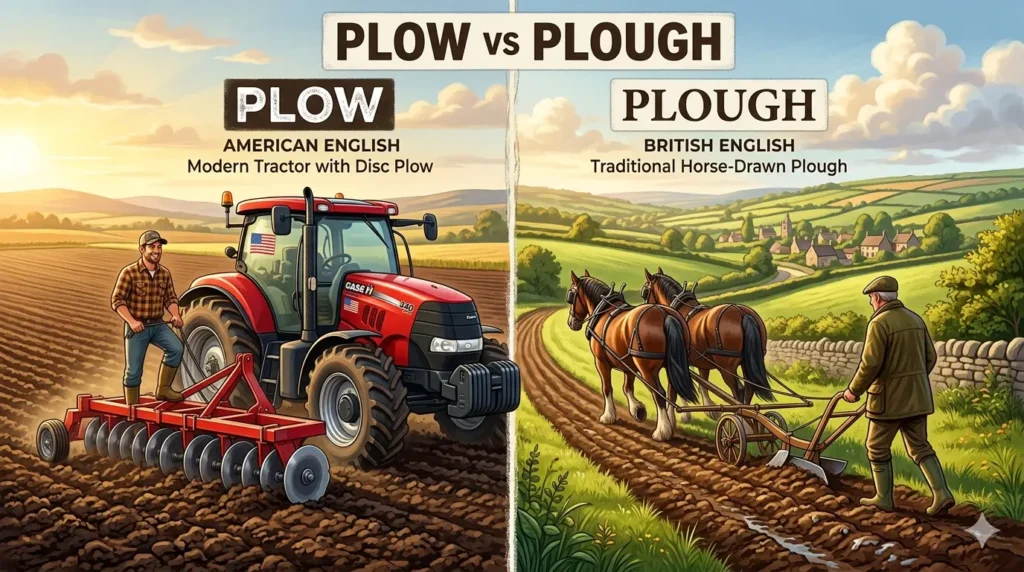
Have you seen the words plow and plough and wondered which one is right? Many English learners, writers, and even native speakers get confused by these two spellings. The good news is simple: both words are correct. They mean the same thing. The difference depends on where you live and which type of English you use.
People often search for “plow or plough” because they want the correct spelling for school, blogs, emails, farming articles, or social media posts. Some worry about grammar mistakes, while others want to write for a global audience. This spelling difference is common in English, just like “color” and “colour” or “center” and “centre.”
In this guide, you will learn the quick answer, the history of the word, British vs American spelling rules, common mistakes, and real-life examples. By the end, you will know exactly when to use the plow and when to use plough with confidence.
Plow or Plough – Quick Answer
Both plow and plough are correct spellings of the same word.
- Plow = American English spelling
- Plough = British English spelling
The word refers to:
- A farming tool used to turn soil
- The action of cutting through snow or soil
Examples
| American English | British English |
| The farmer used a plow. | The farmer used a plough. |
| Snowplows cleared the road. | Snow ploughs cleared the road. |
If you write for an American audience, use plow.
If you write for a British or Commonwealth audience, use plough.
Biting or Bitting: Which Spelling Is Correct?
The Origin of Plow or Plough
The word comes from old Germanic languages. Early forms of the word appeared as:
- Old English: plōh
- Old Norse: plógr
- Middle English: plough
Over time, spelling changed in different regions.
British English kept the older form plough with “ough.” American English later simplified many spellings, creating plow.
This same spelling change happened with other words:
| British English | American English |
| plough | plow |
| draught | draft |
| mould | mold |
The pronunciation stayed mostly the same, but the spelling became different.
Peel or Peal : What’s the Difference and When to Use Each?
British English vs American English Spelling
British and American English often spell words differently. The meaning stays the same.
Main Difference
| British English | American English |
| plough | plow |
Why the Difference Exists
American English spelling became simpler in the 1800s. Writer and dictionary editor Noah Webster supported shorter spellings to make writing easier.
British English kept many traditional spellings.
More Examples Like Plow or Plough
| British English | American English |
| colour | color |
| neighbour | neighbor |
| travelled | traveled |
| plough | plow |
Usage by Region
| Region | Preferred Spelling |
| United States | plow |
| United Kingdom | plough |
| Canada | both |
| Australia | plough |
| New Zealand | plough |
Which Spelling Should You Use?
The best spelling depends on your audience.
Use “Plow” If:
- You write for Americans
- Your website targets US readers
- Your company uses American English
- You write for US schools or businesses
Use “Plough” If:
- You write for British readers
- Your audience is in the UK, Australia, or New Zealand
- You follow British English style guides
For Global Audiences
Choose one spelling and stay consistent throughout your writing.
Do not mix:
- ❌ plow in one paragraph and plough in another
- ✅ use only one style in the whole article
Consistency looks professional.
Common Mistakes with Plow or Plough
Here are mistakes people often make.
| Incorrect | Correct |
| The farmer used a plough in an American school essay. | The farmer used a plow. |
| Snow plough cleared the US highway. | A snowplow cleared the US highway. |
| Mixing plow and plough together | Use one spelling style only |
Another Common Error
Some people think one spelling is wrong.
That is false.
- ✅ Plow is correct in American English.
- ✅ Plough is correct in British English.
Plow or Plough in Everyday Examples
In Emails
- American English: “The city sent extra snowplows during the storm.”
- British English: “The council sent extra snowploughs during the storm.”
In News Headlines
- “Farmers Buy New Plows for Spring Season”
- “Heavy Snow Keeps Plough Crews Busy”
On Social Media
- “Road crews are out with snowplows tonight.”
- “The village plough festival starts tomorrow.”
In Formal Writing
- “Modern plows improve soil preparation.”
- “Traditional plough methods remain important in rural areas.”
Plow or Plough – Google Trends & Usage Data
Search trends show clear regional preferences.
“Plow” Is More Popular In:
- United States
- American farming websites
- US news articles
“Plough” Is More Popular In:
- United Kingdom
- Australia
- New Zealand
- British newspapers
Online Usage Context
| Word | Common Context |
| plow | farming, snow removal, US writing |
| plough | agriculture, British publications, history |
Both spellings appear often online because English is global.
Comparison Table: Plow vs Plough
| Feature | Plow | Plough |
| English Style | American English | British English |
| Meaning | Farming tool/action | Farming tool/action |
| Pronunciation | Same | Same |
| Common Regions | USA | UK, Australia |
| Formal Usage | Accepted | Accepted |
| Informal Usage | Common | Common |
FAQs About Plow or Plough
Is plow or plough correct?
Both are correct. “Plow” is American English, while “plough” is British English.
Do plow and plough mean the same thing?
Yes. Both words refer to turning soil or clearing snow.
Which spelling is older?
“Plough” is the older traditional spelling.
Why did Americans change plough to plow?
American English simplified many spellings for easier writing and reading.
Is plough used in the United States?
Rarely. Most Americans use “plow.”
Can I use both spellings in one article?
No. Choose one spelling style and stay consistent.
Which spelling is better for SEO?
Use the spelling your audience searches most often. For US traffic, use “plow.” For UK traffic, use “plough.”
Conclusion
The debate over plow or plough is really about regional spelling, not right or wrong grammar. Both spellings are correct and accepted in English. The main difference is location and audience. Americans usually write plow, while British and Commonwealth countries prefer plough.
Understanding this difference helps your writing look more natural and professional. It also improves clarity for readers and helps websites target the right audience. If your readers are mostly in the United States, use plow. If your audience is in the United Kingdom, Australia, or New Zealand, use plough.
The most important rule is consistency. Pick one spelling style and use it throughout your content. That keeps your writing clean, easy to read, and SEO friendly. Whether you choose plow or plough, your meaning stays exactly the same. Now you can use the correct spelling with confidence in blogs, emails, articles, and everyday writing.

I am James Wilson, an author at GrammarTribe.com, specializing in English grammar and clear communication.
I create expert, reliable content to help learners write with confidence and accuracy.