
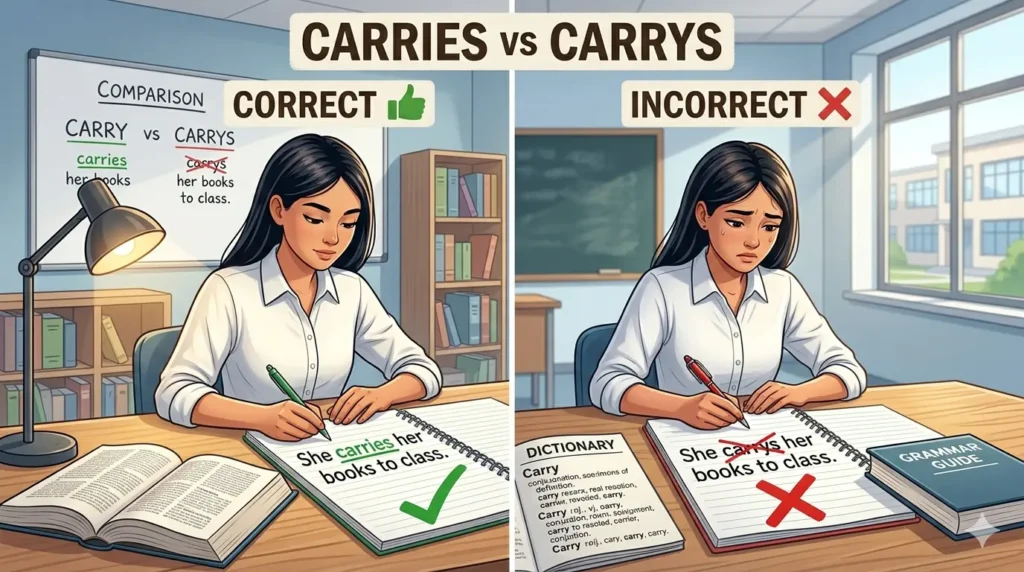
Many English learners and writers search for “carries or carrys” because the two words look very similar. One spelling seems simple, while the other feels natural when adding “s” to a verb. This confusion is common in school work, emails, blog posts, and even social media captions.
The good news is that the rule is easy once you understand it. In English grammar, verbs that end with a consonant + “y” often change before adding “es.” That is why many people stop and wonder whether the correct spelling is “carries” or “carrys.”
This article explains the correct spelling, where the word comes from, and how British and American English use it. You will also learn common mistakes, real-life examples, and helpful grammar tips. By the end, you will know exactly when to use “carries” and why “carrys” is incorrect.
Carries or Carrys – Quick Answer
The correct spelling is “carries.”
“Carrys” is incorrect and not accepted in standard English.
Correct Examples
- She carries her books to school.
- The truck carries food across the city.
- He carries a laptop every day.
Incorrect Examples
- She carrys her books.
- The bus carrys passengers.
Simple Grammar Rule
When a verb ends with a consonant + y, change the y to i and add es.
| Base Verb | Correct Form |
| Carry | Carries |
| Study | Studies |
| Try | Tries |
The Origin of Carries or Carrys
The word “carry” comes from Old French and Anglo-Norman words related to moving or transporting something. Over time, English adopted the word and created different forms like:
- Carry
- Carries
- Carried
- Carrying
The confusion between “carries” and “carrys” exists because English spelling rules are not always simple. Many words only add “s” in the third-person singular form, such as:
- Walk → Walks
- Read → Reads
But verbs ending in consonant + y follow a different pattern:
- Carry → Carries
- Fly → Flies
- Cry → Cries
This spelling change helps pronunciation sound smoother in spoken English.
What or Which? Meaning and Differences
British English vs American English Spelling
Both British English and American English use the spelling “carries.” There is no regional difference for this word.
Some English words change spelling between the UK and the US, but “carries” stays the same in both styles.
Examples
| British English | American English |
| She carries a bag. | She carries a bag. |
| The train carries people. | The train carries people. |
| He carries documents. | He carries documents. |
Comparison Table
| Version | Correct Spelling | Accepted? |
| British English | Carries | Yes |
| American English | Carries | Yes |
| Informal Misspelling | Carrys | No |
So, whether you write for the UK, the US, Canada, Australia, or global readers, always use “carries.”
Hope or Dope: Meaning, Difference, Usage, and Complete Guide
Which Spelling Should You Use?
You should always use “carries” in professional, academic, and casual writing.
Use “Carries” For:
- School assignments
- Business emails
- News articles
- Blog posts
- Social media captions
- Books and reports
Audience-Based Advice
| Audience | Best Spelling |
| United States | Carries |
| United Kingdom | Carries |
| Canada | Carries |
| Australia | Carries |
| Global English Readers | Carries |
There is never a situation where “carrys” is considered correct in modern English.
Common Mistakes with Carries or Carrys
Many people make spelling mistakes because they forget the y → ies grammar rule.
Common Errors
| Incorrect | Correct |
| Carrys | Carries |
| Carrys books | Carries books |
| She carrys | She carries |
Why the Mistake Happens
People often think every verb simply adds “s.” But verbs ending in consonant + y need a spelling change first.
Easy Trick to Remember
If the word ends in:
- consonant + y → change y to ies
- vowel + y → just add s
Examples
| Word Type | Correct Form |
| Carry | Carries |
| Cry | Cries |
| Play | Plays |
| Enjoy | Enjoys |
Carries or Carrys in Everyday Examples
Seeing the word in real situations makes the rule easier to remember.
In Emails
- Sarah carries the meeting notes every week.
- The manager carries responsibility for the project.
In News Writing
- The ship carries oil across Europe.
- The airline carries thousands of passengers daily.
On Social Media
- She always carries positive energy.
- My backpack carries everything I need.
In Formal Writing
- The law carries serious penalties.
- This document carries important information.
Carries or Carrys – Google Trends & Usage Data
Searches for “carries or carrys” are common because many people are unsure about English spelling rules. Students, bloggers, and non-native speakers often search this keyword before writing.
Usage Insights
- “Carries” is widely used worldwide.
- “Carrys” appears mostly as a spelling mistake.
- English learners frequently search this term in:
- United States
- United Kingdom
- India
- Pakistan
- Philippines
Contexts Where People Use “Carries”
| Context | Example |
| School | She carries books. |
| Business | The company carries products. |
| Travel | The bus carries passengers. |
| Legal | The crime carries punishment. |
Comparison Table: Carries vs Carrys
| Word | Correct? | Meaning | Example |
| Carries | Yes | Third-person form of carry | He carries water. |
| Carrys | No | Misspelling | Incorrect usage |
FAQs About Carries or Carrys
Is “carrys” ever correct?
No. “Carrys” is always incorrect in standard English.
Why is it “carries” and not “carrys”?
Because verbs ending in consonant + y change the y to i before adding es.
What is the base form of “carries”?
The base verb is “carry.”
Is “carries” used in British English?
Yes. British English and American English both use “carries.”
How do I remember the rule?
Change y to ies when the word ends in a consonant + y.
Is “carrys” a real word?
No. “Carrys” is a spelling error.
Can I use “carries” in formal writing?
Yes. “Carries” is correct for formal and informal writing.
Conclusion
The spelling debate between “carries or carrys” is easy to solve once you know the grammar rule. The correct spelling is always “carries.” The word “carrys” is a common mistake and should never appear in professional or academic writing.
The reason is simple: verbs ending in a consonant + y change the y to i before adding “es.” This same rule applies to words like tries, flies, and cries. Both British English and American English follow this rule, so there is no regional difference to remember.
Using the correct spelling improves your writing and helps you look more professional. Whether you are sending emails, writing blog posts, posting on social media, or completing school work, choosing “carries” keeps your English clear and correct.
A simple grammar rule can prevent many spelling mistakes. Once you practice it a few times, remembering “carries” becomes natural and easy.

I am James Wilson, an author at GrammarTribe.com, specializing in English grammar and clear communication.
I create expert, reliable content to help learners write with confidence and accuracy.