
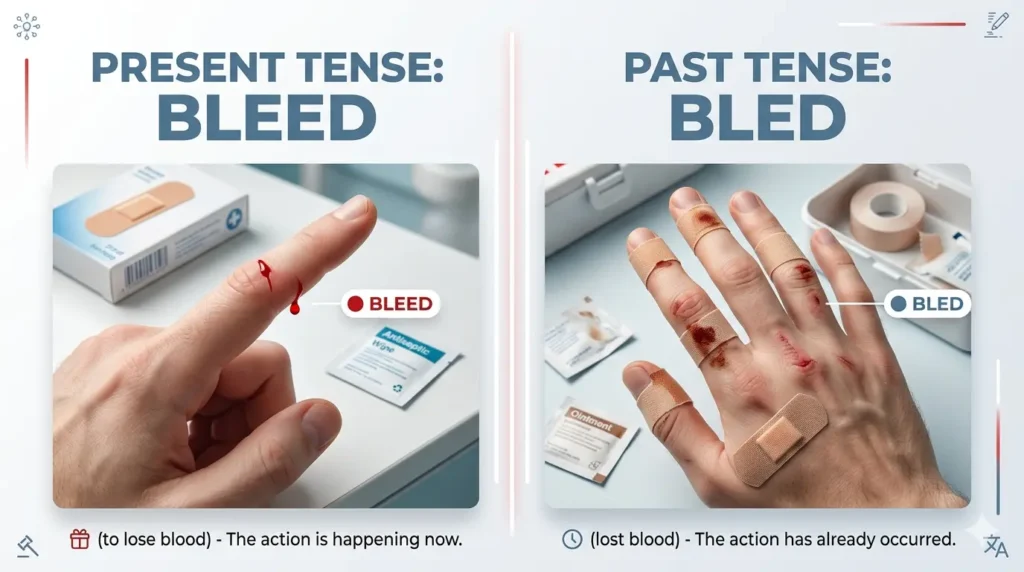
Many English learners get confused by “bleed or bled.” Both words look similar, but they are used in different ways. One is present tense, and the other is past tense. This small change often causes mistakes in writing, emails, schoolwork, and social media posts.
For example, should you say:
- “My finger bleed yesterday.”
- Or “My finger bled yesterday.”
The correct answer is “bled,” but many people still mix them up. This happens because English verbs often change form in irregular ways. Unlike simple verbs such as “walk” and “walked,” the verb “bleed” changes differently.
This guide explains the meaning of bleed or bled in very simple words. You will learn the correct grammar, history, spelling rules, common mistakes, and real-life examples. By the end, you will know exactly when to use each word with confidence.
Bleed or Bled – Quick Answer
The difference is simple:
| Word | Meaning | Tense | Example |
| Bleed | To lose blood | Present tense | “My cut may bleed again.” |
| Bled | Lost blood already | Past tense | “His nose bled yesterday.” |
Quick Rule
- Use bleed for the present or future.
- Use bled for the past.
Examples
- “If you touch the knife, you may bleed.”
- “He bled after the accident.”
Posted inCommon Spelling Mistakes Grammar Knowledge
Wholistic or Holistic: Understanding the Difference / Correct Usage
The Origin of Bleed or Bled
The word bleed comes from Old English. It started from the word “blēdan,” which meant “to let blood flow.”
Over time, English changed, but the basic meaning stayed the same. The past form became “bled.”
This is called an irregular verb. English has many irregular verbs, such as:
| Present | Past |
| Speak | Spoke |
| Write | Wrote |
| Bleed | Bled |
The spelling difference exists because older English verbs changed sounds instead of simply adding “-ed.”
That is why we say:
- “I bleed.”
- “I bled.”
Not:
- “I bleeded.”
British English vs American English Spelling
Good news: there is no spelling difference between British and American English for “bleed” and “bled.”
Both countries use the same forms.
Behavior or Behaviour – Which Spelling Is Correct?
Examples
| British English | American English |
| “The patient bled heavily.” | “The patient bled heavily.” |
| “Cuts can bleed badly.” | “Cuts can bleed badly.” |
Comparison Table
| Form | British English | American English |
| Present tense | Bleed | Bleed |
| Past tense | Bled | Bled |
| Past participle | Bled | Bled |
Unlike words such as “colour/color,” this verb does not change between regions.
Which Spelling Should You Use?
You should choose the word based on time, not country.
Use “Bleed” When:
- Talking about the present
- Talking about the future
- Giving warnings
Examples
- “The wound may bleed again.”
- “Do not touch the sharp edge or you could bleed.”
Use “Bled” When:
- Talking about something that already happened
Examples
- “She bled after falling.”
- “The dog bled from its paw.”
Audience-Based Advice
| Audience | Best Choice |
| US readers | Bleed / Bled |
| UK readers | Bleed / Bled |
| Global audience | Bleed / Bled |
The grammar stays the same everywhere.
Common Mistakes with Bleed or Bled
People often make grammar mistakes with these two words.
Mistake 1: Using “Bleed” for the Past
❌ “Yesterday my nose bleed.”
✅ “Yesterday my nose bled.”
Mistake 2: Saying “Bleeded”
❌ “He bleeded after the game.”
✅ “He bled after the game.”
“Bleeded” is not a real English word.
Mistake 3: Confusing Verb Forms
❌ “She has bleed a lot.”
✅ “She has bled a lot.”
After “has,” “have,” or “had,” use bled.
Quick Correction Table
| Incorrect | Correct |
| He bleed yesterday | He bled yesterday |
| She bleeded badly | She bled badly |
| They have bleed | They have bled |
Bleed or Bled in Everyday Examples
In Emails
- “The patient may bleed after surgery.”
- “The wound bled during treatment.”
In News Reports
- “The athlete bled after the collision.”
- “Doctors worked quickly to stop the bleeding.”
On Social Media
- “I cut my finger and it won’t stop bleeding.”
- “My nose bled during practice today.”
In Formal Writing
- “The victim bled heavily before help arrived.”
- “Some medicines can cause gums to bleed.”
Bleed or Bled – Google Trends & Usage Data
Searches for “bleed or bled” are common among:
- English learners
- Students
- Bloggers
- Grammar learners
People usually search this keyword because they are unsure about:
- Past tense forms
- Irregular verbs
- Correct grammar in writing
Countries Where Searches Are Popular
| Country | Common Search Intent |
| United States | Grammar correction |
| United Kingdom | Verb tense learning |
| India | English education |
| Pakistan | Spoken and written English |
| Philippines | ESL learning |
Usage Contexts
| Context | Common Form |
| Medical writing | Bleed / Bled |
| School grammar | Bled |
| Everyday speech | Both |
| News reports | Bled |
Comparison Table: Bleed vs Bled
| Feature | Bleed | Bled |
| Meaning | To lose blood | Lost blood |
| Tense | Present/Future | Past |
| Verb Type | Base verb | Past tense verb |
| Example | “Cuts bleed.” | “The cut bled.” |
| Common Error | Using for past tense | Writing “bleeded” |
FAQs About Bleed or Bled
Is “bled” the past tense of “bleed”?
Yes. “Bled” is the correct past tense and past participle of “bleed.”
Is “bleeded” a real word?
No. “Bleeded” is incorrect English grammar.
How do you use “bleed” in a sentence?
Example: “Open wounds can bleed badly.”
How do you use “bled” in a sentence?
Example: “His hand bled after the accident.”
Do British and American English spell it differently?
No. Both use “bleed” and “bled.”
Why is “bled” irregular?
English kept older verb sound changes instead of adding “-ed.”
Which is correct: “has bleed” or “has bled”?
“Has bled” is correct.
Example:
✅ “She has bled a lot.”
❌ “She has bleed a lot.”
Conclusion
Understanding bleed or bled is easier once you know the basic rule. Use bleed for the present or future, and use bled for the past. Even though the words look similar, they play different roles in English grammar.
This confusion happens because “bleed” is an irregular verb. Instead of adding “-ed,” the word changes form completely. That is why “bled” is correct, while “bleeded” is wrong.
The good news is that British and American English both use the same spelling, so you do not need to worry about regional differences. You only need to focus on the correct tense.
Remember these simple examples:
- “Cuts can bleed.”
- “His finger bled yesterday.”
Learning small grammar differences like this can improve your writing, speaking, emails, and schoolwork. The next time you see bleed or bled, you will know exactly which one to use.

I am James Wilson, an author at GrammarTribe.com, specializing in English grammar and clear communication.
I create expert, reliable content to help learners write with confidence and accuracy.