Many English learners get confused between “latter” and “ladder” because they look and sound somewhat similar. However, these two words have completely different meanings. This confusion often leads to mistakes in writing emails, exams, social media posts, and even professional documents. People search for “latter or ladder” to quickly understand which word is correct in a sentence and how to avoid embarrassing errors.
The word “latter” is used when talking about the second of two things mentioned. On the other hand, “ladder” is a physical object used for climbing. Mixing them up can change the meaning of a sentence completely. For example, saying “climb the latter” instead of “climb the ladder” can confuse readers.
This article will clearly explain the difference, origin, usage, examples, and common mistakes so you can use both words correctly with confidence in writing and speaking.
Latter or Ladder – Quick Answer
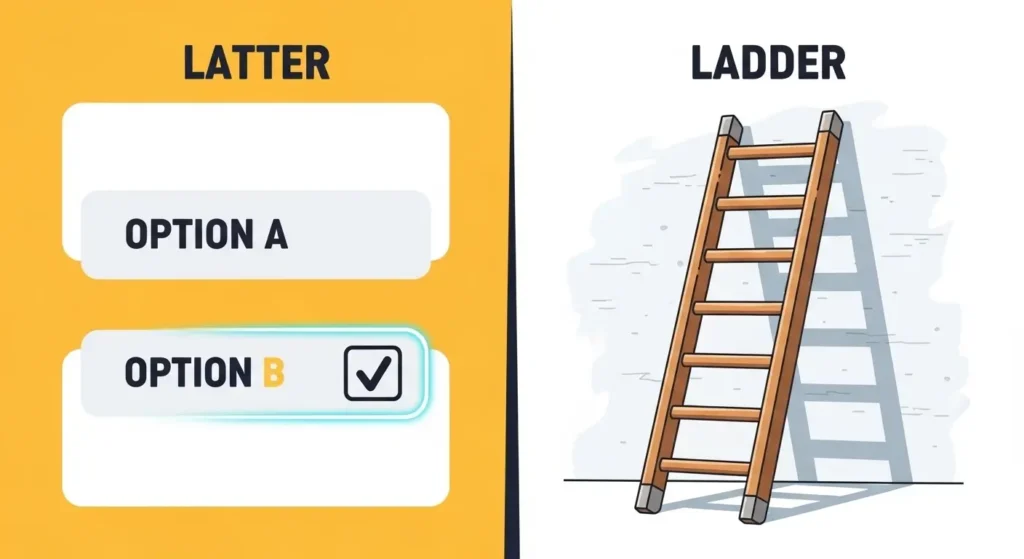
“Latter” means the second of two things.
“Ladder” is a tool used for climbing.
Examples:
- I like tea and coffee, but I prefer the latter.
- He climbed the ladder to fix the roof.
The Origin of Latter and Ladder
“Latter” comes from Old English lætra, meaning “later or second.” It is used in comparisons between two items.
“Ladder” comes from Old English “hlædder, meaning a tool with steps for climbing.
Although they sound similar, their meanings developed separately. The confusion happens only in modern English pronunciation and spelling similarity.
British English vs American English Spelling
There is no spelling difference between British and American English for these words. The confusion is not regional but semantic (meaning-based). Both forms use:
- Latter → same in UK and US
- Ladder → same in UK and US
Comparison Table
| Word | Meaning | Example Sentence |
| Latter | Second of two things | I chose tea and coffee; I prefer the latter. |
| Ladder | Climbing tool with steps | He climbed the ladder carefully. |
Which Spelling Should You Use?
You should use both words based on meaning, not region:
- Use latter in academic, formal, and analytical writing.
- Use ladder in physical descriptions or everyday speech.
This applies globally in all English variations including US, UK, Canada, and Australia.
Common Mistakes with Latter or Ladder
- ❌ He climbed the latter to fix the roof.
✔ He climbed the ladder to fix the roof. - ❌ I prefer the ladder option.
✔ I prefer the latter option. - ❌ The latter is made of wood steps.
✔ The ladder is made of wood steps.
Latter or Ladder in Everyday Examples
- Email: I prefer the latter option discussed in your proposal.
- News: The worker fell from a ladder at the construction site.
- Social Media: Coffee or tea? I’ll take the latter ☕
- Formal Writing: Between online and offline learning, the latter is more flexible.
Latter or Ladder – Google Trends & Usage Data
Search interest shows that “latter or ladder” is commonly searched in countries where English is a second language, especially in South Asia and the Middle East.
- High confusion in academic learners
- More searches during exam seasons
- Mostly used for grammar clarification, not casual speech
This shows that learners want quick clarity on meaning-based confusion rather than spelling rules.
FAQs
1. What is the difference between latter and ladder?
Latter means the second item; ladder is a climbing tool.
2. Can I use the latter for climbing?
No, that is incorrect. Use a ladder.
3. Is the latter plural or singular?
It refers to one of two things, usually singular in meaning.
4. Why do people confuse these words?
Because they sound similar when spoken.
5. Is ladder used in formal writing?
Yes, when describing physical objects.
6. Can the latter be used in conversation?
Yes, especially when comparing two things.
7. Are these words interchangeable?
No, they have completely different meanings.
Conclusion
Understanding the difference between “latter” and “ladder” is important for clear and correct English. Even though they sound similar, their meanings are not related at all. “Latter” is used when choosing between two ideas or items, while “ladder” refers to a physical object used for climbing. Many learners confuse these words, but once you remember their meanings, the mistake becomes easy to avoid.
In writing, using the correct word improves clarity and makes your communication more professional. Whether you are writing an essay, email, or social media post, choosing the right word helps avoid misunderstanding. Practice with examples and you will quickly master the difference. Keep in mind: “latter” is about order, and “ladder” is about climbing. With this simple rule, you will never mix them up again in everyday English usage.

Hi, I’m Henry William, the author of GrammarTribe.com. I’m passionate about the English language and have dedicated my career to helping people master grammar, spelling, and effective writing. Over the years, I’ve guided learners, writers, and professionals in understanding common mistakes, tricky rules, and nuances of English grammar in a simple and easy-to-follow way.
Through GrammarTribe.com, I aim to make grammar approachable and enjoyable for everyone. My work focuses on providing clear explanations, practical tips, and examples that readers can apply in everyday writing, whether it’s emails, essays, social media, or professional documents. I believe that strong grammar skills empower people to communicate confidently and professionally.
When I’m not writing or researching grammar, I enjoy reading, exploring language trends, and creating educational content that simplifies complex concepts. I’m committed to helping my audience write better, understand English deeply, and avoid common pitfalls, all while making learning grammar a fun and rewarding journey.