Many English learners and even native speakers often get confused between “through” and “threw.” At first glance, they look and sound similar, but they have completely different meanings and uses. This confusion leads to common writing mistakes in emails, essays, exams, and even social media posts.
People usually search for this keyword because they are unsure whether they should write “I threw the ball” or “I threw the ball.” Only one of these is correct, and using the wrong one can change the entire meaning of a sentence.
This article solves that confusion in a very simple way. You will learn the exact difference between “through” and “threw,” where these words come from, how they are used in British and American English, and what mistakes to avoid. You will also see real-life examples, usage trends, and a clear comparison table. By the end, you will confidently know when to use each word correctly in speaking and writing.
Through or Threw – Quick Answer
“Through” and “threw” are not interchangeable.
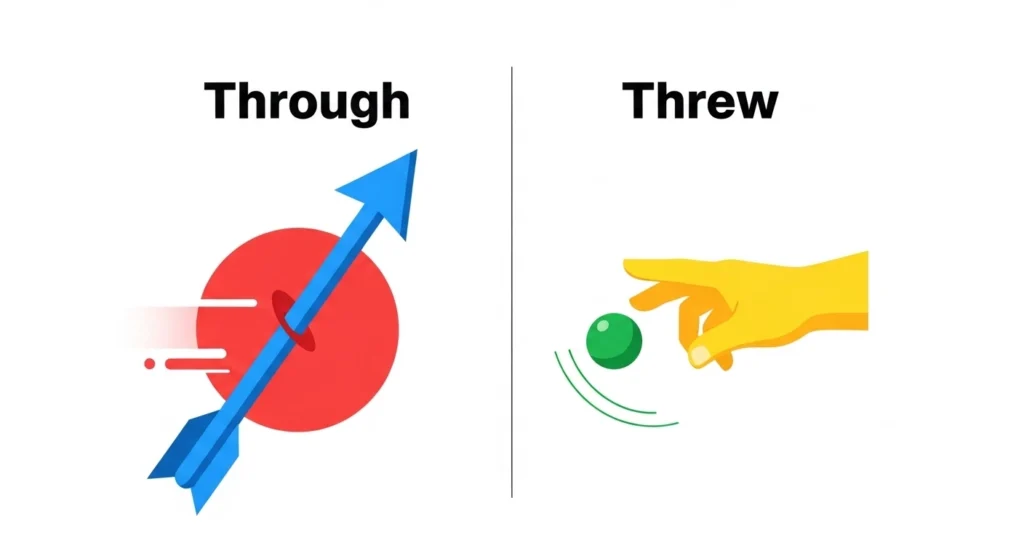
- Through → preposition/adverb meaning movement, passage, or completion
- Example: She walked through the door.
- Threw → past tense of “throw” meaning to toss or hurl something
- Example: He threw the ball.
👉 Simple rule:
- If it shows movement or passing through
- If it shows action of throwing = threw
The Origin of Through and Threw
Both words come from Old English but developed differently.
- Through comes from Old English “þurh” meaning “by, across, or among.”
- Throw / Threw comes from Old English “þrawan” meaning “to twist or hurl.”
Over time:
- “Throw” became the base verb.
- “Threw” became its past tense form.
- “Through” stayed as a preposition describing movement or completion.
This is why they look similar but have different grammar roles.
British English vs American English Spelling
Good news: both British and American English use “through” and “threw” the same way.
There is no spelling difference between UK and US usage for these words.
However, confusion often happens in both dialects due to pronunciation similarity.
Comparison Table
| Word | Type | Meaning | Example Sentence |
| Through | Preposition | Passing or completion | We walked through the park. |
| Threw | Verb (past) | Past action of throw | She threw the stone. |
Which Spelling Should You Use?
- USA English: Use standard grammar rules (no change in spelling)
- UK English: Same usage as US English
- Global English: Always follow meaning, not region
👉 Rule: Focus on meaning, not location
Common Mistakes with Through and Threw
Here are frequent errors learners make:
❌ I through the ball.
✔ I threw the ball.
❌ We walked threw the tunnel.
✔ We walked through the tunnel.
❌ She threw the problem.
✔ She worked through the problem.
👉 Tip:
- “threw” = action (past tense verb)
- “through” = direction, passage, or completion
Through and Threw in Everyday Examples
Emails
- We went through your request carefully.
- He threw the draft away by mistake.
News Writing
- The athlete threw the javelin 80 meters.
- The team worked through the challenges.
Social Media
- “I threw my old habits away 💪”
- “Going through a tough week 😔”
Formal Writing
- The committee went through all the documents.
- The speaker threw light on the issue.
Through vs Threw – Google Trends & Usage Data
Search behavior shows:
- “Through” is far more commonly searched due to multiple meanings (passage, time, completion).
- “Threw” spikes in educational contexts (grammar tests, learning English).
- Countries with high searches: India, Pakistan, Bangladesh, and non-native English learners worldwide.
👉 Insight:
Most confusion comes from ESL (English as Second Language) learners.
Comparison Table: Through vs Threw
| Feature | Through | Threw |
| Word Type | Preposition/Adverb | Verb (past tense) |
| Meaning | Movement or completion | Past action of throw |
| Base Word | — | Throw |
| Example | Walk through door | Threw the ball |
| Usage Context | Direction, time, result | Physical action |
FAQs
1. What is the difference between through and threw?
“Through” shows movement or completion, while “threw” is the past tense of “throw.”
2. Is it correct to say “through the ball”?
No. The correct form is “threw the ball.”
3. Can through be used as a verb?
No. It is mainly a preposition or adverb.
4. Why do people confuse through and threw?
Because they sound similar but have different grammar roles.
5. What is the past tense of throw?
The past tense is “threw.”
6. Is through British or American English?
It is used in both. There is no spelling difference.
7. How can I remember the difference easily?
Think: “throw → threw (action), through → passage (path)”
Conclusion
Understanding the difference between through and threw is simple once you focus on meaning instead of sound. These two words confuse many learners because they look similar and are pronounced in a close way, but they belong to completely different grammar categories. “Through” is used when talking about movement, direction, or completion of something, while “threw” is the past tense of the verb “throw,” used for actions involving tossing or hurling objects.
The key to mastering these words is practice and exposure. Reading sentences, writing your own examples, and correcting mistakes will help you remember them naturally. Both British and American English follow the same rules, so you do not need to worry about regional differences.
If you are writing emails, essays, or social media posts, using the correct form will make your English clearer and more professional. With the examples and tables provided in this guide, you can now confidently choose the right word every time and avoid one of the most common English mistakes.

I am James Wilson, an author at GrammarTribe.com, specializing in English grammar and clear communication.
I create expert, reliable content to help learners write with confidence and accuracy.