
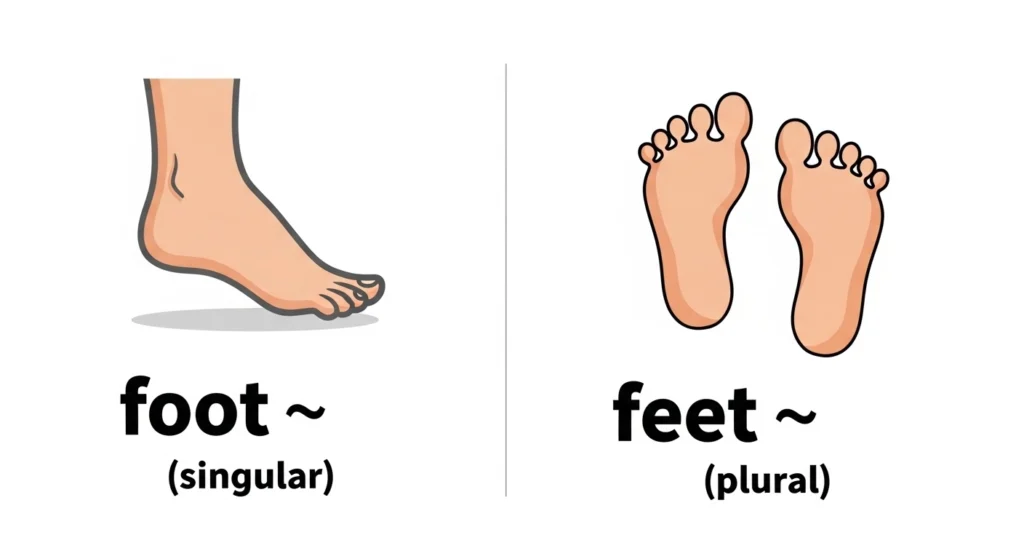
Many English learners get confused between “foot” and “feet.” They often ask: Which one is correct? or When should I use each word? This confusion is very common because both words refer to the same body part, but they change depending on the number. Even native speakers sometimes mix them in fast speech or informal writing.
The problem becomes bigger when people use these words in measurements, writing, or exams. For example, should you say “6 foot tall” or “6 feet tall”? Or is “one feet” correct? These small doubts can change the meaning of a sentence and affect grammar accuracy.
In simple terms, “foot” is singular, and “feet” is plural, but English usage is not always that simple. There are rules, exceptions, and style differences between British and American English.
In this article, you will learn the clear difference between feet or feet, their origin, correct usage, common mistakes, and real-life examples. By the end, you will know exactly which word to use in speaking and writing without confusion.
Feet or Foot – Quick Answer
Foot is used when talking about one unit.
Feet is used when talking about more than one.
Examples:
- I hurt my foot. (one foot)
- She has small feet. (two feet)
- The wall is 10 feet high. (measurement)
👉 Simple rule:
- 1 = foot
- 2 or more = feet
Barbeque or Barbecue: Which Spelling Is Correct ?
The Origin of Feet or Foot
The word “foot” comes from Old English “fōt”, which meant the lower part of the leg. Over time, English changed spelling and pronunciation.
The plural form “feet” comes from a very old language pattern called i-mutation (or vowel change). Instead of adding “-s,” the word changes its vowel:
- foot → feet
- tooth → teeth
- goose → geese
This is why English is sometimes irregular. It keeps old historical forms instead of following simple rules.
British English vs American English Spelling
Good news: Both British and American English use “foot” and “feet” the same way.
There is no spelling difference between the two.
However, usage in measurements can differ slightly in style.
Lovable or Loveable: Which Spelling Is Correct?
Comparison Table
| Situation | British English | American English |
| One unit | 1 foot | 1 foot |
| Multiple units | 5 feet | 5 feet |
| Height style | 6 foot / 6 feet (both used) | 6 feet (more common) |
| Formal writing | prefers “feet” | prefers “feet” |
👉 Conclusion: No spelling change, only style preference.
Which Spelling Should You Use?
It depends on your audience:
- USA readers → Use “feet” for measurements (more common)
- UK & Commonwealth → Both “foot” and “feet” used in casual speech
- Global English → Always prefer “feet” for plural and measurements
👉 Best rule:
Use foot = singular, feet = plural in all writing. This is universally accepted.
Common Mistakes with Feet or Foot
Here are frequent errors:
❌ I am 6 foot tall. (informal error in writing)
✔ I am 6 feet tall.
👉 Tip: Never add “-s” to “foot.”
Feet or Foot in Everyday Examples
1. Emails
- “The package is 4 feet long and 2 feet wide.”
2. News Writing
- “A 10-foot wall collapsed during the storm.”
3. Social Media
- “I walked 10,000 steps—my feet are tired!”
4. Formal Writing
- “The structure measures 15 feet in height.”
👉 In all contexts, feet is used for plural measurements, and foot for singular.
Feet or Foot – Google Trends & Usage Data
Search data shows:
- “feet or foot difference” is highly searched in India, Pakistan, and Bangladesh
- “6 foot vs 6 feet” is popular in USA and UK
- Most confusion happens in education and exam preparation searches
👉 Insight:
People mostly search for this keyword when writing English exams, captions, or measurements.
Comparison Table: Feet vs Foot
| Feature | Foot | Feet |
| Type | Singular | Plural |
| Meaning | One unit | More than one unit |
| Example | 1 foot | 2 feet |
| Usage | Body part, measurement | Body part, measurement |
| Rule | Never add “s” | Irregular plural form |
FAQs About Feet or Foot
1. Is it 6 feet or 6 feet?
Both are spoken, but “6 feet” is grammatically correct in writing.
2. Can I say “one foot”?
No. The correct form is one foot.
3. Why are foot plural feet?
Because English has an old vowel change rule (foot → feet), not regular “-s” plural.
4. Are feet singular or plural?
Feet is plural.
5. What is the short form of feet?
It is written as ft (example: 5 ft).
6. Can foot be used for height?
Yes, but only in singular form or combined usage like “6-foot man.”
7. Is “foot” still used today?
Yes, but mostly in singular form or compound adjectives.
Conclusion
Understanding the difference between feet or foot is simple once you know the basic rule: foot is singular and feet is plural. This small grammar difference is very important in both speaking and writing English correctly. Many learners make mistakes like saying “one feet” or “6 foot tall,” but these errors can be easily fixed with practice.
The origin of these words shows that English keeps many old language patterns, which is why irregular plurals like “feet” still exist today. Although British and American English do not change the spelling, they may differ slightly in style, especially in measurements.
In everyday life, “feet” is used more often because we usually talk about more than one unit, especially in height, distance, and size. Learning the correct usage helps improve grammar accuracy in exams, professional writing, and communication.

Hi, I’m Henry William, the author of GrammarTribe.com. I’m passionate about the English language and have dedicated my career to helping people master grammar, spelling, and effective writing. Over the years, I’ve guided learners, writers, and professionals in understanding common mistakes, tricky rules, and nuances of English grammar in a simple and easy-to-follow way.
Through GrammarTribe.com, I aim to make grammar approachable and enjoyable for everyone. My work focuses on providing clear explanations, practical tips, and examples that readers can apply in everyday writing, whether it’s emails, essays, social media, or professional documents. I believe that strong grammar skills empower people to communicate confidently and professionally.
When I’m not writing or researching grammar, I enjoy reading, exploring language trends, and creating educational content that simplifies complex concepts. I’m committed to helping my audience write better, understand English deeply, and avoid common pitfalls, all while making learning grammar a fun and rewarding journey.