
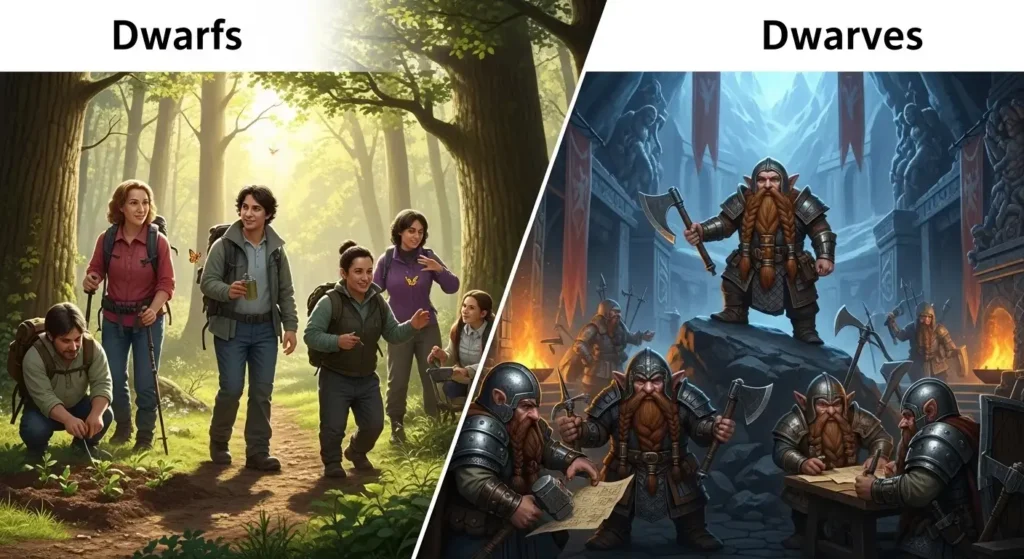
Have you ever stopped while writing and wondered: Is it “dwarfs” or “dwarves”? You’re not alone. This keyword is commonly searched because both spellings exist, and both seem correct but they are used in different contexts. That confusion can make writers, students, and even professionals hesitate.
The truth is, English has evolved over time, and certain words developed multiple accepted forms. “Dwarfs” and “dwarves” are a perfect example of this. One is more traditional and widely accepted in formal English, while the other gained popularity through literature and fantasy.
This article clears up the confusion once and for all. You’ll learn the correct usage, history, regional differences, and practical examples. By the end, you’ll know exactly which spelling to use and when.
Dwarfs or Dwarves – Quick Answer
Both “dwarfs” and “dwarves” are correct plural forms of dwarf, but they are used differently.
- Dwarfs → Standard plural form (used in science, formal writing)
- Dwarves → Used in fantasy or storytelling (popularized by Tolkien)
Examples:
- Scientists study dwarfs (e.g., white dwarfs in astronomy).
- In fantasy stories, you read about dwarves (e.g., The Lord of the Rings).
👉 Simple rule:
Use dwarfs for real-world contexts, and dwarves for fictional ones.
Psalm or Psalms: Meaning, Difference, and Correct Usage?
The Origin of Dwarfs or Dwarves
The word dwarf comes from Old English “dweorg”, meaning a small mythical being.
Originally, the plural was “dwarfs.” This follows normal English rules (add -s).
However, author J.R.R. Tolkien changed the game. In his famous fantasy books, he used “dwarves” instead of “dwarfs” to sound more ancient and unique. His work became so popular that the new spelling spread across fantasy writing.
So today:
- Dwarfs = original, standard form
- Dwarves = creative, literary variation
Losses or Loses: What Is the Correct Spelling ?
British English vs American English Spelling
Interestingly, both British and American English accept “dwarfs” as the standard form. The difference is more about context, not region.
Comparison Table:
| Context | British English | American English | Preferred Form |
| Science | Dwarfs | Dwarfs | Dwarfs |
| Medicine | Dwarfs | Dwarfs | Dwarfs |
| Fantasy Literature | Dwarves | Dwarves | Dwarves |
| General Writing | Dwarfs | Dwarfs | Dwarfs |
👉 Key point: Both regions follow the same rule context matters more than location.
Which Spelling Should You Use?
Choosing the right spelling depends on your audience:
- For US readers: Use dwarfs in formal or real topics
- For UK/Commonwealth readers: Same rule prefer dwarfs
- For global or mixed audience: Use dwarfs unless writing fiction
- For fantasy fans or storytelling: Use dwarves
👉 Safe choice:
If unsure, go with dwarfs. It is widely accepted everywhere.
Common Mistakes with Dwarfs or Dwarves
Here are frequent errors and how to fix them:
❌ Using dwarves in science writing
✔ Correct: Scientists study dwarfs
❌ Mixing both forms in one text
✔ Stick to one form based on context
❌ Assuming “dwarves” is more correct
✔ Both are correct, but used differently
❌ Using “dwarfs” in fantasy novels
✔ Use dwarves for storytelling
Dwarfs or Dwarves in Everyday Examples
Emails:
- “The report includes data on white dwarfs.”
News:
- “Astronomers discovered new dwarfs in the galaxy.”
Social Media:
- “I love fantasy stories with elves and dwarves!”
Formal Writing:
- “Medical research focuses on conditions affecting dwarfs.”
Dwarfs or Dwarves – Google Trends & Usage Data
Search trends show:
- “Dwarfs” is more common worldwide, especially in:
- Education
- Science
- News
- “Dwarves” is popular in:
- Fantasy communities
- Gaming
- Movies and books
Usage Insight:
- USA, UK, Canada → Prefer dwarfs in formal use
- Global fantasy audience → Uses dwarves
Keyword Comparison Table
| Word Form | Usage Type | Example | Popularity |
| Dwarf | Singular | A dwarf star | High |
| Dwarfs | Standard plural | Many dwarfs in astronomy | Very High |
| Dwarves | Fantasy plural | A group of dwarves in a story | Medium |
FAQs About Dwarfs or Dwarves
1. Is “dwarves” grammatically correct?
Yes, but mainly in fantasy or creative writing.
2. Which is more common: dwarfs or dwarves?
Dwarfs is more common in general and formal English.
3. Why did Tolkien use “dwarves”?
He wanted a unique and ancient feel for his fictional race.
4. Can I use “dwarves” in academic writing?
No, use dwarfs in academic or scientific contexts.
5. Are both spellings accepted in dictionaries?
Yes, both are correct with different uses.
6. Is “dwarfs” outdated?
No, it is the standard and widely accepted form.
7. Do Americans and British use different forms?
No, both use dwarfs for standard writing.
Conclusion
The confusion between dwarfs or dwarves comes from history and storytelling. While both spellings are correct, they are not always interchangeable. “Dwarfs” is the original and standard plural form used in science, medicine, and formal writing. On the other hand, “dwarves” gained popularity through fantasy literature and is now widely used in fictional contexts.
Understanding this difference makes your writing clearer and more professional. If you are writing for a general or academic audience, always choose dwarfs. If you are creating stories, games, or fantasy content, dwarves is the better fit.
In simple terms, think of it this way: real world equals dwarfs, imaginary world equals dwarves. Once you remember this rule, you’ll never be confused again. Choosing the right spelling shows attention to detail and improves your credibility as a writer.

Hi, I’m Henry William, the author of GrammarTribe.com. I’m passionate about the English language and have dedicated my career to helping people master grammar, spelling, and effective writing. Over the years, I’ve guided learners, writers, and professionals in understanding common mistakes, tricky rules, and nuances of English grammar in a simple and easy-to-follow way.
Through GrammarTribe.com, I aim to make grammar approachable and enjoyable for everyone. My work focuses on providing clear explanations, practical tips, and examples that readers can apply in everyday writing, whether it’s emails, essays, social media, or professional documents. I believe that strong grammar skills empower people to communicate confidently and professionally.
When I’m not writing or researching grammar, I enjoy reading, exploring language trends, and creating educational content that simplifies complex concepts. I’m committed to helping my audience write better, understand English deeply, and avoid common pitfalls, all while making learning grammar a fun and rewarding journey.