Many English learners get confused between “carries” and “carrys.” At first glance, both look similar, but only one is correct in standard English. This confusion happens because English spelling rules change when verbs end in “y.” People often search this keyword when writing emails, school assignments, social media posts, or professional content and want to avoid mistakes.
The main problem is simple: English changes spelling when adding “-s” to some verbs. So users are unsure whether to write carry + s = carrys or carries. This small doubt can affect confidence in writing and sometimes even grades or professional communication.
In this article, you will learn the correct spelling, why the mistake happens, its origin, and how to use it correctly in real life. You will also see comparisons, examples, and common mistakes so you never get confused again.
Carries or Carrys – Quick Answer
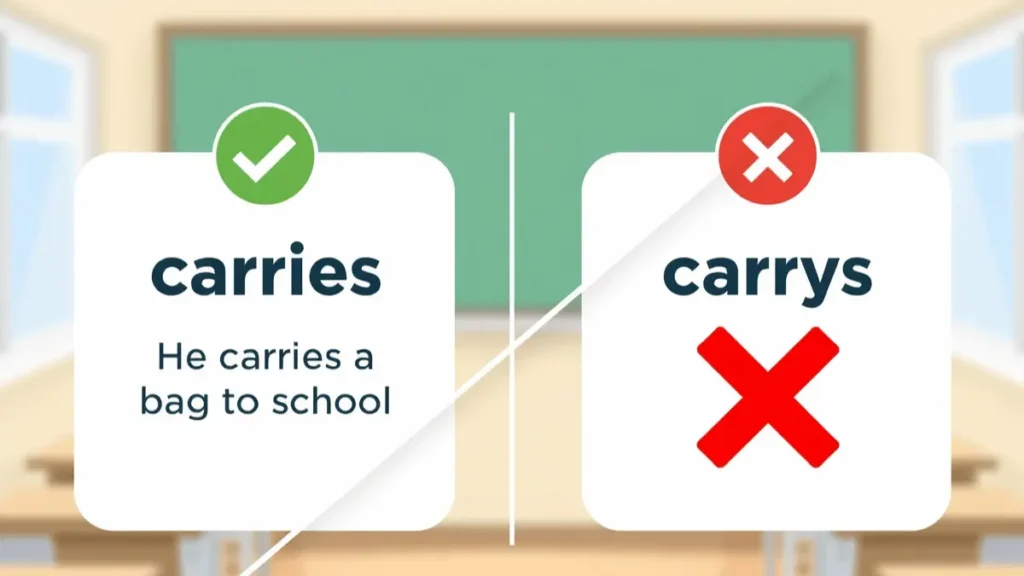
The correct spelling is carries.
❌ carrys (wrong)
✔ carries (correct)
Examples:
- She carries a heavy bag every day.
- The truck carries goods to the city.
- He carries responsibility well.
👉 Rule: When a verb ends in consonant + y, change y → i and add es.
So:
- carry → carries
- try → tries
- study → studies
Tought or Taught: Meaning and Difference?
The Origin of “Carries”
The word carry comes from Old Northern French carier, meaning “to transport in a vehicle.” Over time, English adopted it and changed its spelling rules.
In Old English grammar, verbs followed different patterns. Modern English simplified them but kept special rules for verbs ending in “y.” That is why we now change y to i + es in third-person singular form.
The incorrect form “carrys” appears because learners assume English simply adds “s” to all verbs. But English has hidden spelling rules that must be followed.
British English vs American English Spelling
Good news: “carries” is correct in both British and American English.
There is no difference here.
But English spelling rules still matter across both forms.
Biting or Bitting: Which Spelling Is Correct?
Comparison Table
| Base Verb | Correct Form | Incorrect Form | Rule |
| carry | carries | carrys ❌ | y → i + es |
| try | tries | trys ❌ | y → i + es |
| study | studies | studyes ❌ | y → i + es |
| play | plays | plaies ❌ | vowel before y, just add s |
Which Spelling Should You Use?
- USA English: carries ✔
- UK English: carries ✔
- Canada / Australia / Global English: carries ✔
👉 Conclusion: There is only one correct form worldwide: carries
Common Mistakes with Carries
Here are mistakes learners often make:
❌ Adding only “s” → carrys
✔ Correct → carries
❌ Forgetting the rule
✔ Remember: y → i + es
❌ Mixing forms in writing
Example mistake:
- She carrys books to school ❌
- She carries books to school ✔
Carries in Everyday Examples
1. Emails
- The manager carries out daily reports.
2. News Writing
- The vehicle carries medical supplies to remote areas.
3. Social Media
- My backpack carries everything I need for travel.
4. Academic Writing
- The theory carries important implications for science.
Carries – Google Trends & Usage Data
The word “carries” is widely used in:
- Education content (grammar lessons)
- Writing tools and apps
- ESL (English as Second Language) learning platforms
Search interest is high in:
- India
- Pakistan
- Bangladesh
- Middle East
- Non-native English-speaking countries
The incorrect form “carrys” appears mainly due to spelling confusion in early learning stages.
👉 Insight: Most searches are from students trying to confirm correct grammar before exams or writing tasks.
Comparison Table: Carries vs Carrys
| Feature | Carries | Carrys |
| Correct spelling | ✔ Yes | ❌ No |
| Used in English | Yes | No |
| Grammar rule followed | Yes | No |
| Accepted in dictionaries | Yes | No |
| Example | She carries books | She carrys books ❌ |
FAQs about Carries or Carrys
1. Which is correct: carries or carrys?
Carries is correct. Carrys is wrong.
2. Why do people write carrys?
Because they think English only adds “s” to verbs, but spelling rules change for “y” endings.
3. What is the rule for carries?
Change y → i + es when a verb ends in consonant + y.
4. Is carrys ever used in English?
No. It is always incorrect in standard English.
5. Can I use carries in formal writing?
Yes, it is fully correct in formal, academic, and professional writing.
6. Does British English use carrys?
No. Both British and American English use carries.
7. What are similar words to carries?
Tries, studies, flies, applies—all follow the same rule.
Conclusion
Understanding the difference between carries and carrys is simple once you know the rule. English often changes spelling when verbs end in “y,” and this is one of the most important patterns to remember.
The correct form is always carried, whether you are writing for school, work, or social media. The incorrect form carrys is a common mistake but is not accepted in standard English.
By learning this small rule—y changes to i + es—you can avoid many grammar errors in the future. It also helps you sound more professional and confident in writing.
Next time you write, just pause and check: if the verb ends in consonant + y, use carries and not carrys. That one small step will instantly improve your English accuracy.

Hi, I’m Henry William, the author of GrammarTribe.com. I’m passionate about the English language and have dedicated my career to helping people master grammar, spelling, and effective writing. Over the years, I’ve guided learners, writers, and professionals in understanding common mistakes, tricky rules, and nuances of English grammar in a simple and easy-to-follow way.
Through GrammarTribe.com, I aim to make grammar approachable and enjoyable for everyone. My work focuses on providing clear explanations, practical tips, and examples that readers can apply in everyday writing, whether it’s emails, essays, social media, or professional documents. I believe that strong grammar skills empower people to communicate confidently and professionally.
When I’m not writing or researching grammar, I enjoy reading, exploring language trends, and creating educational content that simplifies complex concepts. I’m committed to helping my audience write better, understand English deeply, and avoid common pitfalls, all while making learning grammar a fun and rewarding journey.