
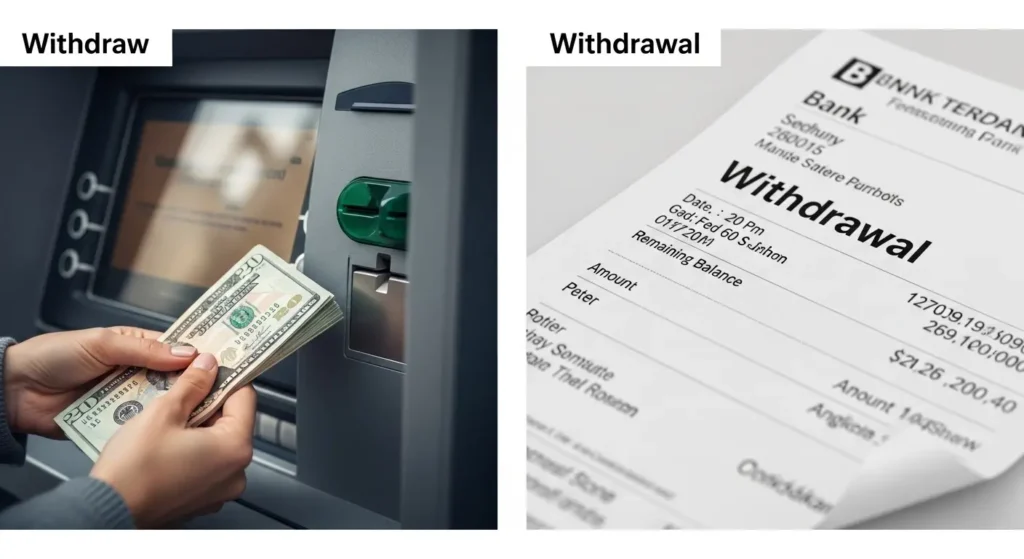
Many English learners, students, job applicants, and even professionals often get confused between the words “withdraw” and “withdrawal.” At first glance, they look similar, but their usage is quite different.
This confusion becomes more common when dealing with banking transactions, exams, academic forms, or online applications. For example, people may ask: “Is it correct to say bank withdrawal or bank withdrawal?” or “I want to withdraw money vs I made a withdrawal. What’s right?”
The reason behind this confusion is that both words come from the same root but serve different grammatical roles. One is a verb, and the other is a noun, which changes how they are used in sentences. In digital banking, finance apps, and formal writing, using the wrong form can make sentences unclear or incorrect.
In this article, you will learn the clear difference between withdraw and withdrawal, their origins, spelling rules, real-life examples, and when to use each one correctly. This guide will help you avoid common mistakes and improve your English accuracy in everyday communication.
Withdraw or Withdrawal – Quick Answer
“Withdraw” is a verb meaning to take something back or remove something.
“Withdrawal” is a noun meaning the act of withdrawing or the amount taken out.
Examples:
- I will withdraw money from the bank. (verb)
- I made a cash withdrawal yesterday. (noun)
- She decided to withdraw her application.
- His withdrawal from the competition shocked everyone.
👉 Simple rule:
- Action = withdraw
- Thing/event = withdrawal
Separate or Seperate: Which Spelling Is Correct ?
The Origin of Withdraw and Withdrawal
Both words come from Old English and Middle English roots.
- Withdraw comes from “with” + “draw,” meaning “to pull back.”
- It was used in early English to describe pulling something away or back.
- Over time, it became a common verb in finance, war, and personal decisions.
- Withdrawal developed later as a noun form.
- The suffix “-al” was added to turn verbs into nouns (like approve → approval, refuse → refusal).
This explains why both words are connected but serve different grammar roles.
Patient or Pacient: Correct Spelling, Meaning, and Usage Explained
British English vs American English Spelling
Good news: there is no spelling difference between British and American English for these words.
Both regions use:
- withdraw
- withdrawal
However, differences appear in usage style, not spelling. Americans often use “withdrawal” more in banking and medical contexts, while British English uses it more formally in written reports.
Comparison Table
| Feature | Withdraw (Verb) | Withdrawal (Noun) |
| Meaning | To remove or take back | The act of removing |
| Grammar Role | Verb | Noun |
| Example | I withdraw money | A cash withdrawal |
| Usage Context | Action-based sentences | Event or result |
| Common Field | Banking, decisions | Finance, medicine |
Which Spelling Should You Use?
Since spelling is the same in both US and UK English, your focus should be on correct usage:
- US English users: Common in banking apps and daily finance talk
- UK/Commonwealth users: Used in formal writing, education, and finance reports
- Global users: Both forms are standard worldwide
👉 Best advice:
Use withdraw when talking about action, and withdrawal when talking about the result or noun form.
Common Mistakes with Withdraw and Withdrawal
1. Wrong verb use
❌ I will withdrawal money
✔ I will withdraw money
2. Wrong noun use
❌ I made a withdraw yesterday
✔ I made a withdrawal yesterday
3. Mixing forms
❌ Bank withdraw fee
✔ Bank withdrawal fee
4. Spelling confusion in fast writing
People often type “withdrawl” (wrong spelling).
✔ Correct: withdrawal
Withdraw and Withdrawal in Everyday Examples
Banking:
- I need to withdraw cash from the ATM.
- There is a daily withdrawal limit.
Email:
- We have decided to withdraw our job application.
- Please confirm your withdrawal request.
News:
- The company announced its withdrawal from the market.
- Troops will withdraw from the area.
Social Media:
- “I’m going to withdraw from social media for a week.”
- “Mental health break and digital withdrawal.”
Formal Writing:
- Withdrawal of consent is required before processing.
- Students may withdraw from courses before the deadline.
Withdraw vs Withdrawal – Google Trends & Usage Insight
Search data shows:
- “withdraw” is more commonly searched in daily actions (banking, exams, apps)
- “withdrawal” is more common in finance, medical, and legal contexts
- High search interest appears in countries like:
- United States
- United Kingdom
- India
- Pakistan
- Philippines
👉 Insight:
People usually search “withdraw money” for action and “withdrawal meaning” for understanding concepts.
Comparison Table: Withdraw vs Withdrawal
| Word | Type | Meaning | Example Sentence |
| Withdraw | Verb | To take back/remove | I will withdraw cash. |
| Withdrawal | Noun | Act of taking back | The withdrawal was successful. |
| Withdrawn | Verb (past) | Already removed | He has withdrawn the request. |
| Withdrawals | Noun (plural) | Multiple acts | Monthly withdrawals are tracked. |
FAQs about Withdraw and Withdrawal
1. What is the main difference between withdraw and withdrawal?
Withdraw is a verb (action), while withdrawal is a noun (result of action).
2. Can I say “I withdrawal money”?
No. The correct form is “I withdraw money.”
3. What is the correct spelling: withdrawl or withdrawal?
Correct spelling is withdrawal.
4. Is withdrawal used in banking only?
No, it is also used in medicine, sports, education, and legal contexts.
5. What is the past tense of withdraw?
The past tense is withdrew and past participle is withdrawn.
6. Is withdraw formal or informal?
It is neutral and used in both formal and informal English.
7. Can withdrawal be plural?
Yes, the plural form is withdrawals.
Conclusion
Understanding the difference between withdraw and withdrawal is important for clear and correct English communication. Although both words come from the same root, they serve different grammatical purposes. “Withdraw” is used when describing an action, such as taking money from a bank or removing an application. On the other hand, “withdrawal” refers to the result of that action, such as a banking transaction or a decision to step back from something.
This difference may seem small, but using the correct form improves your writing clarity and professionalism. Whether you are filling out bank forms, writing emails, or speaking in daily conversation, choosing the right word helps you communicate without confusion. Remember the simple rule: withdraw = action, withdrawal = result. With practice, this distinction becomes easy and natural. Mastering such word pairs will significantly improve your English fluency and confidence in both academic and real-world situations.

Hi, I’m Henry William, the author of GrammarTribe.com. I’m passionate about the English language and have dedicated my career to helping people master grammar, spelling, and effective writing. Over the years, I’ve guided learners, writers, and professionals in understanding common mistakes, tricky rules, and nuances of English grammar in a simple and easy-to-follow way.
Through GrammarTribe.com, I aim to make grammar approachable and enjoyable for everyone. My work focuses on providing clear explanations, practical tips, and examples that readers can apply in everyday writing, whether it’s emails, essays, social media, or professional documents. I believe that strong grammar skills empower people to communicate confidently and professionally.
When I’m not writing or researching grammar, I enjoy reading, exploring language trends, and creating educational content that simplifies complex concepts. I’m committed to helping my audience write better, understand English deeply, and avoid common pitfalls, all while making learning grammar a fun and rewarding journey.