Many people get confused when they see the words “psalm” and “psalms.” They look almost the same, but they are not always used in the same way. This small difference often causes problems for students, Bible readers, writers, and English learners. Some people wonder if one of them is correct and the other is wrong. Others are unsure when to use singular or plural form in writing or speech.
This confusion usually comes from religious texts, especially the Bible, where the Book of Psalms is widely known. At the same time, a single “psalm” refers to one sacred song or poem. Because both forms are correct, the meaning depends on context.
In this article, you will learn the clear difference between psalm and psalms. You will also see their origin, correct usage, common mistakes, and real-life examples. By the end, you will know exactly when to use each form without confusion.
Psalm or Psalms – Quick Answer
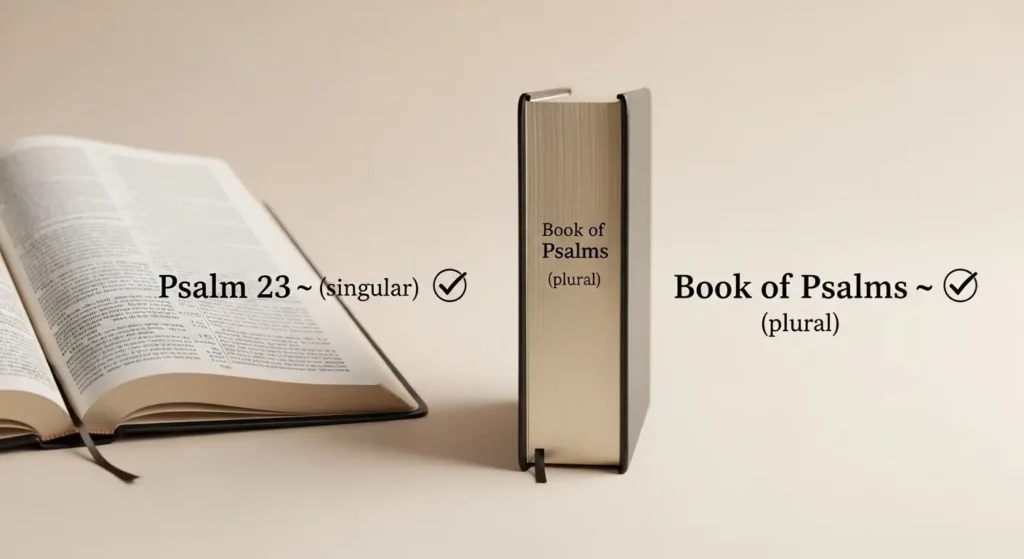
A psalm is a single sacred song or poem, usually from the Bible.
Psalms is the plural form and refers to a collection of these songs, especially the Book of Psalms in the Bible.
Examples:
- Psalm 23 is very famous.
- The Book of Psalms contains 150 psalms.
Monkeys or Monkies: Which Spelling Is Correct?
The Origin of Psalm or Psalms
The word “psalm” comes from the Greek word “psalmos,” which means “a song sung to harp music.” It later passed into Latin as “psalmus” and then into Old English as “psalm.”
In ancient times, psalms were religious poems meant to be sung. Over time, these songs were collected into a single book in the Bible, called the Psalms. That is why we now have both:
- Psalm (one song)
- Psalms (a collection of songs)
Guns or Butter: Meaning, Trade-Off, and Economic Importance
British English vs American English Spelling
There is no difference in spelling between British and American English for “psalm” or “psalms.” Both regions use the same spelling.
The difference is only in usage frequency and context, not spelling rules.
| Form | British English | American English | Meaning |
| Psalm | Psalm 23 | Psalm 23 | One sacred song |
| Psalms | Book of Psalms | Book of Psalms | Collection of songs |
Which Spelling Should You Use?
You do not need to choose between British or American spelling because both use the same form.
Use:
- Psalm when talking about one specific passage
- Psalms when talking about the full Bible book or many songs
Global rule:
Always match the number:
- One = psalm
- Many = psalms
Common Mistakes with Psalm or Psalms
Many learners make simple errors such as:
- Using “psalms” when talking about one verse
- Writing “Psalm” for the whole book
- Mixing singular and plural in the same sentence
Incorrect:
- I read a psalm today.
Correct:
- I read a psalm today.
Incorrect:
- The Psalms of David are beautiful.
Correct:
- The Psalms of David are beautiful.
Psalm or Psalms in Everyday Examples
Even outside religion, the word appears in writing and speech.
Emails:
- “I shared Psalm 91 with the group for encouragement.”
News:
- “Scholars study ancient Psalms for historical meaning.”
Social Media:
- “Feeling calm after reading a psalm this morning.”
Formal Writing:
- “The Book of Psalms is a key part of the Old Testament.”
Psalm or Psalms – Google Trends & Usage Data
Globally, “psalms” is searched more often than “psalm” because most users look for:
- The Book of Psalms
- Psalm verses and meanings
Countries with strong Christian readership, such as the United States, UK, Nigeria, and the Philippines, show higher search interest.
Key insight:
- “Psalms” = higher search volume (book reference)
- “Psalm” = lower but steady (individual verses)
Comparison Table: Psalm vs Psalms
| Feature | Psalm | Psalms |
| Meaning | One sacred song | Collection of songs |
| Usage | Singular context | Plural or book reference |
| Example | Psalm 23 | Book of Psalms |
| Frequency | Less common | More common |
| Context | Specific verse | Entire biblical book |
FAQs
1. What is the difference between psalm and psalms?
“Psalm” is one song; “psalms” is a collection of songs.
2. Is Psalm 23 singular or plural?
It is singular because it refers to one specific psalm.
3. Why is it called the Book of Psalms?
Because it contains many individual psalms collected together.
4. Are psalm and psalms spelled differently in UK and US English?
No, both use the same spelling.
5. How many psalms are in the Bible?
There are 150 psalms in the Book of Psalms.
6. Can I say “a psalms”?
No, that is incorrect grammar.
7. Is psalm only religious?
Mostly yes, but it is also used in literature and poetry contexts.
Conclusion
The difference between psalm and psalms is simple but important. A psalm refers to one sacred song or poem, while psalms refer to a collection of these writings, especially found in the Bible. Many people get confused because both words are closely linked and often appear in religious texts. However, once you understand singular versus plural usage, the meaning becomes very clear.
In writing, always match the word to the number you are referring to. Use “psalm” for one passage and “psalms” for multiple songs or the full biblical book. There is no difference between British and American spelling, so you can use the same forms everywhere.
By learning this small rule, you can avoid common mistakes and write with confidence in both academic and everyday contexts. Whether you are reading, studying, or quoting scripture, you will now know exactly which word to use.

Hi, I’m Henry William, the author of GrammarTribe.com. I’m passionate about the English language and have dedicated my career to helping people master grammar, spelling, and effective writing. Over the years, I’ve guided learners, writers, and professionals in understanding common mistakes, tricky rules, and nuances of English grammar in a simple and easy-to-follow way.
Through GrammarTribe.com, I aim to make grammar approachable and enjoyable for everyone. My work focuses on providing clear explanations, practical tips, and examples that readers can apply in everyday writing, whether it’s emails, essays, social media, or professional documents. I believe that strong grammar skills empower people to communicate confidently and professionally.
When I’m not writing or researching grammar, I enjoy reading, exploring language trends, and creating educational content that simplifies complex concepts. I’m committed to helping my audience write better, understand English deeply, and avoid common pitfalls, all while making learning grammar a fun and rewarding journey.