Many English learners, writers, and professionals often get confused between modelled or modeled. At first glance, both words look correct, and both are widely used in books, articles, and online content. This is why people frequently search for modelled or modeled to understand which spelling is right, and whether there is any real difference in meaning.
The confusion mainly comes from regional English differences. British English often prefers one spelling, while American English uses another. As a result, writers sometimes hesitate when preparing essays, emails, reports, or SEO content. Choosing the wrong form may not change the meaning, but it can affect how professional your writing looks to a specific audience.
In modern digital writing, where content reaches global readers, knowing the correct use of modelled or modeled is important. It helps avoid spelling inconsistency and improves clarity. Whether you are a student, blogger, or business writer, understanding modelled or modeled ensures your writing matches the right English standard. In this article, you will clearly learn the difference, origin, usage rules, and correct contexts for both forms.
Modelled or Modeled – Quick Answer
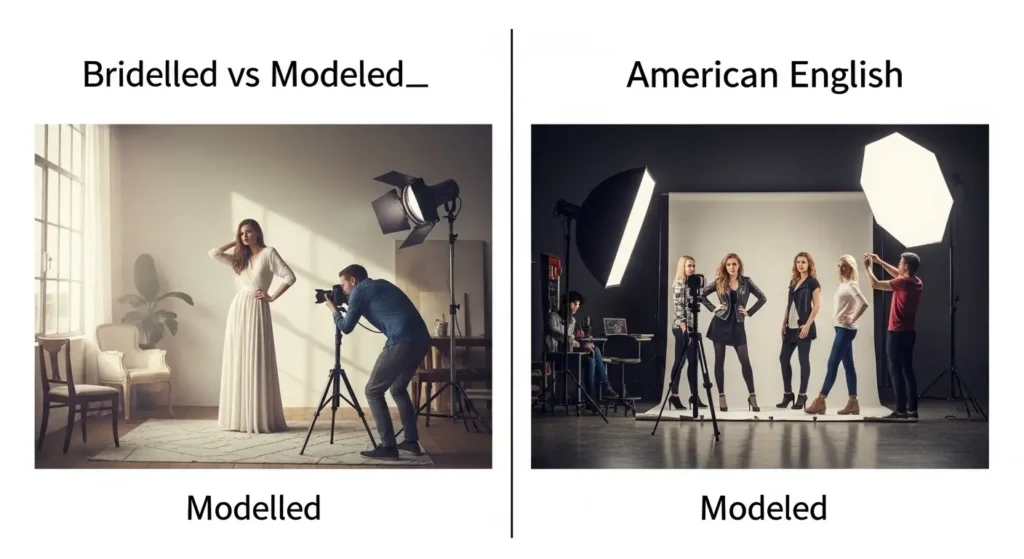
Both modelled and modeled are correct spellings of the same word.
- Modeled → American English
- Example: She modeled the behavior of successful leaders.
- Modelled → British English
- Example: She modelled the behavior of successful leaders.
👉 Meaning: to copy, design, or represent something as a model.
The Origin of Modelled or Modeled
The word comes from the Latin “modulus”, meaning a small measure or standard. It later passed into French as “modeler”, meaning to shape or design.
In English, the word “model” became a verb in the 16th century, meaning to create a representation or example of something.
The spelling difference appeared later:
- American English simplified double letters into many words.
- British English kept traditional spellings.
That is why we now have modeled (US) and modelled (UK).
British English vs American English Spelling
The main difference is the doubling of the letter “l”.
| Feature | British English | American English |
| Spelling | modelled | modeled |
| Usage | UK, Australia, India | USA |
| Rule | Doubles consonant | Simplifies spelling |
| Example | She modelled a dress | She modeled a dress |
Which Spelling Should You Use?
Your choice depends on your audience:
- Use “modeled” if your readers are from the United States.
- Use “modelled” if your readers are from the UK, Canada, Australia, or other Commonwealth countries.
- Use either if your audience is global, but stay consistent in one article or document.
👉 Tip: In SEO writing, consistency matters more than choice.
Common Mistakes with Modelled or Modeled
- Mixing both spellings in one article
- Wrong: She modeled and modelled data.
- Correct: She modeled data (US) OR She modelled data (UK)
- Thinking one spelling is incorrect
- Both are correct depending on the region.
- Using wrong form in academic writing
- Always match your institution’s style guide.
Modelled or Modeled in Everyday Examples
- Emails:
- US: The system modeled user behavior.
- UK: The system modelled user behavior.
- News Writing:
- The economy was modeled using new data sets.
- Social Media:
- She modeled for a fashion brand yesterday.
- Formal Reports:
- The scientist modeled climate change scenarios.
Modelled or Modeled – Google Trends & Usage Data
- “Modeled” is more popular globally due to US dominance in tech and digital content.
- “Modelled” is common in UK, Australia, and Commonwealth education systems.
- Search trends show higher volume for “modeled” in SEO and programming contexts.
- Academic writing in British institutions still prefers “modelled.”
👉 Conclusion: Both are widely used, but “modeled” leads in global search traffic.
Comparison Table: Modelled vs Modeled
| Feature | Modelled | Modeled |
| English Type | British | American |
| Meaning | Same | Same |
| Usage Area | UK/Commonwealth | USA/global tech |
| Frequency | Medium | High |
| Correctness | Correct | Correct |
FAQs About Modelled or Modeled
1. Is modelled or modeled correct?
Both are correct; usage depends on English style.
2. What is the American spelling?
The model is American English.
3. What is the British spelling?
Modelled is British English.
4. Do they have different meanings?
No, both mean the same thing.
5. Which spelling is better for SEO?
“Modeled” is often better for global traffic.
6. Can I mix both spellings?
No, keep consistency in one document.
7. Is one spelling more professional?
Neither is more professional; context matters.
Conclusion
Understanding modelled or modeled is simple once you know the difference between British and American English spelling rules. Both words carry the same meaning: to represent, design, or simulate something. The only difference lies in regional usage. American English uses “modeled,” while British English uses “modelled.” This small spelling variation often confuses writers, students, and content creators, especially when writing for a global audience.
To write professionally, the most important rule is consistency. Choose one form based on your target readers and stick with it throughout your document. If you are writing for SEO or international audiences, “modeled” is often more widely searched, but “modelled” is still essential for UK-based content.
In the end, both spellings are correct and acceptable. What matters most is clarity, consistency, and understanding your audience. Once you master this simple difference, you can write more confidently in academic, professional, and online contexts without hesitation.

Hi, I’m Henry James, the author behind GrammarTribe.com. I’m passionate about the English language and specialize in grammar, helping readers understand complex rules in a simple, clear way. Over the years, I’ve dedicated myself to creating content that makes learning grammar practical, fun, and accessible for everyone. If you’re a student, professional, or language enthusiast.
Through GrammarTribe.com, I share tips, guides, and examples to help people write confidently and correctly. My goal is to make grammar less intimidating and more useful in everyday writing, emails, social media, and professional communication. Writing and teaching grammar isn’t just my profession — it’s my passion.
When I’m not writing, I enjoy reading, exploring language trends, and discovering new ways to make English learning engaging and easy. My mission is to empower readers to communicate clearly and confidently, one grammar tip at a time.