Many English learners and even native speakers often get confused between lieing or lying when writing sentences like He is lying or She is lying about the situation. This small spelling difference creates big confusion in grammar, writing exams, emails, and online communication. That is why people frequently search for lieing or lying on Google to find the correct form and avoid mistakes.
The confusion mainly happens because English spelling rules change when verbs end in -ie. Some learners assume we simply add -ing, resulting in lieing, while others see lying and think it looks incorrect. In reality, only one spelling is correct in modern English. Understanding lieing or lying helps improve writing accuracy, especially in academic, professional, and digital communication.
This article explains the correct form, origin, grammar rules, and differences in usage so you never make this mistake again. You will also learn how lieing or lying is used in real-life sentences and why the correct spelling matters for clear communication.
Lieing or Lying – Quick Answer
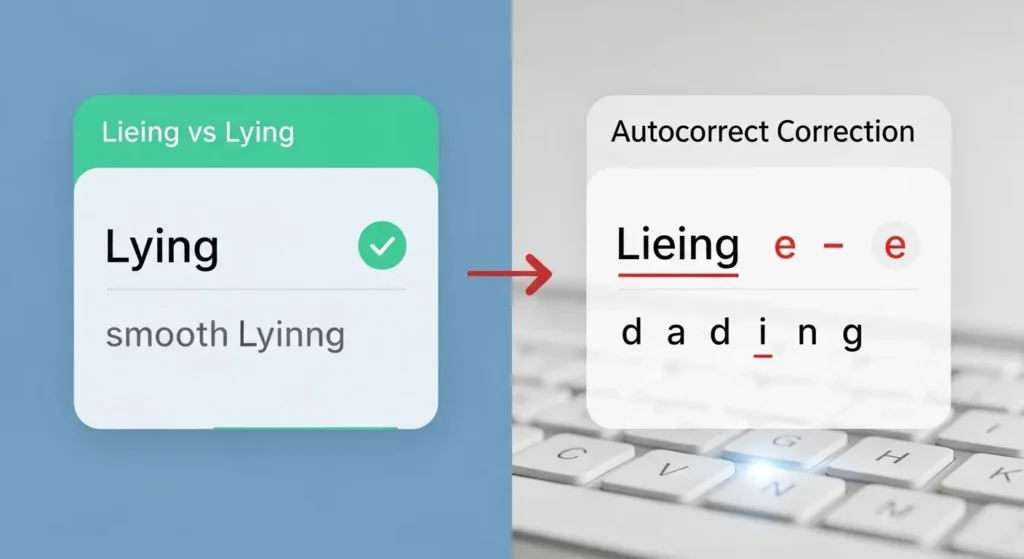
The correct spelling is lying, not lieing.
When the verb lie (to not tell the truth) changes into the -ing form, the ie changes to y before adding -ing.
Examples:
- Correct: He is lying to his teacher.
- Correct: She was lying about her age.
- Incorrect: He is lieing to his teacher.
The Origin of Lieing or Lying
The word comes from Old English:
- Ligan → meaning to lie down or to tell falsehoods
- Over time, English spelling rules evolved
- The ie → y change became standard in verbs ending in -ie
So, lieing was never accepted in standard English. The correct historical and modern form is lying.
British English vs American English Spelling
Good news: there is no difference between British and American English for this word. Both use lying.
However, spelling rules explain why confusion happens.
Spelling Rule:
When a verb ends in ie, change ie → y before adding -ing.
Examples:
- lie → lying
- die → dying
- tie → tying
Comparison Table
| Form | Correct/Incorrect | Example |
| lieing | ❌ Incorrect | He is lieing (wrong) |
| lying | ✅ Correct | He is lying (true form) |
Which Spelling Should You Use?
- US English: Use lying
- UK English: Use lying
- Canada, Australia, Pakistan, India: Use lying
👉 The rule is global. There is no accepted version of lieing in formal English.
So, no matter where you are writingemails, exams, or blogsalways use lying.
Common Mistakes with Lieing or Lying
1. Adding -ing directly
- ❌ lieing
- ✅ lying
2. Confusing with laying
- ❌ He is laying about it
- ✅ He is lying about it
3. Using wrong verb form
- ❌ She is lieing on the bed
- ✅ She is lying on the bed
Lieing or Lying in Everyday Examples
Emails:
- I think he is lying about the deadline.
News:
- The politician was accused of lying to the public.
Social Media:
- Stop lying and tell the truth!
Formal Writing:
- The report suggests the witness was lying under oath.
Lieing or Lying – Google Trends & Usage Data
Search data shows:
- lying is widely used in English-speaking countries
- lieing appears mostly as a misspelling query
- High search volume in South Asia (students learning English)
- Very low usage in professional writing
👉 Conclusion: lying dominates all formal and informal usage worldwide.
Comparison Table: Lieing vs Lying
| Feature | Lieing | Lying |
| Correctness | ❌ Incorrect | ✅ Correct |
| Grammar Rule | Broken rule | Follows ie → y rule |
| Usage | Rare / error | Standard English |
| Meaning | None accepted | Present participle of lie |
| Academic Use | Not allowed | Fully correct |
FAQs
1. Is lieing ever correct?
No, lieing is always incorrect in modern English.
2. Why do people write lieing?
Because they incorrectly add -ing without changing ie to y.
3. What is the correct spelling?
The correct spelling is lying.
4. Is lying used in both US and UK English?
Yes, both use the same spelling.
5. What is the difference between lying and laying?
Lying means not telling the truth. Laying means placing something down.
6. Is lieing used in any dictionary?
No major dictionary accepts lieing.
7. How can I remember the correct form?
Remember: ie becomes y before ing.
Conclusion
Understanding the difference between lieing or lying is important for anyone learning English. The correct form is always lying, and lieing is a common spelling mistake caused by misunderstanding grammar rules.
This rule applies in all types of English British, American, and global usage. Using the correct spelling improves writing clarity, professionalism, and credibility in emails, academic work, and online communication.
By remembering the simple rule ie y before ing, you can avoid this error forever. Whether you are a student, writer, or professional, mastering small details like this strengthens your overall English skills and helps you communicate more effectively.

Hi, I’m Henry William, the author of GrammarTribe.com. I’m passionate about the English language and have dedicated my career to helping people master grammar, spelling, and effective writing. Over the years, I’ve guided learners, writers, and professionals in understanding common mistakes, tricky rules, and nuances of English grammar in a simple and easy-to-follow way.
Through GrammarTribe.com, I aim to make grammar approachable and enjoyable for everyone. My work focuses on providing clear explanations, practical tips, and examples that readers can apply in everyday writing, whether it’s emails, essays, social media, or professional documents. I believe that strong grammar skills empower people to communicate confidently and professionally.
When I’m not writing or researching grammar, I enjoy reading, exploring language trends, and creating educational content that simplifies complex concepts. I’m committed to helping my audience write better, understand English deeply, and avoid common pitfalls, all while making learning grammar a fun and rewarding journey.