Many people get confused when they search for “excell or excel”. Some think both spellings are correct. Others are unsure if they are talking about the same word or different meanings. This confusion happens because English has many words that look similar but have different spellings, meanings, or uses.
The word “excel” is widely used in education, business, and daily writing. It means to be very good at something or to perform better than others. But the extra “l” in “excell” often appears in informal writing, social media posts, or spelling mistakes. People also get confused because of Microsoft Excel, the popular spreadsheet software, which adds another layer of misunderstanding.
In this article, you will clearly learn the correct spelling, where the word comes from, how British and American English treat it, and when people mistakenly use “excell.” You will also see real examples, usage trends, and simple rules to help you always choose the right form. By the end, you will never mix up “excel” and “excell” again.
Excell or Excel – Quick Answer
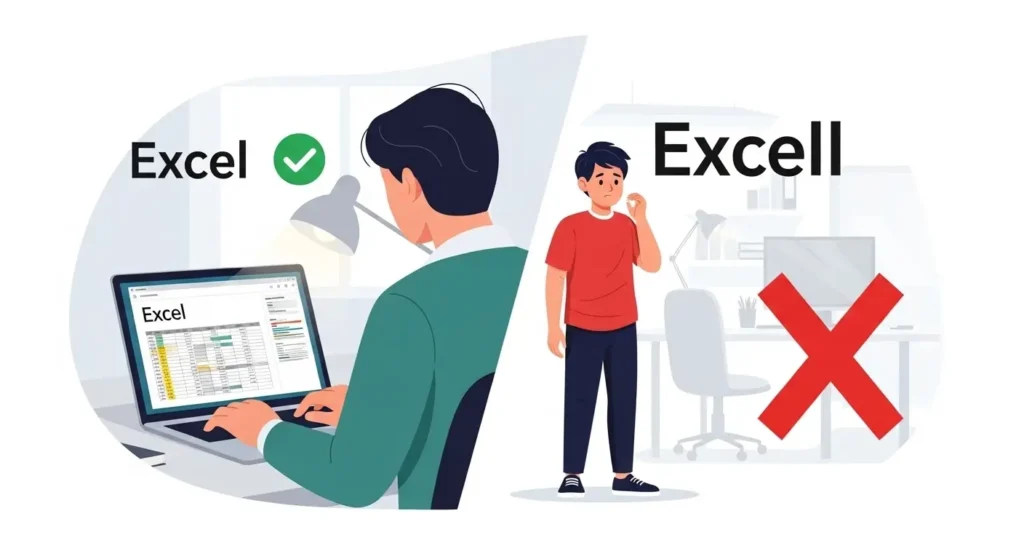
The correct spelling is excel.
- Excel (verb): to be outstanding or perform well
Example: She excels in mathematics. - Excel (software): Microsoft Excel, a spreadsheet program
Example: I use Excel for data analysis. - Excell: ❌ Incorrect spelling in modern English
(Sometimes used as a surname or brand name, but not standard English)
👉 Simple rule: Always use excel in writing unless it is a proper name.
Guns or Butter: Meaning, Trade-Off, and Economic Importance
The Origin of Excell or Excel
The word excel comes from the Latin word “excellere”, which means “to rise, stand out, or be superior.”
- “Ex” = out
- “Cellere” = rise or be high
Over time, Old French influenced English and shortened the spelling to excel.
The double “l” form “excell” appeared in older texts and handwriting variations. However, it disappeared as English spelling became standardized in dictionaries.
Today:
- Excel = correct modern English
- Excell = outdated or incorrect spelling (except names)
Hispanic or Latino: Meaning, Origin, Usage, and Key Differences?
British English vs American English Spelling
Good news: there is no difference between British and American English for this word.
Both use:
- Excel ✔️
- Not “excell” ❌
Comparison Table
| Word Form | British English | American English | Usage |
| excel | Correct | Correct | Standard verb |
| excell | Incorrect | Incorrect | Rare / wrong spelling |
| Excel | Microsoft name | Microsoft name | Software |
👉 Unlike words like “colour/color,” this word does not change across regions.
Which Spelling Should You Use?
Here is a simple guide:
- Students & academic writing: use excel
- Business emails: use excel
- IELTS/TOEFL exams: use excel
- Global English writing: always excel
- Only exception: when writing a brand or surname (e.g., “Excell Motors”)
👉 If you are unsure, choose excel every time.
Common Mistakes with Excell or Excel
People often make these mistakes:
❌ Writing “excell in studies”
✔️ Correct: “excel in studies”
❌ Confusing Excel (software) with excel (verb)
✔️ Example:
- I excel in math (verb)
- I use Excel for charts (software)
❌ Adding extra letters
✔️ Always remember: only one “l”
👉 Tip: “Excel = Excellent (without extra letters)”
Excell or Excel in Everyday Examples
Emails
- “I hope you continue to excel in your role.”
News Writing
- “The team continues to excel in international matches.”
Social Media
- “Hard work helps you excel in life.”
Formal Writing
- “Students who excel academically receive scholarships.”
Excell or Excel – Google Trends & Usage Data
Search behavior shows:
- “excel” → extremely high global usage
- “excell” → very low usage, mostly typo-related
- Highest searches for “excel” come from:
- United States
- India
- United Kingdom
- Pakistan
- Philippines
Why?
- Microsoft Excel is widely used in schools and offices
- “Excel” is also common in career and education searches
- “Excell” appears mostly as spelling errors or brand names
Comparison Table: Excell vs Excel
| Feature | Excel ✔️ | Excell ❌ |
| Correct form | Yes | No |
| Dictionary use | Yes | No |
| Meaning | To perform well / software | None (standard English) |
| Usage | Formal & informal | Rare / incorrect |
| SEO relevance | High | Low |
FAQs about Excell or Excel
1. Is “excell” a correct word?
No, “excell” is not correct in modern English.
2. What is the correct spelling of excel?
The correct spelling is excel with one “l.”
3. Why do people write “excell”?
It is usually a spelling mistake or confusion with older forms.
4. Is Microsoft Excel spelled with one “l” or two?
It is spelled Excel with one “l.”
5. Can “excell” ever be correct?
Only as a proper name (rare cases), not in standard English.
6. What does “excel” mean?
It means to perform very well or be outstanding.
7. Is “excel” used in British and American English?
Yes, both use the same spelling: excel.
Conclusion
The confusion between excell or excel is common, but the answer is simple. The correct and standard spelling in English is excel. The version with double “l” is not accepted in modern dictionaries and is usually just a spelling mistake or an old variation found in names.
Understanding this difference is important for students, professionals, and writers. Whether you are writing emails, academic essays, or using Microsoft Excel, the correct spelling ensures clarity and professionalism. English spelling can be tricky, but this word is easy once you remember the rule: one “l” only.
So next time you write or type it, avoid “excell” and always choose excel for correct and confident communication.

Hi, I’m Henry James, the author behind GrammarTribe.com. I’m passionate about the English language and specialize in grammar, helping readers understand complex rules in a simple, clear way. Over the years, I’ve dedicated myself to creating content that makes learning grammar practical, fun, and accessible for everyone. If you’re a student, professional, or language enthusiast.
Through GrammarTribe.com, I share tips, guides, and examples to help people write confidently and correctly. My goal is to make grammar less intimidating and more useful in everyday writing, emails, social media, and professional communication. Writing and teaching grammar isn’t just my profession — it’s my passion.
When I’m not writing, I enjoy reading, exploring language trends, and discovering new ways to make English learning engaging and easy. My mission is to empower readers to communicate clearly and confidently, one grammar tip at a time.