Have you ever seen someone bend their knees and dip politely in front of a queen, a royal guest, or even in a historical movie and wondered whether it is spelled curtsy or curtsey? You are not alone.
Many English learners, writers, and even native speakers get confused by these two spellings. Both versions appear in books, subtitles, news articles, and online content, which makes the confusion even stronger.
People usually search this keyword to understand which spelling is correct, whether both are acceptable, and if there is a difference in meaning. Some also want to know if curtsy is American English and curtsey is British English, or if one is outdated. This article solves all that confusion in a simple way. You will learn the correct usage, origin, differences, and real-life examples so you can confidently use the word in writing, exams, or conversation.
Curtsy or Curtsey – Quick Answer
Both curtsy and curtsey mean the same thing: a polite gesture where a woman or girl slightly bends her knees and lowers her body as a sign of respect.
- Curtsy → Modern and most commonly used spelling
- Curtsey → Older and less common spelling (still correct)
Examples:
- She gave a graceful curtsy to the queen.
- The actress curtseyed after the performance.
👉 Today, curtsy is preferred in most writing.
Lite or Light: Which Spelling Should You Use?
The Origin of Curtsy or Curtsey
The word comes from the Middle English word “curteisie”, meaning courtesy or polite behavior. Over time, it developed into a physical gesture of respect, especially among women in royal courts.
The spelling split happened because English spelling was not fixed in earlier centuries. Some writers simplified it to curtsy, while others kept the older form curtsey to match pronunciation.
Both forms survived, but modern English gradually moved toward the shorter spelling curtsy.
Withdraw or Withdrawal: Meaning, and Correct Usage Explained ?
British English vs American English Spelling
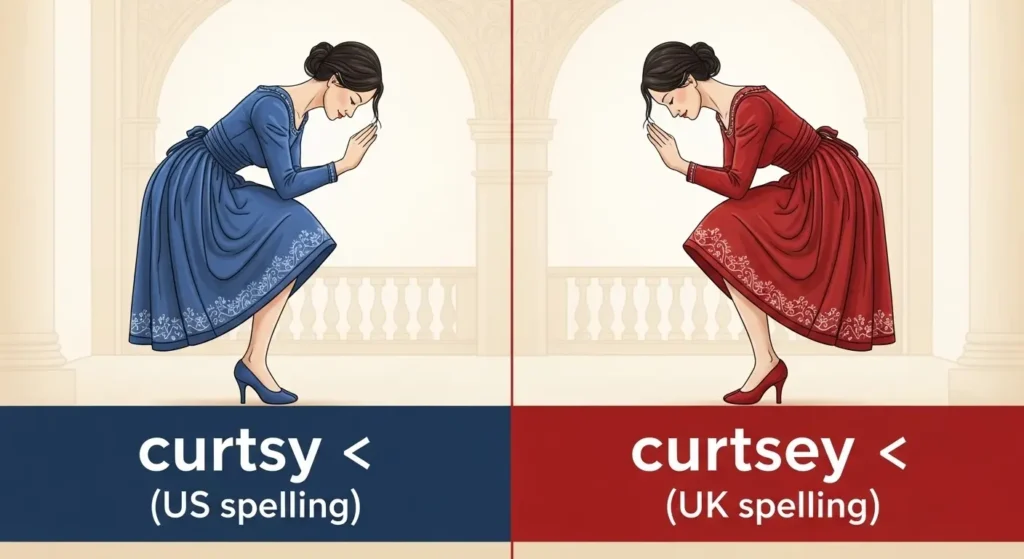
Unlike many word differences between UK and US English, curtsy/curtsey is not strictly regional. Instead, it is a historical spelling variation.
However:
- British English sometimes still uses curtsey in older or formal texts
- American English strongly prefers curtsy
Comparison Table
| Meaning | British English | American English | Modern Usage |
| Polite dip | curtsey | curtsy | curtsy (global) |
Which Spelling Should You Use?
Your choice depends on your audience:
- 🇺🇸 US audience → Use curtsy
- 🇬🇧 UK/Commonwealth → Prefer curtsy, but curtsey still appears in traditional writing
- 🌍 Global content / SEO / blogging → Use curtsy (most accepted modern form)
👉 If you want safe, modern writing, always choose curtsy.
Common Mistakes with Curtsy or Curtsey
Many writers make small but important errors:
❌ Mixing spelling in one article
✔ Use only one version consistently
❌ Using “curtsy” as a noun and “curtsey” as a verb separately
✔ Both spellings can work as noun and verb
❌ Thinking they have different meanings
✔ They mean exactly the same thing
❌ Writing “courtesy” instead of “curtsy”
✔ Courtesy is different (politeness, not a gesture)
Curtsy or Curtsey in Everyday Examples
1. Formal Writing
- The dancer performed a graceful curtsy after her ballet performance.
2. News Article
- The royal guest was greeted with a traditional curtsy by the performers.
3. Social Media
- “She just learned how to curtsy like a princess 👑”
4. Email (Formal Context)
- The performers will conclude the ceremony with a bow or curtsy.
Curtsy or Curtsey – Google Trends & Usage Data
Search behavior shows a clear pattern:
- Curtsy → Higher global search volume
- Curtsey → Lower, mostly historical or academic use
Country Trends:
- United States → Mostly “curtsy”
- United Kingdom → Mixed, but “curtsy” increasing
- India, Pakistan, Commonwealth countries → Mostly “curtsy” in modern writing
- Literature/History searches → “curtsey” still appears
👉 Overall trend: curtsy is the dominant modern spelling worldwide.
Comparison Table: Curtsy vs Curtsey
| Feature | Curtsy | Curtsey |
| Meaning | Polite knee dip | Same meaning |
| Usage level | Modern, common | Old-fashioned |
| Region | Global | Mostly UK older texts |
| SEO usage | High | Low |
| Recommendation | Preferred | Optional |
FAQs
1. Is curtsy or curtsey correct?
Both are correct, but curtsy is more modern and widely used.
2. Is curtsey British English?
Yes, but it is an older spelling still found in traditional British texts.
3. What does curtsy mean?
It is a polite gesture where a woman slightly bends her knees to show respect.
4. Is curtsy used only for women?
Traditionally yes, but modern usage is more flexible and sometimes symbolic.
5. Which spelling is better for SEO?
Curtsy performs better because it is more commonly searched.
6. Is curtsy a verb or noun?
It can be both:
- Noun: She gave a curtsy
- Verb: She curtsied
7. Is curtsey outdated?
It is not incorrect, but it is less common today.
Conclusion
The words curtsy and curtsey refer to the same elegant gesture of respect, but their spelling usage has evolved over time. While both forms are technically correct, modern English strongly prefers curtsy. The older spelling curtsey still appears in historical writing, British literature, and traditional contexts, but it is slowly fading from everyday use.
If you are writing for blogs, exams, or global audiences, choosing curtsy is the safest and most professional option. It aligns with modern dictionaries, SEO trends, and international usage. Understanding this small spelling difference not only improves your writing accuracy but also helps you avoid confusion in reading historical or modern texts. Whether you are a student, writer, or language learner, mastering this detail ensures clearer and more confident communication.

Hi, I’m Henry William, the author of GrammarTribe.com. I’m passionate about the English language and have dedicated my career to helping people master grammar, spelling, and effective writing. Over the years, I’ve guided learners, writers, and professionals in understanding common mistakes, tricky rules, and nuances of English grammar in a simple and easy-to-follow way.
Through GrammarTribe.com, I aim to make grammar approachable and enjoyable for everyone. My work focuses on providing clear explanations, practical tips, and examples that readers can apply in everyday writing, whether it’s emails, essays, social media, or professional documents. I believe that strong grammar skills empower people to communicate confidently and professionally.
When I’m not writing or researching grammar, I enjoy reading, exploring language trends, and creating educational content that simplifies complex concepts. I’m committed to helping my audience write better, understand English deeply, and avoid common pitfalls, all while making learning grammar a fun and rewarding journey.