
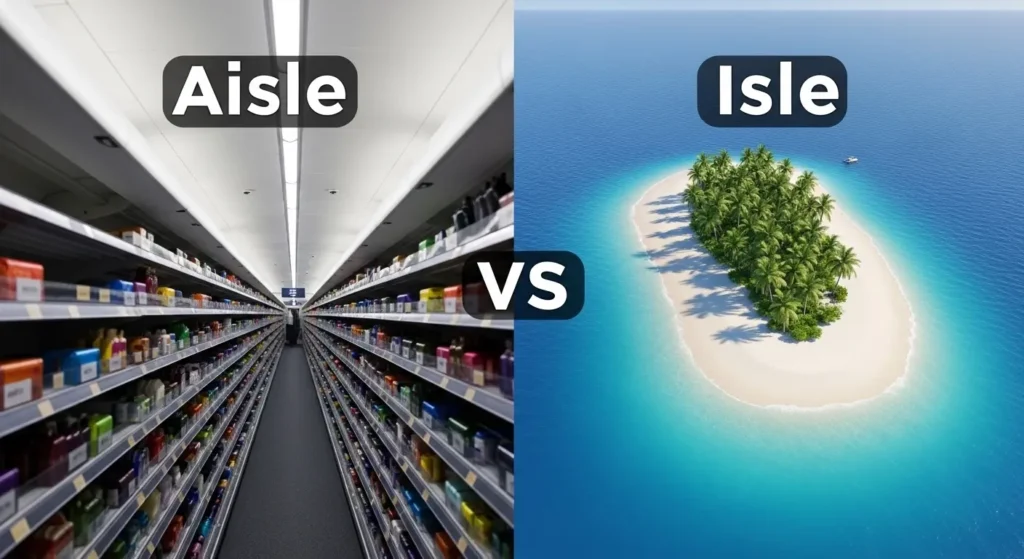
Many English learners get confused between aisle or isle because they look similar but mean completely different things. One is commonly used in shopping malls, airports, and wedding venues, while the other is used in geography and travel descriptions.
People search for aisle or isle because both words sound the same when spoken, but their spelling and meaning create confusion in writing. For example, someone may write “I sat on the plane isle seat” when they actually mean “aisle seat.” This small mistake can change clarity in communication.
Understanding aisle or isle helps improve grammar accuracy and prevents embarrassing errors in emails, exams, and professional writing. In this article, we will clearly explain aisle or isle, their origins, differences, usage rules, and real-life examples so you never confuse them again.
Aisle or Isle – Quick Answer
- Aisle → A passage between rows of seats or shelves
- Example: “I sat in the airplane aisle seat.”
- Isle → A small island
- Example: “The Isle of Man is beautiful.”
The Origin of Aisle or Isle
- Aisle comes from Old French ele meaning wing or passage in a building.
- Isle comes from Latin insula, meaning island.
Over time, both words evolved in English but kept similar pronunciation, causing confusion.
British English vs American English Spelling
Good news: aisle and isle are NOT British vs American spellings. They are two completely different words.
However, confusion often comes from pronunciation similarities.
- Aisle (UK/US): eye-l
- Isle (UK/US): eye-l
Which Spelling Should You Use?
Use depends on meaning, not region:
- Use aisle when talking about:
- Shops, airports, theaters
- Example: grocery aisle, plane aisle
- Use isle when talking about:
- Islands or land surrounded by water
- Example: tropical isle, Isle of Wight
Both UK and US English use the same rules.
Common Mistakes with Aisle or Isle
- ❌ “I walked through the isle in the supermarket”
✔ Correct: aisle - ❌ “The airplane has an isle seat”
✔ Correct: aisle seat - ❌ “The beach aisle is beautiful”
✔ Correct: isle (if referring to island)
Aisle or Isle in Everyday Examples
- Email: “Please reserve an aisle seat for my flight.”
- News: “Tourism increases on the tropical isle.”
- Social Media: “Got the best aisle seat on my trip ✈️”
- Formal Writing: “The island, or isle, is a major tourist attraction.”
Aisle or Isle – Google Trends & Usage Data
- “Aisle” is more common globally due to travel, shopping, and aviation use.
- “Isle” is less frequent but appears in geography and travel content.
- Highest confusion appears in non-native English countries.
Comparison Table
| Feature | Aisle | Isle |
| Meaning | Passage between rows | Small island |
| Usage | Shopping, travel, seating | Geography, tourism |
| Example | airplane aisle | Isle of Skye |
| Category | Indoor space | Natural landform |
FAQs
1. What is the main difference between aisle and isle?
Aisle is a passage; isle is an island.
2. Why do aisle and isle sound the same?
Because both are pronounced “eye-l.”
3. Is aisle British or American English?
Both languages use it equally.
4. Can I use isle in a supermarket?
No, use aisle instead.
5. What is an example of isle?
“The Isle of Man is a famous tourist destination.”
6. What is an aisle seat?
A seat next to the walkway in a plane or theater.
7. Are aisle and isle interchangeable?
No, they have completely different meanings.
Conclusion
The confusion between aisle or isle is very common because both words sound identical but have different meanings. Aisle refers to a passage between rows in places like airplanes, supermarkets, and theaters. Isle refers to a small island surrounded by water.
Understanding the difference helps improve writing clarity and prevents common grammar mistakes. Whether you are writing emails, academic work, or travel blogs, using the correct word is important for professionalism.
Remember, aisle is for walking paths, and isle is for islands. Once you understand this simple rule, you will never confuse them again. This small grammar knowledge can significantly improve your English accuracy and confidence in communication.

Hi, I’m Henry James, the author behind GrammarTribe.com. I’m passionate about the English language and specialize in grammar, helping readers understand complex rules in a simple, clear way. Over the years, I’ve dedicated myself to creating content that makes learning grammar practical, fun, and accessible for everyone. If you’re a student, professional, or language enthusiast.
Through GrammarTribe.com, I share tips, guides, and examples to help people write confidently and correctly. My goal is to make grammar less intimidating and more useful in everyday writing, emails, social media, and professional communication. Writing and teaching grammar isn’t just my profession — it’s my passion.
When I’m not writing, I enjoy reading, exploring language trends, and discovering new ways to make English learning engaging and easy. My mission is to empower readers to communicate clearly and confidently, one grammar tip at a time.