
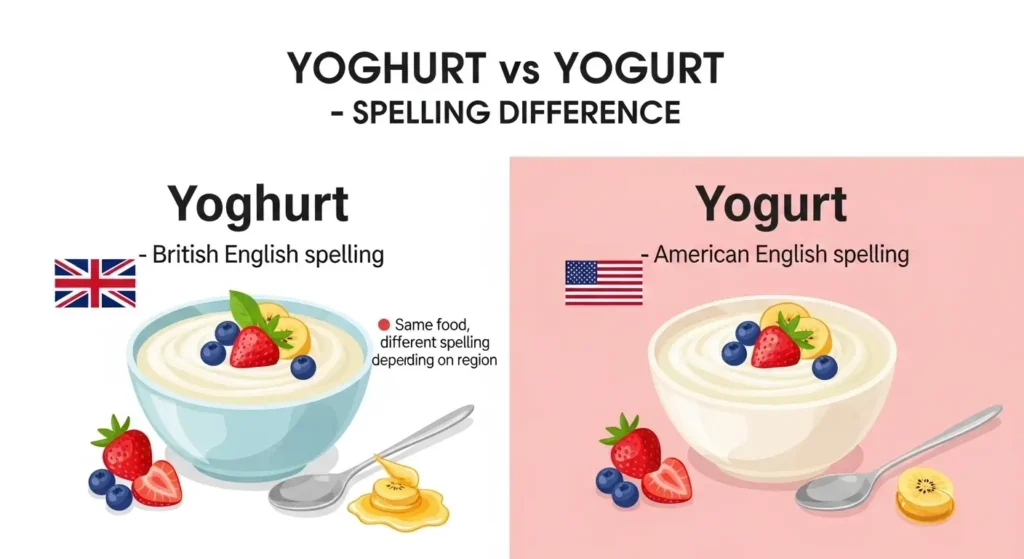
When it comes to the creamy, tangy dairy product we love to eat or add to smoothies, you might have noticed a spelling dilemma: is it “yoghurt” or “yogurt”? People often search for this because the two spellings can cause confusion, especially when reading recipes, shopping online, or writing formally.
Understanding which version to use can save embarrassment and make your writing appear professional. In this article, we break down the difference, history, and usage of these spellings so you can confidently choose the right one.
Whether you are a student, a blogger, or someone learning English, knowing the correct spelling for your audience is important. We will cover origins, British vs American usage, common mistakes, practical examples, and even Google Trends data. By the end, you will know exactly which spelling fits your context.
Yoghurt or Yogurt – Quick Answer
Quick Answer:
- Yoghurt – Commonly used in the UK, Australia, and other Commonwealth countries.
- Yogurt – Preferred in the US and increasingly in international English.
Example Sentences:
- UK: “I had a bowl of natural yoghurt with honey for breakfast.”
- US: “She added strawberry yogurt to her smoothie.”
Tip: Both are correct; it depends on your audience.
The Origin of Yoghurt/Yogurt
The word yogurt comes from the Turkish word “yoğurt”, which refers to the fermented milk product. Europeans first encountered it in the 17th–18th centuries and adapted the spelling.
- Yoghurt – The older British English spelling, influenced by Greek and Turkish transliteration.
- Yogurt – Simplified American spelling introduced in the early 20th century for easier pronunciation.
The difference is mostly historical and regional, rather than grammatical.
British English vs American English Spelling
The main difference is the extra “h” in the British spelling.
| Feature | British English | American English |
| Spelling | yoghurt | yogurt |
| Common Regions | UK, Australia, New Zealand | USA, Canada |
| Example Sentence | “She loves Greek yoghurt.” | “He prefers vanilla yogurt.” |
| Dictionary Reference | Oxford English Dictionary | Merriam-Webster |
Rule: There’s no strict rule; choose based on your audience.
Which Spelling Should You Use?
- UK/Commonwealth → Use yoghurt in formal and informal writing.
- US → Use yogurt for all contexts.
- Global Blogs & Recipes → Either works, but yogurt is widely recognised internationally.
Pro Tip: When targeting global readers online, yogurt may improve search visibility.
Common Mistakes with Yoghurt/Yogurt
- Mixing spellings in the same text: “I love yogurt and yoghurt.” ❌
✅ Correct: “I love yoghurt.” (UK) or “I love yogurt.” (US) - Misspelling as “yogourt” or “yoqurt.” ❌
- Using yoghurt in US recipes could confuse some readers. ❌
Yoghurt/Yogurt in Everyday Examples
Emails:
- UK: “Please include yoghurt in the shopping list.”
- US: “Add yogurt to your grocery order.”
News Headlines:
- “Study shows Greek yoghurt boosts gut health” (UK)
- “Low-fat yogurt sales rise in the US”
Social Media:
- Instagram: “Breakfast goals: smoothie with yogurt 🍓”
- Twitter (UK): “Nothing beats a spoon of creamy yoghurt.”
Formal Writing:
- Academic or health articles often follow regional spelling conventions.
Yoghurt or Yogurt – Google Trends & Usage Data
Google Trends shows:
- UK & Australia → “yoghurt” is dominant.
- USA & Canada → “yogurt” is dominant.
- Global Search → “yogurt” slightly more popular due to US influence.
This confirms the spelling preference depends on geography and target audience.
Keyword Comparison Table
| Variation | Region | Usage Example |
| Yoghurt | UK, Australia | “Greek yoghurt is rich in protein.” |
| Yogurt | US, Canada | “Low-fat yogurt is popular in the US.” |
FAQs
1. Are yoghurt and yogurt the same thing?
Yes, they refer to the same fermented dairy product; only spelling differs.
2. Which spelling is correct in UK English?
Yoghurt is preferred in UK English.
3. Which spelling is correct in US English?
Yogurt is standard in US English.
4. Can I use yogurt in the UK?
Yes, but yoghurt looks more traditional in British writing.
5. Is there a pronunciation difference?
Not significantly; both are pronounced as “yo-gurt.”
6. Is yogurt more common online?
Yes, especially in international blogs and recipes.
7. Should I follow dictionary references?
Yes, use Oxford for UK (yoghurt) and Merriam-Webster for US (yogurt).
Conclusion
Choosing between yoghurt and yogurt is simple once you know your audience. For UK, Australia, and Commonwealth readers, yoghurt aligns with tradition and formal writing. For US readers or global content, yogurt is clear and widely recognised.
Both are correct, so avoid mixing them in the same text. Check your dictionary or style guide when in doubt. Ultimately, consistency matters more than the exact spelling. If in recipes, academic papers, or social media posts, using the right variant improves readability and professionalism.

Hi, I’m Henry James, the author behind GrammarTribe.com. I’m passionate about the English language and specialize in grammar, helping readers understand complex rules in a simple, clear way. Over the years, I’ve dedicated myself to creating content that makes learning grammar practical, fun, and accessible for everyone. If you’re a student, professional, or language enthusiast.
Through GrammarTribe.com, I share tips, guides, and examples to help people write confidently and correctly. My goal is to make grammar less intimidating and more useful in everyday writing, emails, social media, and professional communication. Writing and teaching grammar isn’t just my profession — it’s my passion.
When I’m not writing, I enjoy reading, exploring language trends, and discovering new ways to make English learning engaging and easy. My mission is to empower readers to communicate clearly and confidently, one grammar tip at a time.