Many English learners get confused between the words “suppose” and “supposed.” They look very similar, but their meanings and usage are quite different. This confusion often leads to grammar mistakes in writing, emails, exams, and even professional communication. People search for this keyword because they want a quick and clear answer: Which one is correct? When should I use suppose? When should I use supposed?
The problem becomes more confusing because both words come from the same root and are used in similar sentence patterns. For example, “I suppose” and “I am supposed to” look close, but they do not mean the same thing. One shows opinion, while the other shows obligation or expectation.
In this article, you will learn the simple difference between suppose and supposed, their origin, spelling usage, real-life examples, and common mistakes. By the end, you will clearly understand when to use each word correctly without confusion.
Suppose or Supposed – Quick Answer
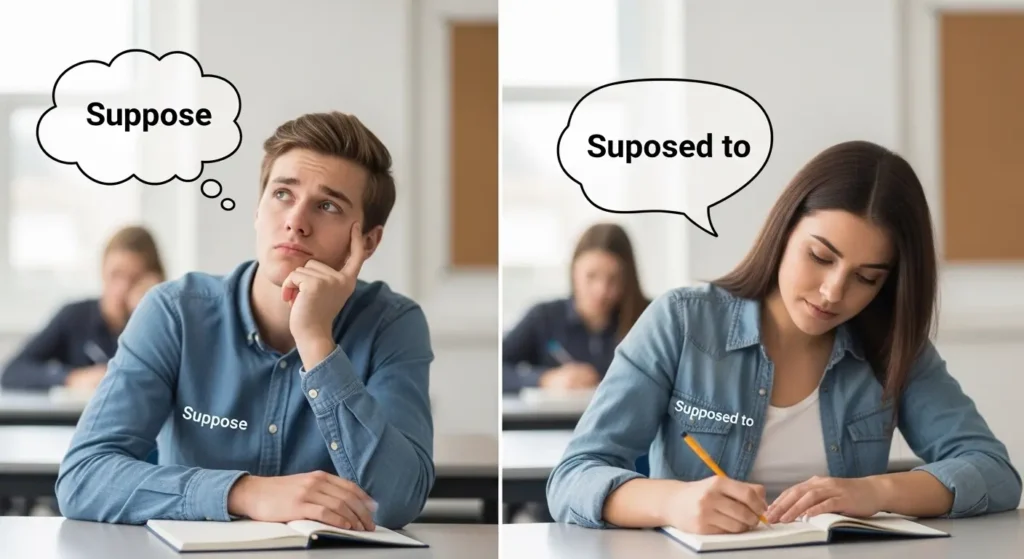
Suppose = to think, believe, or assume something
Supposed = expected, required, or assumed to be true
Examples:
- I suppose he is at home. (opinion/guess)
- You are supposed to finish your work. (obligation)
Simply:
- Suppose = thinking
- Supposed = duty or expectation
Posted inGrammar Knowledge
Patient or Pacient: Correct Spelling, Meaning, and Usage Explained
The Origin of Suppose and Supposed
Both words come from the Latin word “supponere,” meaning to place under or assume.
Over time:
- Old French transformed it into “supposer”
- English adopted it as suppose
The word “supposed” is just the past form and adjective form of “suppose.” It developed to show something expected or assumed.
So the difference is not spelling error—it is grammar form:
- suppose (base verb)
- supposed (past participle/adjective)
Accidently or Accidentally: Which Spelling Is Correct ?
British English vs American English Spelling
Good news: there is no spelling difference between British and American English for “suppose” or “supposed.”
Both regions use:
- suppose
- supposed
The difference is only in usage patterns, not spelling rules.
Comparison Table
| Form | Meaning | Example Sentence |
| suppose | think/assume | I suppose it will rain today. |
| supposed | expected/required | You are supposed to wait here. |
Which Spelling Should You Use?
Your choice depends on meaning, not location:
- Use “suppose” when expressing opinion or guess
- Use “supposed” when talking about rules, duty, or expectation
Simple Guide:
- Students: use both correctly in grammar writing
- Business writing: “supposed” is more common
- Everyday speech: “I suppose” is very common
Common Mistakes with Suppose or Supposed
1. Mixing meanings
❌ I supposed he is coming
✔ I suppose he is coming
2. Wrong structure
❌ You suppose to finish it
✔ You are supposed to finish it
3. Overusing “suppose” in formal writing
❌ I suppose this report is correct (formal tone needed)
✔ This report is expected to be correct
4. Confusing past tense usage
❌ He is suppose to come
✔ He is supposed to come
Suppose or Supposed in Everyday Examples
Emails:
- I suppose we can schedule the meeting tomorrow.
- You are supposed to submit the report by Monday.
News:
- The suspect is supposed to appear in court today.
- Analysts suppose the market will rise.
Social Media:
- I suppose this movie is overrated.
- We are supposed to be happy all the time?
Formal Writing:
- The system is supposed to update automatically.
- Researchers suppose the theory is valid.
Suppose or Supposed – Google Trends & Usage Data
Search behavior shows:
- “supposed meaning” is searched more than “suppose meaning”
- Most confusion comes from ESL learners
- High search volume in India, Pakistan, and Southeast Asia
- “suppose” is more common in spoken English
- “supposed” appears more in academic and formal writing
Overall trend:
- “supposed” = higher confusion keyword
- “suppose” = higher conversational use
Comparison Table: Suppose vs Supposed
| Feature | Suppose | Supposed |
| Word type | Verb | Verb (past participle/adjective) |
| Meaning | think, assume | expected, required |
| Usage tone | informal/general | formal/rule-based |
| Example | I suppose it’s true | You are supposed to go |
FAQs
1. What is the difference between suppose and supposed?
“Suppose” means to think or assume, while “supposed” means expected or required.
2. Is it correct to say “I supposed”?
Yes, but it refers to past thinking, not present opinion.
3. What does “supposed to” mean?
It means something is expected or required by rule or duty.
4. Can we use “suppose” in formal writing?
Yes, but it is more common in informal or conversational English.
5. Is “supposed” always past tense?
Not always. It is often used as an adjective showing expectation.
6. Why do people confuse suppose and supposed?
Because both come from the same root and look very similar in writing.
7. Which one is more common in daily English?
“Suppose” is more common in speaking, while “supposed” is common in instructions.
Conclusion
Understanding the difference between suppose and supposed is important for clear and correct English communication. While they look similar, their meanings are completely different. “Suppose” is used when you are expressing a thought, guess, or assumption. On the other hand, “supposed” is used when something is expected, required, or considered correct according to rules or situations.
Many learners confuse these words because they come from the same root and appear in similar sentence structures. However, once you remember the simple rule—suppose = think, supposed = expected the confusion disappears quickly.
Using the right form also improves your writing quality in emails, exams, and professional communication. Whether you are a student or a professional, mastering this small grammar point will make your English more accurate and natural. Practice with daily examples, and soon the difference will become automatic and easy to use in real conversations.

Hi, I’m Henry William, the author of GrammarTribe.com. I’m passionate about the English language and have dedicated my career to helping people master grammar, spelling, and effective writing. Over the years, I’ve guided learners, writers, and professionals in understanding common mistakes, tricky rules, and nuances of English grammar in a simple and easy-to-follow way.
Through GrammarTribe.com, I aim to make grammar approachable and enjoyable for everyone. My work focuses on providing clear explanations, practical tips, and examples that readers can apply in everyday writing, whether it’s emails, essays, social media, or professional documents. I believe that strong grammar skills empower people to communicate confidently and professionally.
When I’m not writing or researching grammar, I enjoy reading, exploring language trends, and creating educational content that simplifies complex concepts. I’m committed to helping my audience write better, understand English deeply, and avoid common pitfalls, all while making learning grammar a fun and rewarding journey.