
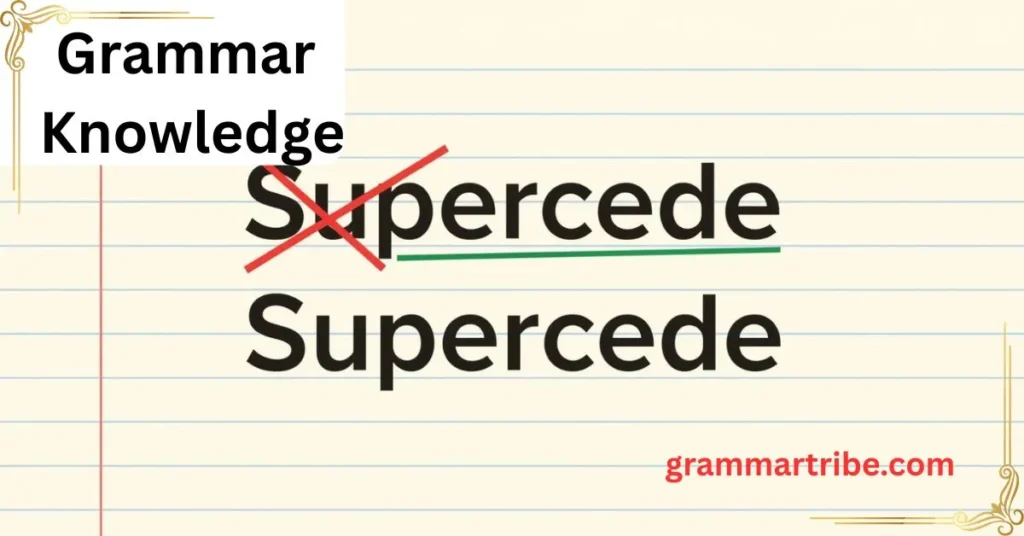
Have you ever paused while writing an email, article, or document and wondered: is it “supercede” or “supersede”? You’re not alone. This is one of the most commonly confused spelling pairs in English.
Even experienced writers and professionals make mistakes with this word because it looks like it should follow common spelling rules.
People search for “supercede or supersede” because spellcheck tools sometimes fail to explain why one spelling is correct and the other is not. The confusion mainly comes from similar-looking verbs like precede and concede, which end in -cede. Naturally, many assume supercede must be correct too.
This article clears that confusion once and for all. You’ll get a quick answer, learn the history of the word, see how it’s used in British and American English, and understand which spelling you should use based on your audience. We’ll also cover common mistakes, real-life examples, Google usage trends, and FAQs—so you never doubt this spelling again.
Let’s settle it clearly and simply.
Supercede or Supersede – Quick Answer
✅ The correct spelling is supersede.
❌ Supercede is incorrect.
Supersede means to replace, overrule, or take the place of something.
Examples:
- This new law will supersede the old regulation.
- Digital payments have superseded cash in many places.
Read more: Supercede or Supersede – Which Spelling Is Correct?
The Origin of Supersede
The word supersede comes from Latin:
- super = above
- sedere = to sit
It literally means “to sit above” or take priority over. Because it comes from sedere, the word ends in -sede, not -cede.
Why the confusion exists
Many English verbs like precede, concede, and exceed end in -cede, which makes people wrongly assume supercede follows the same rule. But supersede is an exception—and English loves exceptions.
Read more: Lieing or Lying? Which One Is Correct (And Why It Matters)
British English vs American English Spelling
Good news: there is no difference here.
Both British and American English use supersede as the only correct spelling.
| Version | Correct Spelling | Example |
| American English | supersede | This rule supersedes all others. |
| British English | supersede | New policies supersede old ones. |
❌ Supercede is incorrect in all forms of English.
Which Spelling Should You Use?
Always use supersede, no matter your audience.
- US audience: supersede
- UK audience: supersede
- International / SEO writing: supersede
If you use supercede, it may:
- Hurt credibility
- Trigger grammar errors
- Reduce SEO trust signals
Common Mistakes with Supersede
Here are frequent errors writers make:
❌ The new policy will supercede the old one.
✅ The new policy will supersede the old one.
❌ This update superceded all past rules.
✅ This update superseded all past rules.
Tip:
If you remember “super + sede”, you’ll never misspell it again.
Supersede in Everyday Examples
Emails:
- “This agreement supersedes our previous discussion.”
News:
- “The court ruling supersedes earlier decisions.”
Social Media:
- “New trends have superseded old habits.”
Formal Writing:
- “This document shall supersede all prior versions.”
Supercede or Supersede – Google Trends & Usage Data
Search data shows:
- “Supercede or supersede” is commonly searched worldwide.
- Most searches come from the US, UK, India, Pakistan, and Australia.
- People usually search it while writing emails, legal documents, or SEO content.
Usage context:
- Legal writing
- Business policies
- Academic work
- SEO and blogging
The high search volume proves this spelling confusion is still very common.
Comparison Table: Supercede vs Supersede
| Feature | Supercede | Supersede |
| Correct spelling | ❌ No | ✅ Yes |
| Used in US English | ❌ | ✅ |
| Used in UK English | ❌ | ✅ |
| Accepted in formal writing | ❌ | ✅ |
| SEO-safe spelling | ❌ | ✅ |
FAQs: Supercede or Supersede
1. Is “supercede” ever correct?
No. It has never been a correct spelling.
2. Why do people spell supersede wrong?
Because many English verbs end in -cede, which causes confusion.
3. Is it supersede British or American English?
Both. It’s standard in all English variants.
4. Does supersede follow normal spelling rules?
No. It’s an exception based on Latin origin.
5. Can supersede be used in legal writing?
Yes. It’s very common in laws, contracts, and policies.
6. What is the past tense of supersede?
Superseded
7. How can I remember the correct spelling?
Think: super + sede (to sit above).
Conclusion
The confusion between supercede or supersede is understandable, but the rule is simple: supersede is always correct. The misspelling supercede may look right, but it has no grammatical support in modern English. The word’s Latin roots explain why it ends in -sede, making it an exception to common spelling patterns.
If you’re writing an email, blog post, legal document, or academic paper, using the correct spelling protects your credibility and professionalism. Search engines, grammar tools, and editors all recognize supersede as the only valid option.
If English spelling feels tricky, remember this: when something replaces or overrules another thing, it supersedes it—always with an S-E-D-E ending. Keep this one rule in mind, and you’ll never hesitate again.

I am James Wilson, an author at GrammarTribe.com, specializing in English grammar and clear communication.
I create expert, reliable content to help learners write with confidence and accuracy.